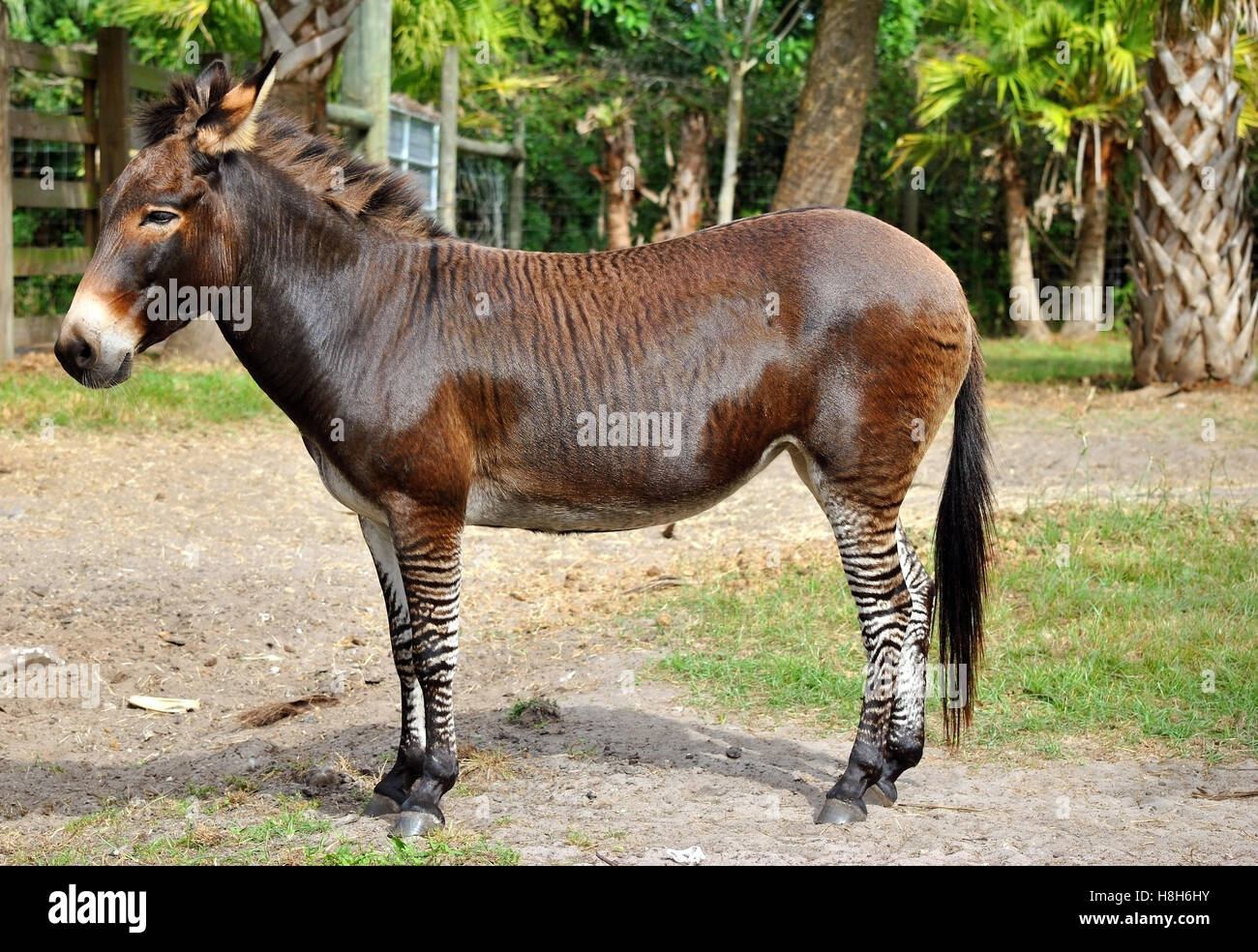
They look like a glitch in a video game. You’re walking through a farm or a rescue center, and you see a creature that has the sturdy, humble frame of a burro but is wearing striped stockings. It’s a zonkey. While it sounds like something dreamed up for a Saturday morning cartoon, the hybrid of a zebra and a donkey is very real, very stubborn, and carries a biological history that’s honestly kind of a mess.
People usually assume these animals are "made" by humans in a lab. That’s rarely the case. Usually, it’s just a matter of proximity—a male zebra (sire) and a female donkey (mare) sharing a pasture for too long. Nature, as they say, finds a way. But just because they can breed doesn’t mean it’s a smooth transition for the offspring. The genetics of these two animals are like trying to fit a square peg in a round hole, yet they’ve been popping up in the historical record for centuries. Charles Darwin even mentioned them. He was fascinated by how the stripes manifested in hybrids, seeing it as a window into how species diverge.
The Genetic Math of a Zebra and a Donkey
Chromosomes are the real deal-breaker here. Let’s look at the numbers because they explain why these animals are almost always sterile. A donkey has 62 chromosomes. A Plains zebra—the kind you usually see—has 44. When you mix a zebra and a donkey, the offspring ends up with 53.
That odd number is a dead end.
Because the chromosomes can’t pair up evenly during meiosis, a zonkey can’t produce its own "donk-bras." They are biological outliers. It’s the same reason mules (horse and donkey) can’t reproduce. You get the hybrid vigor—the strength and stamina of both parents—but the lineage stops right there.
It’s not just about the numbers, though. It’s the temperament. Donkeys are famous for their "freeze" response. When they’re scared, they stop and think. Zebras are the opposite. They are prey animals in a high-stakes environment where lions are literally trying to eat them every single day. Their instinct is "flight" or "fight," and they are incredibly good at kicking. When you combine those two worldviews, you get an animal that is notoriously difficult to train. A zonkey isn't a pet. It's a high-strung, incredibly strong wild-domestic hybrid that would just as soon kick you as look at you.
Why the Stripes Look So Weird
If you look at a zonkey, the stripes aren't everywhere. Usually, the zebra's coat pattern is dominant only on the legs and sometimes the neck or rump. The rest of the body often takes on the solid gray, dun, or brown color of the donkey parent. This is called "disruptive coloration."
In the wild, a zebra's stripes are meant to confuse the motion-tracking of predators like tsetse flies or lions. On a zonkey, the stripes are more of a fashion statement. They appear in "points." You might see a beautiful, tawny brown coat that suddenly turns into vivid black-and-white bars at the knees. It’s striking. It’s also a reminder that the zebra’s wild genes are fighting for dominance over the thousands of years of domestication baked into the donkey’s DNA.
Real Examples: From Florence to the Caribbean
These aren't just myths. In 2013, a zonkey named Ippo was born in Florence, Italy. He became an overnight sensation. His father was a zebra rescued from a failing zoo, and his mother was an endangered Amiata donkey. The owners had put up a fence, but the zebra jumped it. That’s the thing about zebras—they are incredible jumpers.
Then there’s the case of "Zippy" in Somerset, England. Born in 2018, Zippy was the result of a similar "accidental" romance. Owners often report that these hybrids are smarter than the average donkey. They seem to possess a certain "wild" intelligence. They are more observant. They notice when a gate is left unlatched. They are also incredibly hardy. While donkeys are susceptible to certain foot rots in wet climates, the zebra DNA seems to lend a bit of extra resistance to certain parasites.
The Ethics of the Hybrid
We have to talk about the elephant—or the zebra—in the room. Is it ethical to breed a zebra and a donkey?
Most reputable zoologists say no.
Because zonkeys are sterile, breeding them serves no conservation purpose. It doesn’t help save the Grevy’s zebra or the mountain zebra. It’s often done for "curiosity" or as a roadside attraction. This is where it gets murky. A zonkey requires specialized care. You can’t just treat it like a pony. They need the social structure of an equine group but often find themselves caught between two worlds. They don't quite fit in with the donkeys, and they definitely aren't wild enough for a zebra herd.
Training and Temperament Issues
- They are "one-person" animals. Once they bond, they are loyal, but getting that bond takes years.
- Their "flight" instinct is explosive. A spooked zonkey is a dangerous animal.
- Traditional horse training methods often fail because the zebra side doesn't understand "submission."
What Most People Get Wrong About Equine Hybrids
People often confuse zonkeys with zorses or zonies. A zorse is a zebra-horse mix. A zonie is a zebra-pony mix. Each has a different vibe. Zorses tend to be larger and more athletic, often used in specialized riding (by very brave people). The zonkey, however, is more compact.
There's also a misconception that they are "savages." They aren't. They’re just misunderstood. A donkey is a stoic, hardworking animal. A zebra is a wild, striped horse that never signed a contract with humanity. When you mix them, you're asking a domestic animal to share a brain with a creature that views everything as a potential threat.
Honestly, the zonkey is a testament to how weird biology can be. It’s a bridge between the African savannah and the local farm. But it’s a bridge that doesn’t lead anywhere else. No grandkids. No new species. Just a singular, striped individual living out its life as a genetic anomaly.
How to Manage a Hybrid (If You Ever Encounter One)
If you find yourself in a position where you’re visiting a sanctuary or (heaven forbid) you’ve inherited one of these creatures, there are a few rules. First, respect the space. A zebra and a donkey hybrid has a powerful kick that can reach sideways, not just backwards. This is a zebra trait—they kick in an arc to catch predators.
Second, diet matters. They are "easy keepers." This means they can get fat very quickly on rich pasture or high-grain diets. They evolved to eat tough, fibrous grasses. Overfeeding them is the quickest way to cause founder (laminitis), which is incredibly painful and often fatal for equines.
Finally, mental stimulation is key. These are bored animals. In the wild, a zebra spends 60% of its day moving and foraging. A donkey is a problem-solver. A zonkey needs puzzles, varied terrain, and companions that won't bully it.
Actionable Next Steps for Equine Enthusiasts
If you’re fascinated by the intersection of wild and domestic genetics, don't go out and try to find a zonkey to buy. Instead, focus on these practical moves:
- Support Equine Sanctuaries: Many zonkeys end up in rescues because owners realize too late they can't handle the "wild" side. Look for facilities accredited by the Global Federation of Animal Sanctuaries (GFAS).
- Study Donkey Behavior First: To understand a hybrid, you have to understand the base. Read The Wisdom of Donkeys by Andy Beer or look into the work of The Donkey Sanctuary in the UK.
- Learn About Zebra Conservation: The Grevy’s zebra is endangered. Instead of focusing on hybrids, look at how organizations like the African Wildlife Foundation are protecting the purebred wild populations.
- Observe the Gait: If you ever see a zonkey in person, watch how it moves. It often has a "rocking" gait that is a bizarre blend of a donkey's trot and a zebra's powerful stride.
The world of the zebra and a donkey is a reminder that nature doesn't always follow the rules we set for it. These hybrids are beautiful, difficult, and totally unique. They deserve respect, not as a circus act, but as a complex biological reality that challenges our ideas of what a species really is.