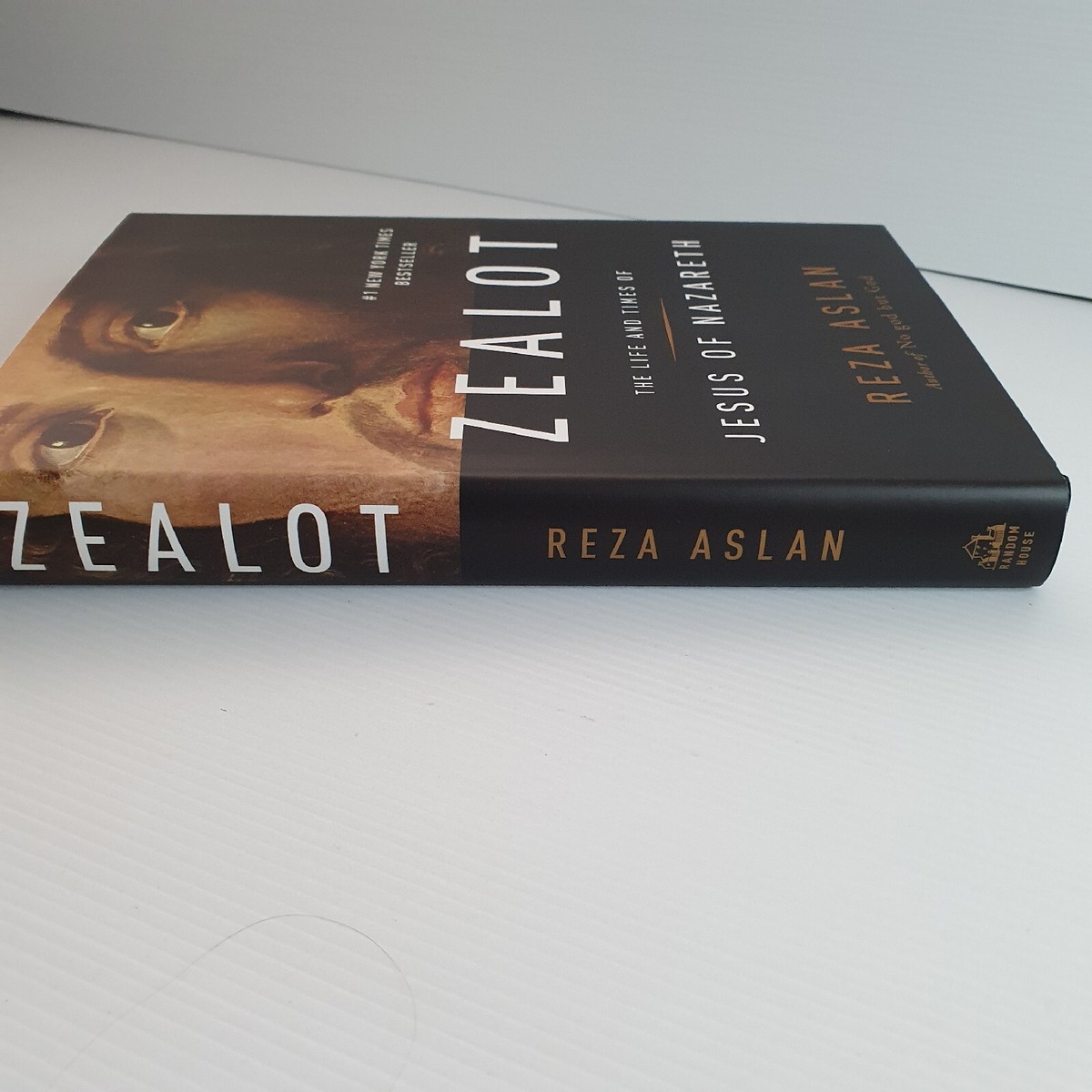
Reza Aslan didn't just write a book; he basically set off a cultural hand grenade when he released Zealot: The Life and Times of Jesus of Nazareth. You probably remember that infamous Fox News interview where the anchor kept asking why a Muslim would write about Jesus. It went viral. It was awkward. But beyond the cable news drama, the book itself is a fascinating, gritty, and deeply researched look at the historical man behind the divine figure.
Aslan isn't interested in the Christ of faith. He’s looking for the peasant from Galilee.
The core tension in Zealot by Reza Aslan is the gap between the "Jesus of History" and the "Christ of Faith." It’s a gap that scholars have been trying to bridge for centuries, but Aslan brings a certain cinematic flair to the 1st-century Palestinian landscape. He paints a picture of a land choking under Roman occupation, filled with "messiahs" who ended up on crosses long before Jesus arrived.
The Roman Context You Probably Missed
To understand the book, you have to understand the word "zealot." In our modern world, it just means someone who is really intense about their beliefs. In 1st-century Judea? It was a political stance. It was about the "zeal" for the Law of Moses and the absolute sovereignty of God over the land.
Basically, if you were a zealot, you thought Rome had no business being there.
Aslan argues that Jesus was much more aligned with this revolutionary spirit than the "gentle shepherd" imagery suggests. Think about it. The Romans didn't crucify people for blasphemy or for saying they were the Son of God. They didn't care about Jewish theology. They crucified people for sedition. They killed rebels. The very fact that Jesus died on a Roman cross is, for Aslan, the most telling piece of historical evidence we have. It proves the Romans saw him as a threat to the state.
Why the "Simple Peasant" Narrative Changes Everything
Most people imagine Jesus as a literate, peaceful teacher. Aslan pushes back on this. He notes that in the time of Jesus, literacy was a luxury reserved for the elite. Jesus was a tekton—a word often translated as "carpenter," but it more likely meant a day laborer or a stonemason. He was part of the marginalized poor.
When you realize Jesus was likely illiterate and came from a tiny, insignificant village like Nazareth, his movement feels different. It feels more like a grassroots uprising of the dispossessed.
This is where the controversy kicks in. If Jesus was a revolutionary aiming to establish the Kingdom of God on earth—a physical kingdom that would kick the Romans out—then what happened to that message? Aslan points the finger at the Apostle Paul. He argues that after the Roman destruction of Jerusalem in 70 CE, the early Christian movement had to pivot. They couldn't be a "rebel" religion anymore because the Romans had just crushed the Jewish rebellion. So, the message became more spiritual. It became about a kingdom "not of this world."
The Scholarly Pushback is Real
It’s worth mentioning that not every historian agrees with Aslan. Honestly, some of them find his work a bit too "pop-history." Scholars like Dale Martin or E.P. Sanders have spent decades on the "Third Quest" for the historical Jesus, and they sometimes argue that Aslan simplifies complex theological shifts to fit a punchy narrative.
For example, many critics argue that Aslan overemphasizes the "revolutionary" aspect. They point out that Jesus’ teachings, like "turn the other cheek," don't exactly scream "armed insurrection." Aslan counters this by looking at the context of the Temple. When Jesus flipped the tables in the Temple, he wasn't just having a bad day. He was attacking the heart of the Jewish aristocratic and Roman-aligned power structure. That’s a political act.
The Three Layers of the Book
- The World: Aslan spends a huge chunk of the book describing the socio-economic reality of Galilee. It was a place of crushing debt and heavy taxation.
- The Man: This is where we see the "Jesus of Nazareth" who is hungry, tired, and eventually executed as a state criminal.
- The Myth: This covers the aftermath. How did a Jewish revolutionary become a Roman God? This part focuses heavily on the tension between James (Jesus' brother) and Paul.
What Most People Get Wrong About the Controversy
The biggest misconception is that the book is an "attack" on Christianity. It’s really not. Aslan has stated many times that he is a follower of Jesus in a certain sense, even if he is a practicing Muslim. He respects the historical figure enough to want to strip away the centuries of Roman-influenced polish to see the man underneath.
The real controversy wasn't the content—most of what Aslan writes is standard fare in secular religious studies departments—it was the delivery. He wrote a bestseller that brought academic debates into the living rooms of people who had never heard of "Q" or the "Synoptic Problem."
How to Approach Reading Zealot
If you’re going to pick up a copy, don't read it as a devotional. Read it as a historical biography.
Pay attention to the footnotes. They are actually where a lot of the heavy lifting happens. Aslan uses them to cite Josephus, the Jewish historian of the era, and various Roman records to ground his narrative in something tangible.
Actionable Insight: How to Critically Evaluate Historical Religious Texts
To get the most out of Zealot by Reza Aslan, or any book on the historical Jesus, you should try the following:
- Compare the "Criteria of Embarrassment": This is a tool historians use. If a story in the Gospels is "embarrassing" to the early church (like Jesus being baptized by John the Baptist, implying John was superior), it's more likely to be historically true. Check how Aslan applies this to the crucifixion.
- Look for the "Why": Ask why the author is emphasizing a specific detail. Aslan emphasizes the "banditry" of the era to place Jesus in a specific social class.
- Cross-Reference with Josephus: Pick up a copy of The Jewish War by Flavius Josephus. Seeing how a contemporary historian described the same events gives you a much wider lens on the chaos of 1st-century Palestine.
- Acknowledge the Gap: Accept that we will never have 100% certainty. We are looking at a man through the lens of followers who wrote decades after his death. Every biography, including Aslan's, is a reconstruction.
By looking at Jesus through the eyes of a 1st-century Jew living under the boot of an empire, you start to see why his message was so dangerous—and why it eventually changed the world. Whether you believe he was the Son of God or just a very dedicated radical, the historical reality Aslan presents makes the story much more human and, in some ways, much more impressive.