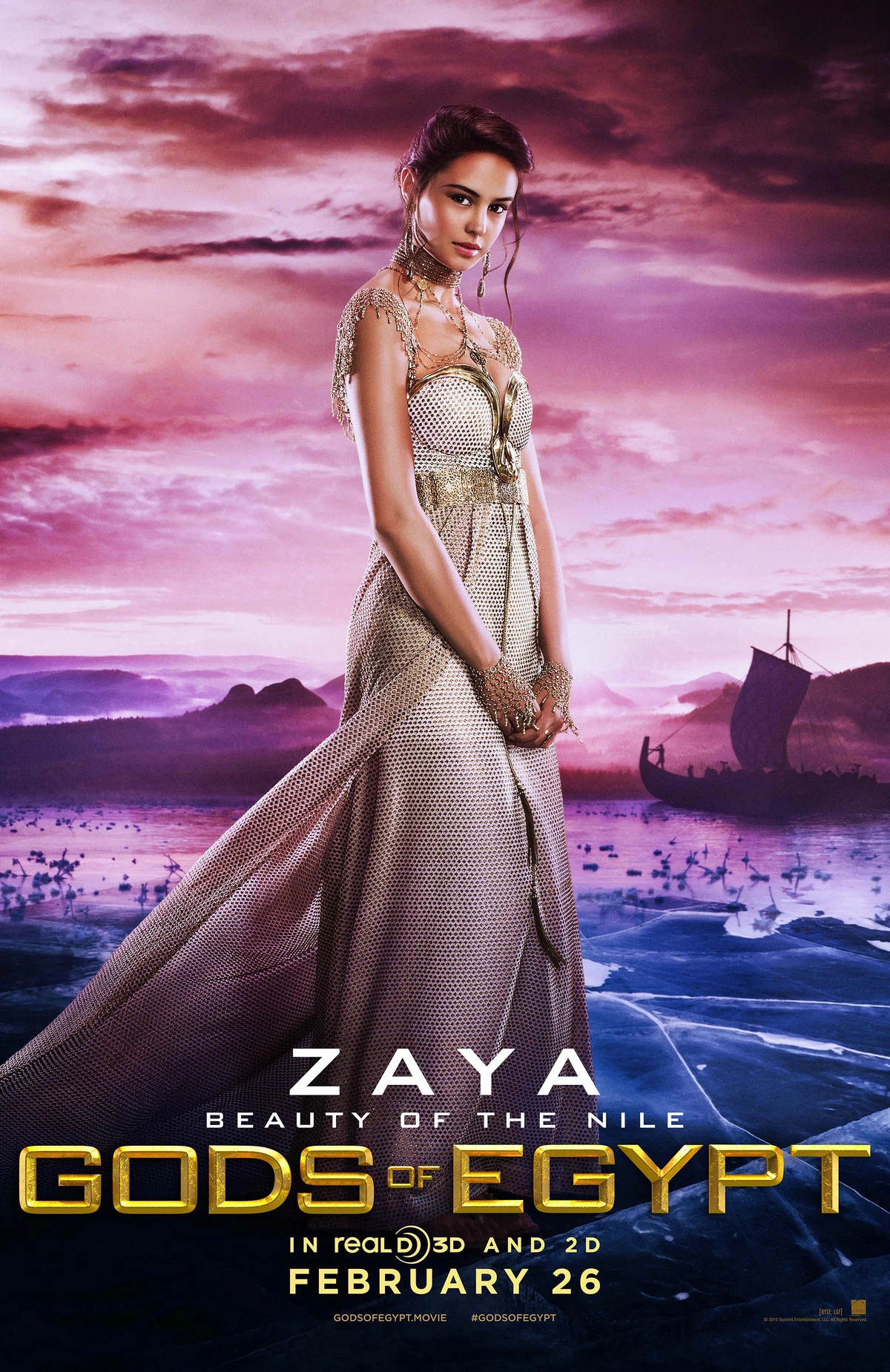
Honestly, if you watched Alex Proyas’s 2016 epic Gods of Egypt, you probably remember the gold-blooded deities and the over-the-top CGI first. But the heart of the whole messy, glittering spectacle isn't actually a god at all. It's Zaya. Played by Courtney Eaton, Zaya in Gods of Egypt serves as the literal and metaphorical compass for the protagonist, Bek. While the film took a massive beating from critics for its "whitewashed" casting and dizzying visual effects, the narrative weight of Zaya is often overlooked. She’s not just a damsel in distress; she is the reason the plot moves. Period. Without her death, Bek has no motivation to steal from a god, and Horus has no reason to learn humility.
It's a weird movie. We know this. But Zaya represents something specific in the mythos Proyas tried to build—a bridge between the immortal and the mundane.
The Role of Zaya in Gods of Egypt and Why It Matters
Zaya starts the film as a slave to the chief architect, Urshu. She’s a believer. While Bek is a cynical thief who thinks the gods are basically just tall, shiny jerks, Zaya maintains a devout faith in Horus. This contrast is the engine of the first act. When Set usurps the throne and plunges Egypt into chaos, Zaya is the one who convinces Bek that stealing back the Eye of Horus is the only way to save the world.
She pays for that belief with her life.
Her death occurs early, during a frantic escape from Urshu’s estate. An arrow from Urshu himself finds its mark. It’s a gut-punch moment because the movie shifts from a heist film to a literal journey through the afterlife. This is where the movie gets interesting from a mythological standpoint. Most fantasy films treat death as an ending or a simple "save the soul" quest, but here, Zaya’s journey through the Underworld (Duat) happens in real-time alongside Bek’s journey on earth.
Faith vs. Physics in the Duat
The Duat in this film is a series of trials. Zaya has to pass through the Gates of the Afterlife, and her survival there depends entirely on the actions of the living. It’s a high-stakes ticking clock.
Think about the mechanics of the movie's afterlife. It’s based loosely—very loosely—on the Egyptian Book of the Dead. In the film, you need riches to buy your way into the afterlife. If you’re poor, you’re basically screwed. Zaya, being a slave, has nothing. This creates the primary tension: Bek is trying to bring her back to life, while Zaya is facing the literal erasure of her soul because she lacks the "gold" required for passage. It’s a biting, if unintentional, commentary on class that sits right in the middle of a $140 million blockbuster.
Courtney Eaton’s Portrayal and the Casting Controversy
We can't talk about Zaya without talking about the elephant in the room. The casting. Courtney Eaton is an Australian actress of Chinese, Maori, and Cook Islander descent. While she is a person of color, the film was lambasted for casting mostly white or light-skinned actors in an Egyptian setting. Lionsgate and Alex Proyas actually issued apologies before the movie even hit theaters.
Despite the noise, Eaton brings a necessary softness to the screen.
In a movie where Nikolaj Coster-Waldau and Gerard Butler are screaming at each other while turning into metallic falcons, you need someone grounded. Eaton’s Zaya is the only character who feels like a real human being with something to lose. She doesn't have wings. She doesn't bleed gold. She’s just a girl who loves a thief and believes in a better world. Her performance is subtle, which is a miracle considering she spent most of her time acting against green screens and tennis balls on sticks.
The Dynamics of the Bek and Zaya Relationship
It’s a classic trope. The thief and the believer. But it works here because the stakes are final.
- The Motivation: Bek doesn't care about Egypt. He doesn't care about the throne. He only cares about Zaya. This makes him a relatable protagonist in a world of ego-maniacal gods.
- The Sacrifice: Zaya is willing to face oblivion in the Duat if it means Bek can help Horus defeat Set. She chooses the greater good over her own "resurrection" toward the end of the film.
- The Chemistry: Brenton Thwaites and Eaton have a genuine spark that carries the slower emotional beats of the second act.
Navigating the Mythological Inaccuracies
If you’re looking for a history lesson, Gods of Egypt is a nightmare. Zaya herself isn't a figure from traditional Egyptian mythology. She is a creation for the film. In actual Egyptian myth, the story of Osiris, Isis, Horus, and Set is far more complex and involves a lot more... let’s say, "biological" oddities that a PG-13 movie wouldn't touch.
In the real Book of the Dead, the heart is weighed against the feather of Ma'at (truth/justice). If your heart is heavier than the feather, the demon Ammit devours you. In the movie, this is replaced by the "poverty vs. wealth" mechanic mentioned earlier. It’s a simplification for the sake of the plot, but it changes the character of Zaya. Instead of her soul being judged on her morality, she is judged on her status. This makes Bek’s quest to "buy" or "earn" her way back more urgent for a modern audience to understand.
Why Zaya is the Movie's True Hero
Most people say Horus is the hero. He gets the character arc, right? He starts as a brat and ends as a King. But Horus only changes because he sees the devotion Bek has for Zaya.
Horus is a god who views humans as ants. Throughout the film, his interactions with Bek—driven entirely by Bek’s need to save Zaya—force the god to realize that the "mortals" have a capacity for love and sacrifice that he lacks. Zaya’s presence in the Underworld acts as a tether. She is the moral center. Even while facing the end of her existence, she tells Bek to keep going, to help Horus, even if it means she stays dead. That’s the definition of a hero.
It's also worth noting the visual design of her character. While the gods are adorned in impossible, shifting armor, Zaya’s costuming is simple, organic, and linen-based. It emphasizes her vulnerability. When she stands before the scales of Anubis, the scale of the world is finally felt.
The Visuals of the Afterlife
The scenes featuring Zaya in the Duat are some of the most visually striking in the film. While the "over-world" is bright, saturated, and often looks like a high-end video game cinematic, the Underworld is moody and atmospheric.
We see the line of souls waiting for judgment. It’s a somber, haunting sequence. Zaya stands in this line, a small figure in a vast, dark expanse. This is where the CGI actually serves the story. It emphasizes the loneliness of death. Her interaction with Anubis (the jackal-headed god of the dead) is one of the few times the movie slows down enough to breathe.
Anubis is portrayed as a neutral, almost sympathetic figure. He isn't a villain. He’s a bureaucrat of the soul. His interactions with Zaya provide a much-needed sense of gravity. When he tells her it’s time to move on, you feel the weight of it.
Lessons from Zaya’s Arc for Modern Storytelling
What can we take away from Zaya in Gods of Egypt?
First, a character doesn't need a lot of screen time to be the most important person in the room. Zaya is dead for about 70% of the movie, yet her presence is felt in every scene. Second, the "Human Perspective" is vital in high-fantasy. Without Zaya and Bek, Gods of Egypt is just two shiny CGI models hitting each other.
The movie failed at the box office, making only about $150 million against a massive budget, but it has found a cult following on streaming services. People are starting to appreciate the sheer audacity of its world-building. At the center of that world-building is a girl who believed in gods who didn't deserve her.
Practical Insights for Fans and Writers
If you're analyzing the film or writing your own myth-adjacent fiction, look at how Zaya functions as a "Lynchpin Character."
- Define the Stakes: Zaya isn't just "a girl." She is the representation of the innocent people suffering under Set’s rule. To save her is to prove that Set can be defeated.
- Contrast the Divine: Use human characters to highlight the flaws of the gods. Zaya's selfless love makes Horus's initial selfishness look pathetic.
- The Price of Magic: In the world of the film, bringing someone back from the dead isn't a simple spell. It requires a bargain with a god. Zaya’s arc shows that every supernatural favor has a human cost.
What Happens at the End? (Spoilers)
In the final act, after Set is defeated, Ra (the sun god, played by Geoffrey Rush) grants Horus a favor. Horus, finally having learned what it means to be a true protector, doesn't ask for power or glory. He asks for Zaya and Bek to be brought back.
They are resurrected. It’s a happy ending that feels earned only because we’ve seen the hell Zaya walked through to get there. They are given a place in the new kingdom, no longer slaves, but symbols of the new era of cooperation between gods and men.
The film concludes with the idea that the afterlife shouldn't be bought with gold, but earned through the "wealth" of one's deeds and the love they leave behind. This shift in the Egyptian cosmos is directly credited to the journey Zaya took.
Moving Forward: How to Engage with Gods of Egypt Today
If you’re going to re-watch the film, or watch it for the first time, try to look past the shiny gold blood and the confusing proportions of the gods. Focus on the Zaya and Bek subplot. It’s a surprisingly tight narrative inside a very loose movie.
- Watch for the symbolism: Notice how Zaya is often bathed in soft, natural light compared to the harsh, artificial gold light that surrounds Set.
- Check the sources: If Zaya sparked an interest in Egyptology, go read the Hymn to Osiris or the actual Book of the Dead. You’ll see exactly where the movie took creative liberties and where it tried to stay true to the vibe of the myths.
- Appreciate the production: Despite the flaws, the costume design for Zaya is genuinely beautiful and provides a lot of inspiration for historical fantasy aesthetics.
Zaya remains a fascinating example of how a character can be the soul of a film while barely being "in" it. She is the catalyst, the conscience, and the ultimate reward. In the chaotic pantheon of the Gods of Egypt, she is the only one who truly feels immortal.
To dive deeper into the world of film mythology, you can compare Zaya’s journey to other cinematic interpretations of the afterlife, such as the Duat in Marvel's Moon Knight. You’ll find that while the aesthetics change, the core themes of judgment, love, and the weighing of the heart remain remarkably consistent across decades of storytelling. Pay close attention to the way modern media handles the "price" of the afterlife; it tells you a lot about our current cultural values versus those of the ancients.



