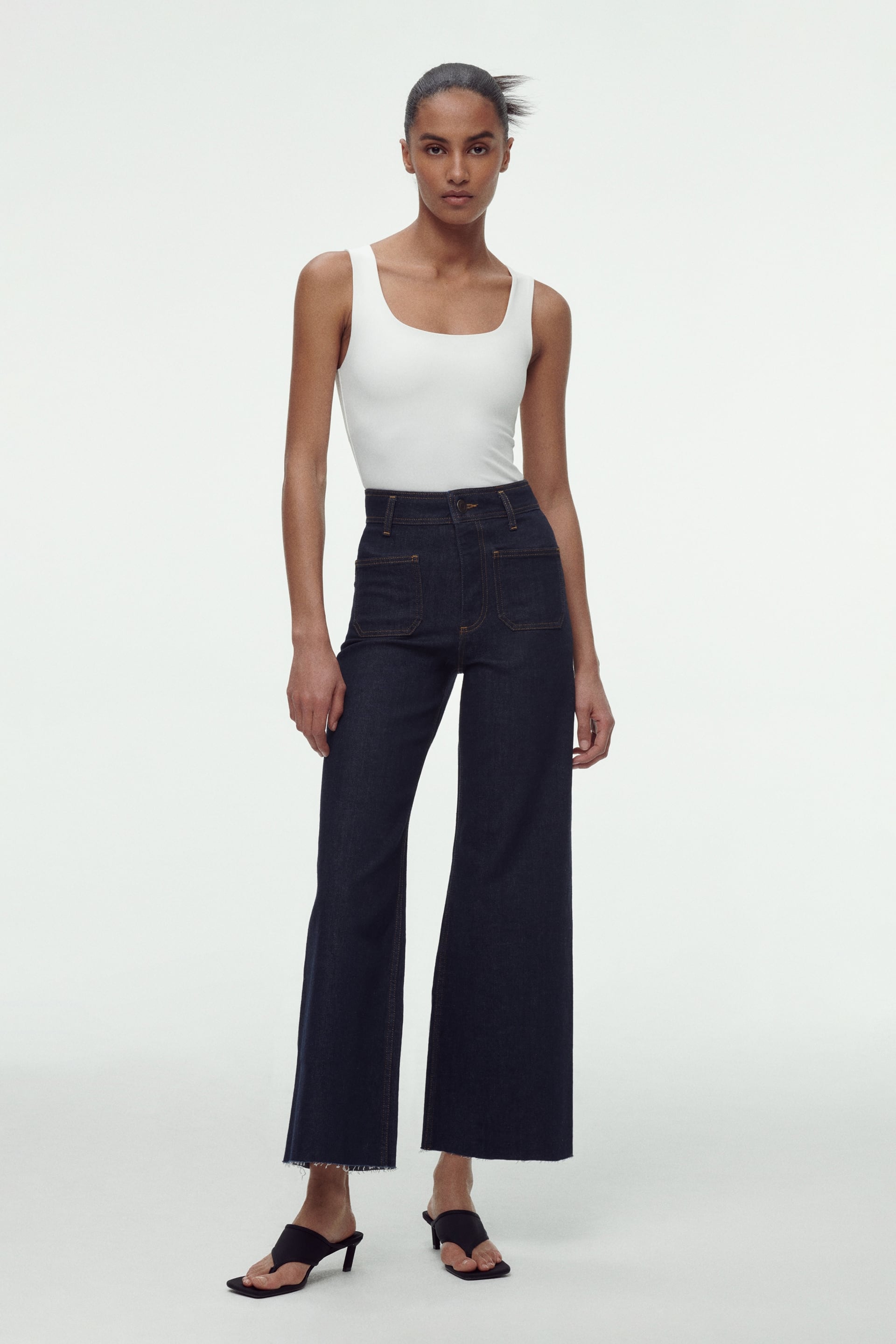
You’re standing in the fluorescent-lit dressing room, two pairs of Zara size 40 jeans in your hands. One is a rigid high-waisted mom jean; the other is a flared Marine fit. You try the first pair. They won't even clear your thighs. You try the second. They’re so loose you could fit a sourdough loaf in the waistband. It’s maddening. Honestly, anyone who has shopped at Inditex’s flagship brand knows that "40" is less of a measurement and more of a vague suggestion.
Finding the right fit isn't just about the number on the tag. It's about geography, fabric chemistry, and the weird way fast fashion production lines actually work.
The European 40 vs. The World
First, let's look at the math. A European size 40 is generally intended to translate to a US size 8 or 10, or a UK size 12. But Zara isn't a US company. It’s Spanish. In Spain, a 40 is firmly a "medium," but because Zara targets a global demographic with a specific, slim-cut aesthetic, their patterns often lean smaller than what you’d find at Gap or American Eagle.
If you usually wear a 10 in American brands, a Zara size 40 jeans order might feel like a personal insult. It’s not you. It’s the block pattern. Most Zara denim is designed on a "Model Fit" block, which prioritizes a straighter hip-to-waist ratio. If you have a classic hourglass shape or a muscular lower body, that 40 is going to fight you every step of the way.
Fabric is the silent killer
You have to check the care tag before you even head to the checkout. A size 40 in 100% cotton is a completely different garment than a size 40 with 2% elastane. Rigid denim—the kind used in their popular "Authentic" lines—has zero give. If you buy those in a 40, they might fit in the morning and feel like a corset by 3:00 PM after a desk lunch.
Contrast that with the "Hi-Rise Power Stretch" or any of the jegging-adjacent styles. In those, a 40 might actually feel too big after two hours of wear because the fibers "bag out" at the knees and seat. It’s a delicate balance. I’ve seen people buy a 40 in the "Marine Straight" (which runs notoriously large) and have to size down to a 38, only to go back the next week and need a 42 in a pair of TRF skinny jeans. It makes zero sense until you realize these clothes are produced in different factories across Morocco, Turkey, and Bangladesh, often using slightly different interpretations of the master pattern.
Why "Vanity Sizing" Doesn't Exist Here
Most people complain about vanity sizing—the practice of making clothes larger so customers feel better about their size. Zara arguably does the opposite. They participate in "trend sizing."
When a "slim" look is trending, their size 40s suddenly feel like 36s. When the "oversized" look dominates, like with the 90s Full Length styles, you’ll find yourself drowning in denim. It’s a chaotic system.
Real talk: the brand moves so fast—producing thousands of designs a year—that quality control on sizing consistency is the first thing to go. According to industry insiders and fashion logistics experts, the speed of the "Fast Fashion Cycle" (which Zara pioneered) means that a batch of denim cut on a Tuesday might have a 0.5-inch variance from the batch cut on Friday simply because of how the fabric was layered on the cutting table. That half-inch is the difference between a size 40 that zips and one that doesn't.
The "Z-One" and The "Woman" Lines
Zara typically splits its inventory into different "sub-brands," and this affects your size 40 jeans more than you’d think.
- ZARA Woman: This is the "main" line. It’s generally the most true-to-size (by European standards). A 40 here is meant for a grown adult woman with actual curves.
- TRF (Trafaluc): This is the younger, trendier line. Historically, TRF is cut smaller and narrower. If you are a 40 in Woman, you might be a 42 in TRF.
- ZARA Basic: These are the staples. They tend to be the most inconsistent because they are produced in the highest volumes across the most diverse factory network.
The Real-World Measurement of a Size 40
If we look at the official Zara size guide (which, let's be honest, is an optimistic document), a size 40 is designed for a waist of roughly 74 centimeters and hips of 102 centimeters.
In inches, that's roughly a 29-inch waist and 40-inch hips.
Compare that to a Levi’s 29 or 30. Usually, a Levi’s 30 feels much more spacious than a Zara 40. Why? Because Zara’s "rise"—the distance from the crotch to the waistband—is often shorter. A short rise on a size 40 jeans means the waistband hits at the widest part of your midsection rather than the narrowest part of your waist, leading to the dreaded "it won't close" moment.
How to Actually Buy Zara Size 40 Jeans Without Losing Your Mind
Stop looking at the number. Seriously.
If you’re shopping online, look at the "Check My Size" tool, but take it with a grain of salt. Instead, look at the model's height. If the model is 5'10" and wearing a size 36, and the jeans hit her ankles, you know that as a size 40, those jeans are going to be significantly longer and wider.
Also, check the "Join Life" label. Zara’s sustainable line often uses recycled cotton, which can sometimes feel stiffer and less forgiving than virgin cotton. If you see "Recycled Cotton" on a pair of size 40s, you might want to size up if you’re between sizes.
The Sit Test
Never buy Zara jeans without sitting down in them. Because the rise is often skewed, a pair of 40s might look incredible while you're standing still in front of a mirror but will cut off your circulation the moment you sit for coffee. If the waistband digs in or the fabric bunches painfully behind the knees, the cut is wrong for your frame, regardless of what the tag says.
Practical Steps for Your Next Zara Haul
Don't let the tag dictate your mood. The inconsistency is a manufacturing reality, not a reflection of your body.
- Bring two sizes to the room. Always. Grab the 40 and the 42. If the 42 fits perfectly, cut the tag off and never think about it again.
- Inspect the side seams. On many Zara jeans, if the seam isn't perfectly straight, the denim will twist after one wash, making that size 40 feel even tighter and more awkward.
- Wash cold, air dry. Zara denim is prone to shrinkage. If your size 40 fits "just right" in the store, one trip to a hot dryer will turn them into a size 38.
- Check the hem. Zara loves a raw hem. If the 40 fits your waist but is too long, these are the easiest jeans in the world to DIY trim.
- Identify your "Power Fabric." If you find that the "Marine" fit in a 40 always works for you, stick to that silhouette. Zara tends to reuse successful patterns across different washes and seasons.
When you find a pair of Zara size 40 jeans that actually fits—where the waist doesn't gap and the thighs don't strangle—buy two. Because by next month, they’ll have changed the supplier, and the new 40 will be a completely different animal. That's just the nature of the beast in the world of high-speed fashion.