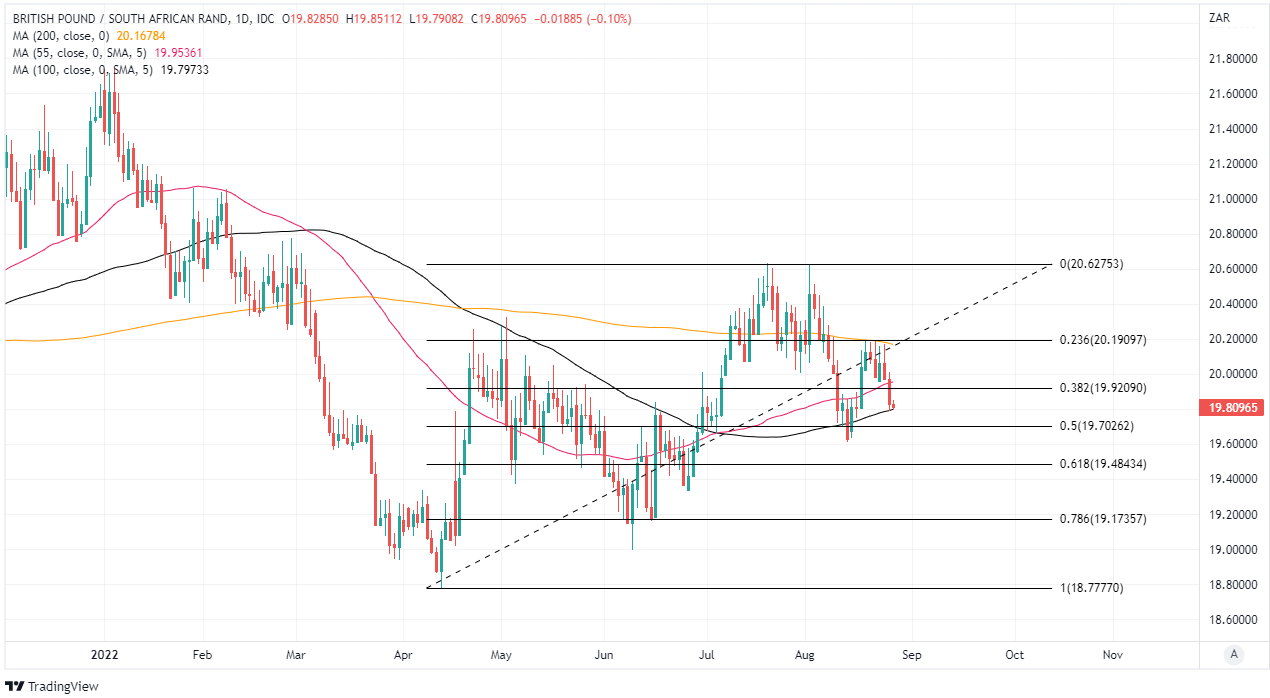
Money is weird. One day you’re looking at your bank account thinking you’re doing alright, and the next, a shift in the ZAR to pound sterling exchange rate makes your upcoming UK trip or business import bill look like a horror movie script.
Honestly, the South African Rand has always been a bit of a rollercoaster. It’s one of the most liquid emerging market currencies in the world, which is a fancy way of saying people trade it constantly, making it jumpy. As of mid-January 2026, we are seeing some really interesting movements that haven't been the "norm" for a while. For an alternative look, see: this related article.
The Rand has actually been showing some grit. While the British Pound remains a global heavyweight, the ZAR to pound sterling rate has moved from around 0.042 GBP per Rand this time last year to roughly 0.0456 GBP today. That doesn't sound like much until you're moving a million Rand and realize you've just "gained" thousands of Pounds in purchasing power.
What is actually driving the Rand right now?
It’s easy to blame (or thank) the local government for currency moves, but the Rand is a global animal. Most of the time, what happens in Pretoria matters less than what happens in Washington or London. Further reporting regarding this has been shared by Financial Times.
Lately, the UK has been wrestling with its own demons. Inflation there hasn't quite settled into the "boring" 2% zone the Bank of England craves. When the Pound feels shaky because of stagnant growth in the British manufacturing sector, the Rand often seizes the gap.
Commodity Prices and the ZAR
South Africa is basically a giant treasure chest. We export gold, platinum, and coal. When global demand for these things goes up—or when there’s a supply crunch elsewhere—the Rand gets a massive boost.
In early 2026, we’ve seen a steady demand for platinum group metals (PGMs). This has provided a floor for the Rand. If you're watching the ZAR to pound sterling charts, you've likely noticed that every time the Rand looks like it’s going to crash, a spike in commodity prices seems to catch it.
The Pound Sterling side of the equation
You can't look at one side of the pair in a vacuum. The British Pound (GBP) is currently sensitive to interest rate talk.
If the Bank of England keeps rates high to fight inflation, the Pound gets stronger because investors want to keep their money in UK banks to earn that sweet interest. But there’s a breaking point. If rates stay too high for too long, the UK economy starts to choke. We are seeing some of that friction now.
- UK Retail Data: It's been a bit "meh." People aren't spending like they used to in London or Manchester.
- Energy Costs: Still a headache for British businesses, which weighs down the Pound.
- Political Stability: Unlike the chaos of a few years ago, the UK has been relatively "quiet," which usually helps the Pound, but investors are bored, and bored investors look for high-yield "risky" currencies like the Rand.
Converting ZAR to pound sterling: The practical reality
If you’re sending money home or paying for a master’s degree in the UK, the "interbank rate" you see on Google isn't what you actually get.
Banks take a "spread." This is basically a hidden fee. If the market rate for ZAR to pound sterling is 0.045, your bank might only give you 0.043. On a 100,000 ZAR transfer, that's a loss of 200 Pounds just for the privilege of moving your own money.
Expert Tip: Don't just use your standard retail bank for currency transfers. Specialty FX brokers or fintech apps often have spreads that are 50% to 70% cheaper than the big traditional banks.
The psychological 20:1 barrier
For years, South Africans have used the 20:1 ratio as a psychological benchmark. When the Pound costs more than 20 Rand, everyone panics. When it’s under 20, we feel like kings.
Currently, we are sitting around the 21.93 Rand per Pound mark. It’s not "cheap" by historical standards, but it’s a lot better than the 23.00+ levels we’ve seen during periods of intense domestic load-shedding or political drama.
Why timing the market is a fool's errand
I’ve talked to many people who wait for that "perfect" day to convert their Rand. They wait for the ZAR to pound sterling rate to hit a specific decimal point.
Then, a random tweet from a central banker or a surprise jobs report from the US sends the Rand into a 3% tailspin in twenty minutes.
The Rand is what traders call "high beta." It overreacts. If the global mood is "risk-on," the Rand flies. If there’s a war scare or a banking hiccup in Europe, the Rand is the first thing people sell.
Actionable steps for managing your ZAR/GBP exposure
You don't need to be a Wall Street trader to handle this well. You just need a plan.
Watch the SARB and the BoE. The South African Reserve Bank (SARB) is famously conservative. They hate inflation. If they hike rates while the UK holds steady, the Rand will likely gain ground. Keep an eye on the calendar for their MPC (Monetary Policy Committee) meetings.
Use limit orders. If you have time on your side, tell your broker: "I want to exchange 50,000 ZAR, but only if the rate hits 0.046." This is called a limit order. The trade triggers automatically while you’re sleeping. It takes the emotion out of it.
Diversify your timing. Instead of moving 500,000 Rand in one go, move 100,000 every week for five weeks. This "averages" your rate. You won't get the absolute best rate, but you definitely won't get the absolute worst one either.
Keep an eye on the "Big Three" South African risks. The ZAR to pound sterling rate is currently sensitive to:
- Logistics (Transnet's ability to get those commodities to the coast).
- The fiscal deficit (how much the government is borrowing).
- Global sentiment toward China (South Africa's biggest trading partner).
If China's economy looks like it's booming, the Rand usually hitches a ride on that wagon. If China stalls, the Rand feels the pinch almost immediately.
The path ahead for 2026
We aren't out of the woods, but the Rand has proven to be more resilient than the doomsayers predicted. The Pound is steady but lacks the "growth engine" to really bully the Rand back to the 25:1 levels right now.
If you are holding Rand and need Pounds, the current window is relatively stable. We haven't seen massive volatility in the last few weeks, which is usually the "calm before the storm" in currency markets.
To manage your funds effectively, start by auditing your current transfer method. Look at the total cost—fee plus the exchange rate margin—not just the flat fee. You might find that your current "free" transfer is actually costing you hundreds of Pounds in a poor exchange rate. Once you've optimized your provider, use a staggered entry strategy to move your capital over the next quarter to mitigate the risk of a sudden Rand slump.