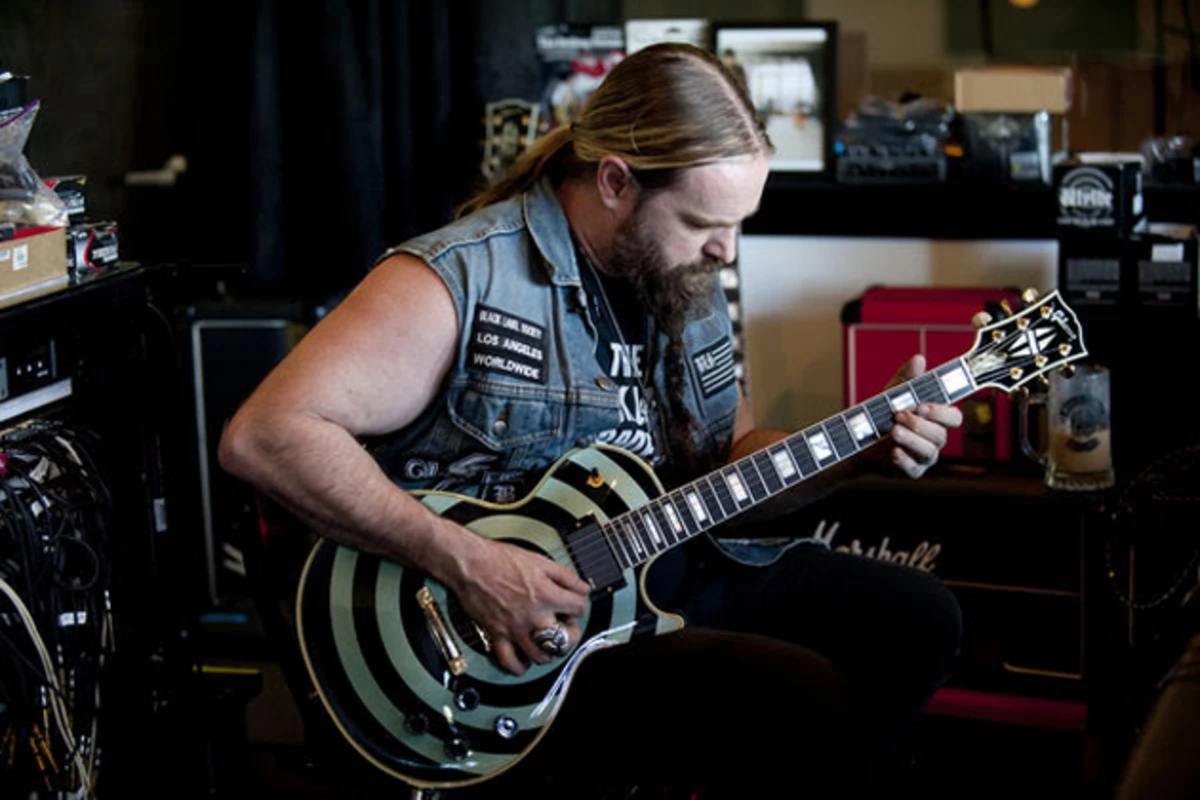
If you close your eyes and think of 1980s metal, you probably see a wall of Marshalls and a blonde kid with a beard flailing around a guitar that looks like a target board. That's the Zakk Wylde bullseye guitar. It’s arguably one of the most recognizable instruments on the planet. Honestly, it’s right up there with Eddie Van Halen’s Frankenstein or Jimmy Page’s double-neck. But here’s the kicker: Zakk never actually wanted a bullseye.
It was a total mistake.
When Zakk landed the gig with Ozzy Osbourne in 1987, he was just a nineteen-year-old kid from New Jersey. He had the chops, sure, but he was stepping into the shoes of Randy Rhoads and Jake E. Lee. Talk about pressure. He bought a 1981 Gibson Les Paul Custom from a buddy named Scott Quinn. Back then, it was just a regular cream-colored Les Paul.
Why the Bullseye Happened (and Why It Wasn't a Swirl)
Zakk realized pretty quickly that playing a cream Les Paul Custom made him look like a Randy Rhoads clone. He didn't want to be "that guy." He needed a visual identity that screamed "Zakk," not "Randy 2.0." He decided to send the guitar off to be refinished.
His original idea? The spiral design from the poster of Alfred Hitchcock's movie Vertigo.
He wanted a dizzying, hypnotic swirl. He sent it to a luthier, went about his business, and waited. When the guitar finally came back, Zakk opened the case and saw... circles. Bold, concentric, black-and-white rings. The painter had completely botched the "vertigo" request and delivered a literal bullseye instead.
With a photoshoot for No Rest for the Wicked scheduled for that very day, he didn't have time to send it back. He basically shrugged his shoulders and said, "Alright, I guess this is my thing now." That "mistake" became the visual centerpiece of the No More Tears era and followed him through the formation of Black Label Society.
The Anatomy of the Grail: What Makes It Tick?
Fans call that original 1981 Gibson "The Grail." It isn't just a pretty paint job; it’s a specific beast of a machine. Unlike your standard Les Paul, which usually features a mahogany neck, the Zakk Wylde bullseye guitar uses a three-piece maple neck. Maple is way denser than mahogany. It gives the guitar a "snappy" top end and a faster attack, which is exactly how Zakk gets those legendary pinch harmonics to squeal like a banshee.
The back of the neck is unfinished. It's raw wood. If you've ever played a guitar with a thick, sticky nitrocellulose finish, you know how it can slow you down when your hands get sweaty under stage lights. Zakk’s solution was to keep it smooth and fast.
Then there are the electronics.
You can't talk about this guitar without mentioning the EMGs. It’s loaded with an EMG 81 in the bridge and an EMG 85 in the neck. These are active pickups, meaning they require a 9-volt battery to run. They are high-output, low-noise monsters. While some purists think they sound "sterile" for blues, for high-gain metal, they are surgical. They provide the clarity needed to hear every note in a fast run, even when you're buried in a mountain of distortion.
The Mystery of the Stolen Grail
In 2000, tragedy struck. While the band was traveling between Dallas and Houston, the back doors of their equipment truck swung open. Two guitars fell out. One was a replica, and the other was the original Grail.
Zakk thought it was gone forever.
Fast forward three years. A guy named Jerry Weisinger walked into a pawnshop in Texas and saw a beat-up bullseye guitar. He bought it for about $250. It wasn't until he took the pickups out to clean the guitar that he saw "ZW" engraved on the back of the EMGs. He realized he wasn't holding a cheap copy; he was holding the actual Grail. Jerry did the right thing and contacted Zakk’s team, and the guitar was finally returned to its rightful owner.
It’s a miracle the thing didn't shatter into a million pieces hitting the pavement at 70 mph.
Beyond the Gibson: Epiphone and Wylde Audio
For years, if you wanted the Zakk look, you had to shell out several thousand dollars for a Gibson Custom Shop model. Eventually, Gibson’s sister company, Epiphone, released a more affordable version.
The Epiphone Zakk Wylde bullseye guitar was a massive hit for bedroom shredders. It kept the core specs—the maple neck, the bullseye, and eventually even the active EMG 81/85 set in the "Plus" versions—but at a price point that didn't require a second mortgage.
Recently, Zakk moved away from Gibson to start his own brand: Wylde Audio.
- The Odin Grail: This is the modern evolution. It still has the single-cutaway look but with a sharper, more aggressive body "horn" and a different headstock.
- The Psychic Bullseye: Sometimes he swaps the black-and-white for a trippy, multi-colored swirl that looks more like what he actually wanted back in 1987.
- The Buzzsaw: Another variation where the rings are replaced by jagged, saw-tooth lines.
How to Get the Zakk Tone (Without the $5k Price Tag)
You don't necessarily need to own the exact signature model to sound like Zakk, though it certainly helps the vibe. If you’re looking to replicate that sound, focus on the "Chain of Doom."
First, you need the pickups. Swapping a standard set of humbuckers for an EMG 81/85 set gets you 80% of the way there. Second, you need a chorus pedal. People forget that Zakk’s "secret sauce" is a Boss CH-1 Super Chorus or a Dunlop Rotovibe. He keeps the chorus on almost all the time—even for his heavy rhythms—to give the sound a thick, wide, "liquid" texture.
Finally, you need a high-gain tube amp. A Marshall JCM800 is the classic choice, but you have to push it with an overdrive pedal like his signature MXR Berserker Overdrive to get that specific sustain.
Is It Still Relevant?
Some people think the bullseye is a relic of the hair metal days. They're wrong. When Zakk joined the Pantera celebration tour to fill in for the late Dimebag Darrell, what did he bring? He brought the bullseye. It’s a symbol of a certain era of guitar playing where technique, showmanship, and sheer volume were king.
It’s heavy. Literally. A solid mahogany Les Paul with a maple cap and a maple neck usually weighs between 10 and 11 pounds. It’ll kill your shoulder after an hour, but that mass is exactly why the sustain lasts for days.
If you're looking to buy one today, the used market is your best bet for the Gibson or Epiphone models, as they aren't in active production since the launch of Wylde Audio. Look for the "Grail" specs: the maple neck is the dead giveaway for an authentic signature rather than a DIY paint job.
Check the back of the headstock for the Zakk silhouette decal. On the Epiphone models, the 2011-and-later "Plus" versions are the ones with the real active EMGs; the older ones used passive "EMG-HZ" pickups which, frankly, aren't nearly as good.
To start your own journey with this sound, begin by experimenting with active electronics. You can find pre-wired EMG sets that don't even require soldering. Once you feel that extra "push" against your amp, you'll understand why Zakk never looked back—even if the paint job was a total accident.



