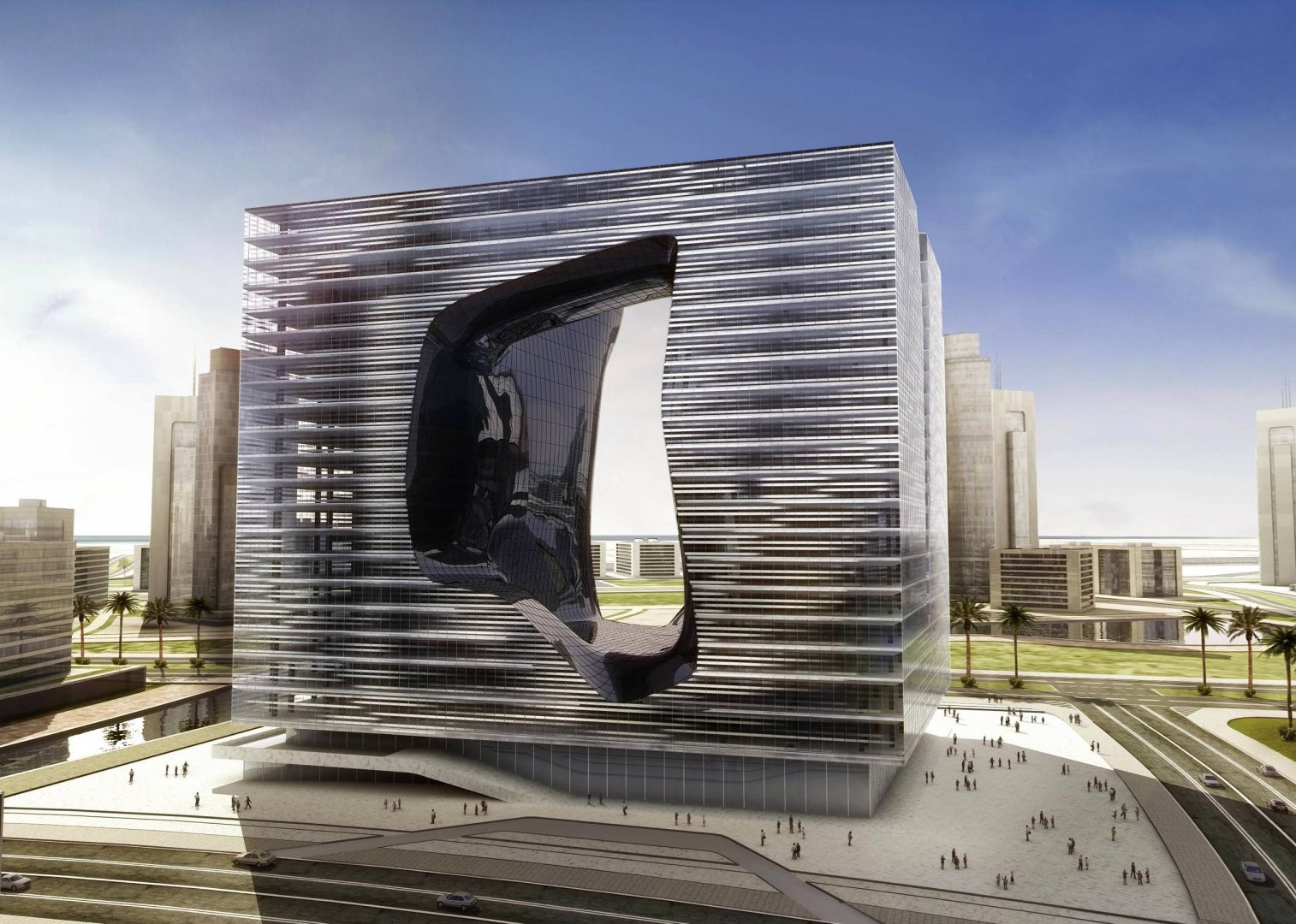
You’ve seen them. Even if you don’t know the name, you’ve definitely seen the "vibe." Those massive, white, swooping structures that look like a spaceship just landed in the middle of a dusty city. We are talking about Zaha Hadid Architects buildings, and honestly, they are some of the most polarizing objects ever built by human hands. People call them masterpieces. Others call them expensive nightmares.
The truth is usually somewhere in the middle, buried under a mountain of curved concrete.
Zaha herself was often called the "Queen of the Curve." But here is the thing: she didn't actually start with curves. Her early work was all sharp angles and jagged lines that looked like a stack of glass shards falling down a hill. She was a "paper architect" for years because nobody thought her stuff could actually be built. Then, the Vitra Fire Station happened in 1993. It was basically a giant concrete lightning bolt in Germany. It proved she wasn't just dreaming.
Why the Curves Actually Matter (It’s Not Just for Show)
Most people think these buildings look like melted plastic because it's "futuristic." That's a bit of a surface-level take. The firm, now led by Patrik Schumacher since Zaha’s passing in 2016, uses a thing called parametricism.
Basically, they use crazy-powerful algorithms to design buildings like nature designs mountains or rivers.
Take the Heydar Aliyev Center in Baku. It doesn't have a clear "start" or "end." The floor turns into the wall, which turns into the ceiling. It’s one continuous skin. This isn't just to be fancy; it’s about flow. They want you to move through a space without feeling like you’re trapped in a box. In a ZHA building, you aren't just in a room—you're in a landscape.
The Buildings You Actually Need to Know
If you're trying to spot a ZHA project in the wild, these are the heavy hitters:
- The London Aquatics Centre: Built for the 2012 Olympics. The roof looks like a massive wave. It’s heavy as hell, but it looks like it’s floating.
- Guangzhou Opera House: They call it the "double pebble." It sits right on the Pearl River in China. Inside, it looks like the bridge of a Star Trek ship.
- MAXXI Museum (Rome): This one won the Stirling Prize. It’s built on the site of old military barracks. It’s all about overlapping paths. It feels like walking through a bunch of frozen rivers.
- BEEAH Headquarters (Sharjah): This is the newer stuff. Finished recently, it looks like a series of sand dunes. It’s also nearly net-zero, which answers the critics who say these buildings are just wasteful sculptures.
The "Expensive" Elephant in the Room
Let's be real. Building these things is a headache. You can't just go to a hardware store and buy a curved steel beam for a Zaha Hadid Architects project. Almost every piece has to be custom-made.
This leads to the biggest criticism: the cost.
The Dongdaemun Design Plaza in Seoul cost nearly $450 million. People lost their minds. But now? It’s the most Instagrammed spot in Korea. It brought in millions in tourism. So, is it a waste of money? Or is it a long-term investment in a city’s brand?
There’s also the human cost. The Al Janoub Stadium in Qatar was plagued by reports of poor worker conditions. Zaha’s response at the time—basically saying it wasn't her job to police the site—sparked a massive backlash. It’s a reminder that even the most beautiful "space-age" architecture is built by real people on the ground.
What’s Happening in 2026?
The firm isn't slowing down. Right now, they are working on the Bishoftu International Airport in Ethiopia. It’s planned to be the biggest in Africa. They also just finished the Danjiang Bridge in Taiwan, which is the world’s longest single-mast, asymmetric cable-stayed bridge.
They are also leaning hard into AI-driven design. They have an exhibition running at MOCAUP in Shenzhen called "Architecture of Possibility" that shows how they use AI to figure out how people will move through their buildings before a single brick is laid.
Actionable Insights for Architecture Lovers
If you want to experience these buildings without just looking at a screen, here is how to do it right:
- Don't just look at the outside. The magic of ZHA is the "interior urbanism." Go inside the MAXXI or the London Aquatics Centre. The way the light hits the curves changes every hour.
- Check the acoustics. The Guangzhou Opera House isn't just pretty; it’s designed for sound. If you can catch a performance there, do it. The gypsum-paneled ceilings are engineering marvels.
- Look for the "Old meets New." My favorite ZHA building is actually the Port House in Antwerp. They took a 19th-century fire station and dropped a giant, glass, diamond-shaped spaceship on top of it. It shouldn't work, but it does.
- Follow the tech. If you're into the "how," look up Parametricism. It’s the coding language that makes these shapes possible.
Zaha Hadid Architects buildings aren't just places to work or look at art. They are proof that we don't have to live in boring grey boxes. They are weird, they are expensive, and they are definitely loud. But in a world of cookie-cutter skyscrapers, maybe we need a little more "weird."
Next Steps for the Architecture Enthusiast: Visit a ZHA site during "golden hour." The way the shadows wrap around the curvilinear facades of buildings like Galaxy SOHO in Beijing or the One Thousand Museum in Miami is something a photograph can't fully capture. If you're a student or professional, dive into Rhino and Grasshopper software; these are the actual tools the firm uses to translate these complex mathematical curves into structural reality.