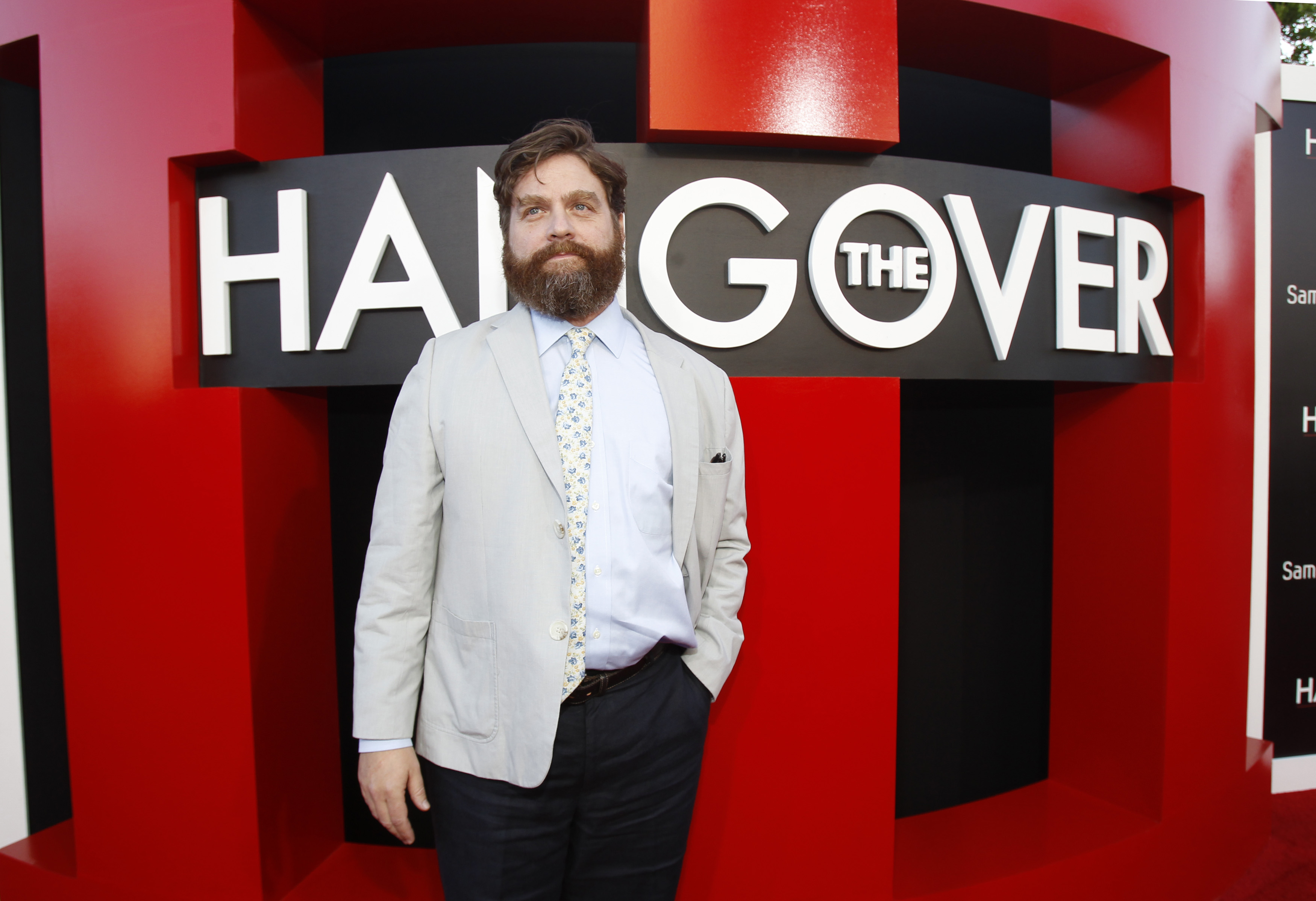
Before he was the guy with the satchel in The Hangover, Zach Galifianakis was making people in half-empty dive bars feel incredibly, deeply uncomfortable. Honestly, if you only know him as Alan or the guy who insults celebrities between two ferns, you’re missing the weirdest, purest version of the man.
He didn't just tell jokes. He staged mini-revolts against the very idea of a comedy show.
Usually, it involved a piano. A small, out-of-tune upright piano. He’d sit there, tinkling out these melancholy, beautiful melodies while dropping one-liners that felt like they were written by a very depressed, very clever ghost. "I hope I've pronounced my name right," he'd say, staring at the floor. Then he’d play a soft C-major chord and talk about how he doesn't sleep on anything that rhymes with crouton.
It was art. It was also total chaos.
The Purple Onion and the Birth of a Legend
If you want to understand Zach Galifianakis stand up comedy, you have to watch Live at the Purple Onion. Filmed in 2005, it’s basically the Rosetta Stone for his entire career. Most comics at the time were doing that high-energy, "have you ever noticed" observational stuff. Zach did the opposite.
He was slow.
He was quiet.
He took pauses that lasted so long you’d start checking your watch, wondering if he’d forgotten where he was. Then he’d look at a guy in the front row and ask, "Why are you even here?" in a tone that wasn't quite mean but wasn't quite joking either.
The Purple Onion special is also where we got introduced to Seth Galifianakis, Zach’s "twin brother." Seth was a polite, effeminate Southerner who thought Zach’s comedy was trash. It was a brilliant way to bake a critique of his own fame into the act before he even became a household name. He shaves his beard off on camera during the special to play the part. Watching a man destroy his own iconic look mid-show just for a bit? That’s commitment.
Why the Piano Actually Mattered
A lot of people think the piano was just a gimmick. It wasn't.
Zach discovered the piano trick by accident at the Largo in Los Angeles. There was a piano on stage for a musical act, and he decided to use it as "bed music" for his set. It changed everything. The music gave his weird, dark non-sequiturs a cinematic weight.
- It created a "trance-like" atmosphere.
- The juxtaposition of soft music and "racy" or absurd jokes made the punchlines hit harder.
- It allowed him to fill the silence without having to speak.
He’d play these gorgeous, tinkling notes and then whisper, "Getting fatter really sucks because I'm extremely claustrophobic." It’s a hilarious line, but the music makes it feel like a tragic confession. That’s the Galifianakis magic.
The "Comedians of Comedy" Era
Before the blockbusters, Zach was part of a specific movement. He toured with Patton Oswalt, Maria Bamford, and Brian Posehn. They called themselves the Comedians of Comedy.
They weren't playing the usual club circuit. They were playing rock venues and indie theaters. They were the "alt-comedy" vanguard. Zach was the wildcard of the group. While Patton was doing brilliant, tight scripts, Zach was often just messing with the lighting guy or drinking a beer and staring at the audience for five minutes.
He famously hated the "polished" nature of show business. He once said he tried to perform three new jokes every single time he went on stage. If a joke got out on TV or a DVD, he’d kill it. He didn't want to be a jukebox playing the hits. He wanted the experience to be live, raw, and potentially a disaster.
The Disappearing Act
If you try to find a lot of his old Zach Galifianakis stand up comedy clips on YouTube now, you’ll notice something: a lot of them are gone.
There’s a theory among hardcore fans that his management scrubbed a lot of his early, edgier material once he became a massive movie star. He used to say some pretty wild, politically incorrect things under the guise of his "idiot" persona. It was satire, sure, but in the post-2010 world, it didn't fit the "lovable weirdo" brand as well.
Still, you can find the gems if you look. His 2001 Comedy Central Presents special is a masterpiece of early-2000s absurdity. He walks out with a full beard (back when that was rare for a lead comic) and starts by telling the audience it's a "dream for them" to be seeing him. The arrogance-mixed-with-insecurity is a tightrope he walked better than anyone.
How to Actually "Watch" Him Today
Zach doesn't really "do" stand up anymore. Not in the traditional sense. He’s a "Serious Actor" now, or at least a very busy one. But the DNA of his stand up is in everything he does.
Between Two Ferns is just his stand-up crowd work turned into a talk show. The way he insults his guests is the exact same way he used to insult hecklers at the Purple Onion. He’s always playing a version of a man who is deeply uncomfortable with being looked at, yet can’t stop seeking attention.
If you’re looking to dive into the archives, here’s the roadmap:
- Live at the Purple Onion (2006): The absolute gold standard. If you only watch one thing, make it this.
- Comedy Central Presents (2001): Great for seeing the younger, slightly more energetic (but still weird) Zach.
- The Comedians of Comedy Documentary: It shows the "behind the scenes" of how he operated on the road.
- SNL Monologues: His Saturday Night Live monologues are basically mini stand-up sets where he brings back the piano and the oversized notepad.
Actionable Steps for Comedy Nerds
If you want to appreciate his style or even incorporate his "vibe" into your own creative work, stop trying to be "perfect." Zach’s whole thing was leaning into the mistake. If he tripped on a word, that became the new joke.
- Watch for the "Long Pause": Pay attention to how long he waits before a punchline. Silence is a tool, not a gap to be filled.
- Study the Juxtaposition: Use something "classy" (like a piano) to deliver something "trashy" (like a fart joke). The contrast creates the humor.
- Embrace the Awkward: Next time you’re watching The Hangover, try to spot the moments where Zach is using his stand-up timing. It’s all over his performance as Alan.
Zach Galifianakis proved that you don't need a high-energy "showman" persona to rule a room. You just need a piano, a beard, and the courage to let a room stay silent until the audience starts to sweat.
Check out the Purple Onion DVD extras if you can find them. The "Road Trip" segments with his friend Joe Wagner give a lot of insight into how his brain actually processes the world. It's less of a "performance" and more of a lifestyle of being perpetually, hilariously out of place.
Search for his 1998 set with Ken Jeong if you want a real deep-cut. It’s grainy, it’s old, and it’s a fascinating look at two future stars before the world knew their names.
The most important thing to remember about Zach Galifianakis stand up comedy is that it was never about the punchline. It was about the tension. And nobody handles tension better than him.



