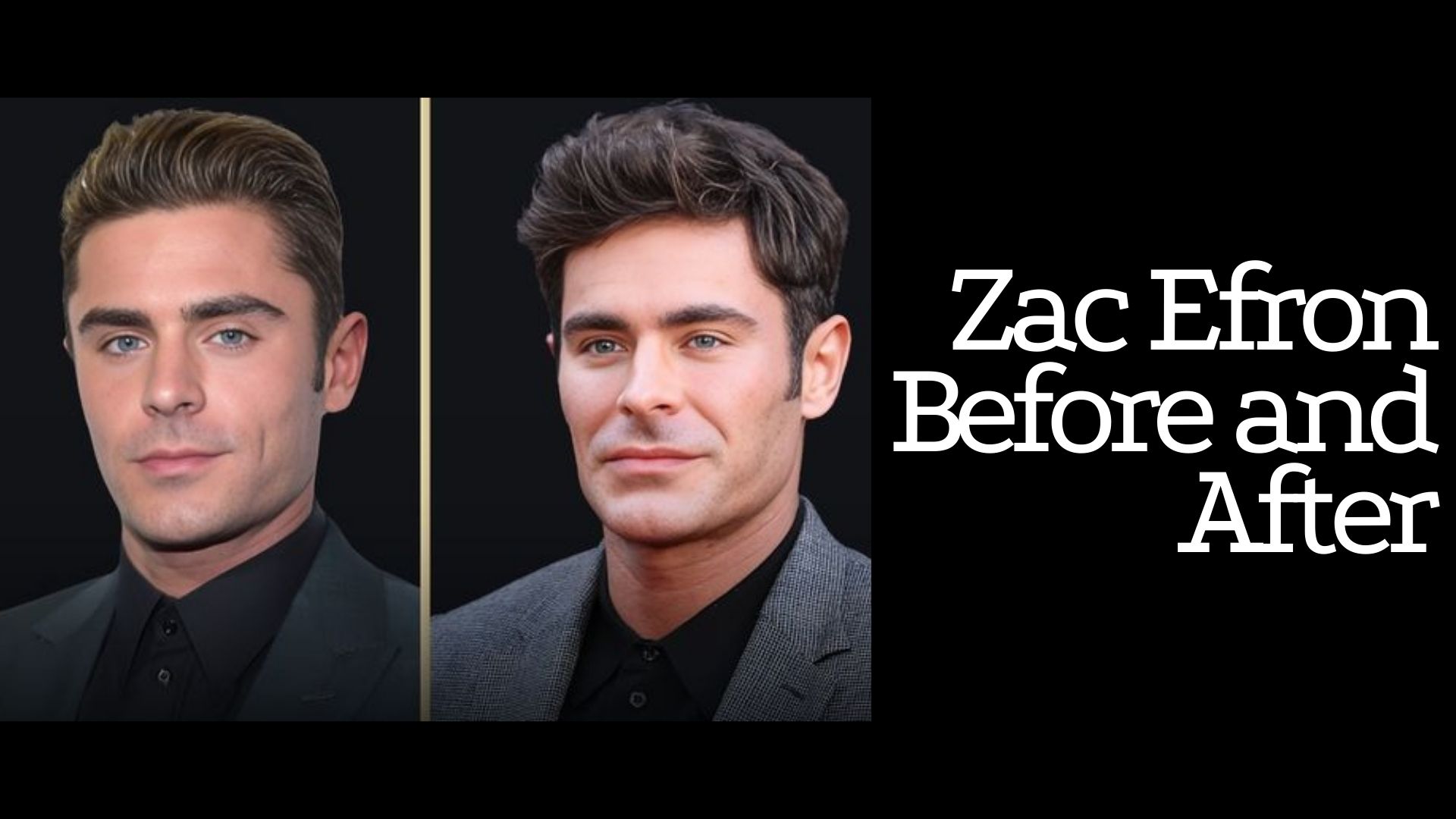
Everyone remembers the "Earth Day Musical" video from 2021. It was a weird time. Zac Efron popped up on screen to talk about the planet, but nobody was looking at the trees. They were looking at his jaw. It looked… different. Square. Heavy. Basically, the internet had a collective meltdown, and the term "Jaw-gate" was born before the video even finished playing.
People were ruthless. The comments ranged from "Who is his surgeon?" to "He looks like a Marvel villain." Honestly, it’s kinda wild how fast we jump to conclusions when a celebrity’s face changes by a few millimeters. But for Zac Efron, the "before and after" isn't just about a trip to a clinic in Beverly Hills. It’s actually a story about a granite fountain, a pair of socks, and a near-death experience that most people completely missed while they were busy zooming in on his chin.
The 2013 Accident: When Everything Changed
Most of the world thinks the transformation happened in 2021. It didn't. To understand the Zac Efron before and after timeline, you have to go back to 2013.
Imagine this: You’re at home. You’re running through the house in socks—we’ve all done it—and you slip. But instead of just a bruised tailbone, Zac smacked his chin directly into the granite corner of a fountain. He lost consciousness immediately. When he finally woke up, he told Men’s Health in a 2022 interview that his "chin bone was hanging off" his face.
It was gruesome.
He had to get his jaw wired shut. He went through a massive reconstructive surgery. And while the public saw him back on red carpets shortly after, the internal damage was still there. The human body is weirdly resilient; when one part breaks, other parts overcompensate. In Zac’s case, his masseter muscles—the ones used for chewing—had to do all the heavy lifting while his jaw healed.
Why the Jaw Looked Different in 2021
So why did the change suddenly become so visible years later?
Zac had been working with a specialist and doing intensive physical therapy for years to manage the injury. But during the pandemic, while he was filming Down to Earth in Australia, he took a break from the PT. Without the exercises to keep everything in check, those masseter muscles just… grew. They got huge. Like a "symphony" where one instrument is playing way too loud, his facial muscles overdeveloped to the point that his entire lower face shape shifted.
The Brutal Reality of the Baywatch Body
We can't talk about his physical changes without mentioning Baywatch (2017). If the jaw injury was an accident, the Baywatch look was a choice—but a dangerous one.
Zac has been incredibly vocal about how much he hated that process. To get that "CGI look," he wasn't just lifting weights. He was:
- Taking powerful diuretics (Lasix) to strip all the water out of his skin.
- Overtraining to the point of exhaustion.
- Eating the exact same three meals every single day.
- Sleeping only four hours because he had to be in the gym by 4 a.m.
He looked like a Greek god, sure. But inside? He was a wreck. He developed insomnia and fell into a "pretty bad depression" that lasted long after the movie wrapped. He told reporters it took six months just to feel like himself again. When you look at his "before and after" from the High School Musical days to Baywatch, you’re seeing the result of extreme physical and mental strain, not just "fitness."
The Iron Claw and the "Bulked" Era
By the time The Iron Claw (2023) came around, the conversation shifted again. Playing Kevin Von Erich meant he had to get big—really big. But this time, it felt different. It wasn't the "shredded to the bone" look of Baywatch. It was a heavy, powerhouse physique.
Some fans still pointed at his face during the press tour, claiming he’d had even more work done. But if you look at the mechanics of his injury, the "heavier" look makes sense. Between the natural aging process (he’s in his late 30s now), the residual effects of the masseter hypertrophy, and the massive weight gain for the role, his face was bound to look different than the 18-year-old kid with the side-swept bangs.
Expert Perspectives vs. Fan Theory
While Zac denies any cosmetic surgery, some plastic surgeons have weighed in with their own theories. Dr. Sam Rizk, a well-known surgeon, suggested in various interviews that while the injury explains a lot, things like the brow shape or cheek volume could be the result of fillers or Botox.
However, it’s all speculation. We don't have his medical records. What we do have is a man who survived a shattered face and spent a decade trying to put the pieces back together while the world watched his every move.
Lessons from Zac’s Transformation
The obsession with the Zac Efron before and after narrative says more about us than it does about him. We want our celebrities to stay frozen in time, but life happens. Bones break. Mental health dips. People grow up.
If you're looking at Zac's journey and wondering how to apply it to your own life, here are some actual takeaways:
- Function over aesthetics: Zac’s current routine involves ice baths, foam rolling for an hour, and "circadian rhythm" alignment. He’s focused on feeling good, not just looking "ripped."
- The danger of diuretics: Never mess with water pills for aesthetic reasons. The "shredded" look you see in movies is often the result of severe dehydration that can cause long-term kidney and heart issues.
- Masseter health: If you struggle with jaw clenching or a "widening" jaw, it might be muscle-related rather than bone-related. Physical therapy and even Botox (for medical reasons) are common ways to treat masseter hypertrophy.
- Ignore the noise: Zac famously stays off social media to protect his peace. In his words, if he valued what people thought of him, he wouldn't be able to do his job.
At the end of the day, Zac Efron is a guy who has been through the Hollywood ringer. He’s been the teen idol, the shredded action star, and the rugged outdoorsman. His face has changed because his life has changed. Maybe it's time we let him—and ourselves—age without the constant scrutiny of a magnifying glass.
To truly understand the impact of extreme physical transformations, you can research the long-term effects of diuretics on metabolic health or look into masseter physical therapy techniques if you suffer from TMJ or similar jaw tension issues. Taking care of the "inside" is usually what determines how the "outside" looks in the long run.