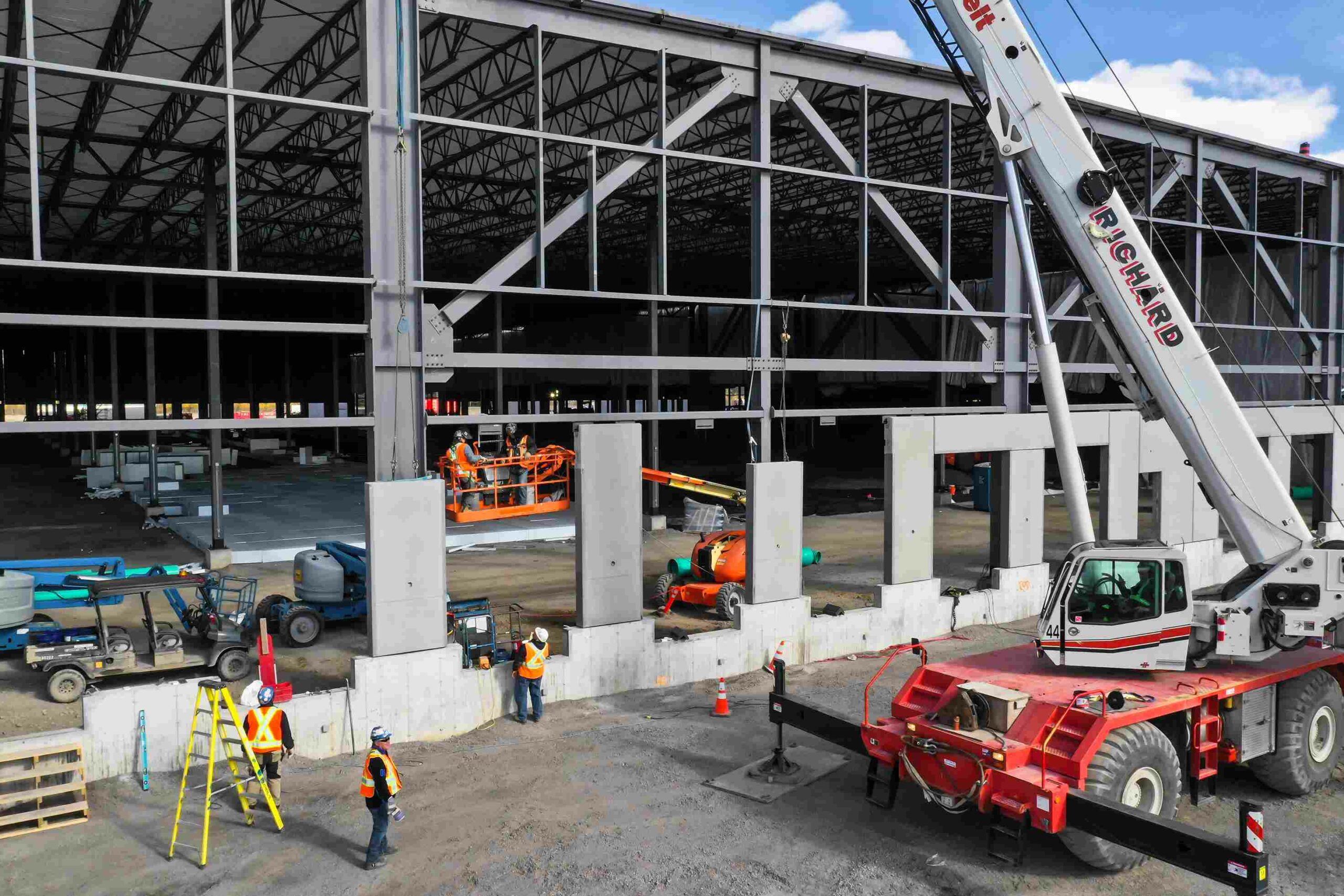
It’s hard to miss the massive structure sitting on the old Ford plant lands in Southwold, just outside St. Thomas, Ontario. This is YXU1 Amazon fulfillment centre, a project that spent years as a "mystery" before the tech giant finally put its name on the door. If you’re driving down Highway 4, the sheer scale of the place is almost disorienting. It covers about 2 million square feet. That’s roughly the size of 34 football fields stacked on top of each other.
Honestly, for a long time, locals just called it "Project Pine." There was all this secrecy surrounding the construction. People knew something big was coming, but nobody was 100% sure if it was Amazon or another major player until the official announcement in 2021. Now that it’s operational, it has fundamentally shifted the economic gravity of the London-St. Thomas corridor.
The Logistics Behind the YXU1 Amazon Fulfillment Centre
Why here? That’s the question people always ask.
Amazon doesn't pick locations because the scenery is nice. They pick them because of physics and timing. The YXU1 Amazon fulfillment centre sits right in a sweet spot between the Greater Toronto Area (GTA) and the U.S. border at Windsor/Detroit. It’s all about the "last mile." By placing a massive robotics-led facility here, Amazon can hit same-day or next-day delivery targets for a massive chunk of Southwestern Ontario that used to rely on shipments coming all the way from Brampton or Milton.
This isn't a traditional warehouse. You won't see rows of people wandering through aisles with clipboards. Instead, YXU1 is a "robotics" facility. This means thousands of drive units—small, orange robots—scurry across the floor, sliding under shelves and bringing the products directly to the human associates. It’s a dance of algorithms and mechanical precision that happens 24/7.
The building itself is four stories tall. Inside, it’s a maze of conveyor belts that stretch for miles. If you could unfold all the belts, they’d likely reach halfway to Lake Erie. The technology used here is part of Amazon’s newer generation of designs, specifically focused on handling smaller items like books, electronics, and household goods.
Jobs, Wages, and the St. Thomas Reality
Let's talk about the elephant in the room: the jobs.
When the Ford Talbotville plant closed in 2011, it left a gaping hole in the local economy. For over a decade, that land sat vacant. YXU1 Amazon fulfillment centre promised to fill that void with over 1,000 full-time jobs.
The pay is a point of contention for some. Amazon typically starts its tier-one associates at a rate that is competitive for the warehouse sector but lower than what the old-school United Auto Workers (UAW) used to make at the Ford plant. However, they include benefits like health, dental, and vision insurance from day one. They also have this "Career Choice" program where they pay up to 95% of tuition for employees to go back to school. It’s a different kind of stability.
The ripple effect is real. When 1,000+ people show up for a shift change, the local gas stations, diners, and coffee shops in St. Thomas feel it. The traffic on Wonderland Road and Highway 4 has noticeably increased. It’s a busy, sometimes chaotic, new normal for a region that was very quiet for a long time.
How YXU1 Fits Into the Broader Network
Amazon uses specific codes for their buildings. YXU is the airport code for London International Airport. That’s how they name these things. Even though it’s technically in Southwold/St. Thomas, its identity is tied to the London logistics hub.
The YXU1 Amazon fulfillment centre works in tandem with "Delivery Stations."
- An item is stored at YXU1.
- You click "Buy Now."
- A robot brings the item to a worker.
- It’s packed and sent on a truck to a delivery station (like the one in London).
- A van brings it to your porch.
It’s a closed loop. The efficiency is terrifyingly impressive.
What Most People Get Wrong About the Robots
There’s this persistent myth that the robots at YXU1 Amazon fulfillment centre are replacing humans. Sorta, but not really. The robots actually create a need for a new class of worker: the RME (Reliability, Maintenance, and Engineering) tech. These are the people who have to fix the robots when they bump into each other or get a "fault" code.
The robots don't have eyes; they follow a grid of QR codes on the floor. If a sticker gets peeled up, the whole system can stutter. It's a high-tech environment that requires a lot of human oversight. The "human" part of the job has shifted from heavy lifting to "stowing" and "picking" with the help of computer interfaces. It’s physically demanding in a different way—mostly from standing in one spot for long periods rather than walking miles across a warehouse floor.
Environmental and Social Impact
Building a 2-million-square-foot box on former industrial land has environmental consequences. Amazon has made big claims about "The Climate Pledge," aiming for net-zero carbon by 2040. At YXU1, you see this in the LED lighting and the high-efficiency HVAC systems. But the real footprint is the trucks. Hundreds of heavy trucks move in and out of that site daily.
The local community has had to adapt. Southwold Township, which is primarily rural, suddenly became home to one of the largest buildings in Canada. That requires upgrades to water lines, electricity grids, and road maintenance. The tax revenue is a windfall for the municipality, but it comes with the "big city" problems of congestion and noise.
Comparing YXU1 to Other Ontario Sites
If you look at the fulfillment centres in Hamilton (YHM1) or Ottawa (YOW1), YXU1 is very similar in design. It represents the "standardization" of Amazon’s global footprint. They found a blueprint that works—multi-story, robotics-heavy, near a highway—and they stamp it out wherever the data tells them a gap exists in their delivery network.
However, Southwestern Ontario is unique because of its manufacturing history. People here know how to work in big plants. The transition from "building cars" to "moving packages" is a symbolic shift for the region. It’s moving from the 20th-century industrial age to the 21st-century e-commerce age.
What it’s Actually Like to Work There
Working at YXU1 Amazon fulfillment centre isn't for everyone. It's disciplined. You have "rates" to hit. The computer tracks how many items you process per hour. If you're someone who likes a slow-paced, chatty environment, you’ll probably hate it.
But for people who like to stay busy and want a clear path to a paycheck without needing a specialized degree, it’s a lifeline. The "peak season"—which runs from Black Friday through Christmas—is intense. Mandatory overtime is a regular thing during those months. You’re basically a part of a giant machine designed to make sure a kid in Sarnia gets their LEGO set by 8:00 PM on a Tuesday.
Moving Forward with YXU1
The presence of the YXU1 Amazon fulfillment centre is a permanent change for St. Thomas. It’s paved the way for other massive investments, like the Volkswagen PowerCo battery plant. Once a big player like Amazon proves the logistics work in a specific town, other corporations follow.
If you're a business owner in the area, the goal is to leverage this. The logistics network is better than it’s ever been. If you’re looking for work, it’s a steady option with a low barrier to entry.
Actionable Insights for Locals and Job Seekers:
- Check the "Career Choice" options: If you take a job at YXU1, don't just stay a picker. Use their tuition money to get a certification in something like IT or Mechatronics. Amazon will literally pay for your exit strategy into a higher-paying career.
- Monitor Traffic Patterns: If you commute through the Talbotville area, avoid Highway 4 during shift change times (usually around 6:00-7:30 AM and PM). The congestion is real and can add 15 minutes to your trip.
- Local Supply Chain: Small business owners should look into "Amazon Relay." It’s a program where independent carriers can bid on hauling loads for Amazon. With YXU1 right there, there’s a lot of regional "middle-mile" work available for local trucking companies.
- Prepare for "Peak": If you’re an employee or a vendor, the months of November and December are "all hands on deck." Don't plan major life events during these weeks if you're tied to the facility's operations.
The YXU1 Amazon fulfillment centre is more than just a giant warehouse. It’s a signal that Southwestern Ontario is no longer just "farm country" or "car country"—it’s a central nervous system for the Canadian economy. Whether that’s a good thing or a bad thing depends on who you ask, but there’s no denying the building has changed the landscape forever.