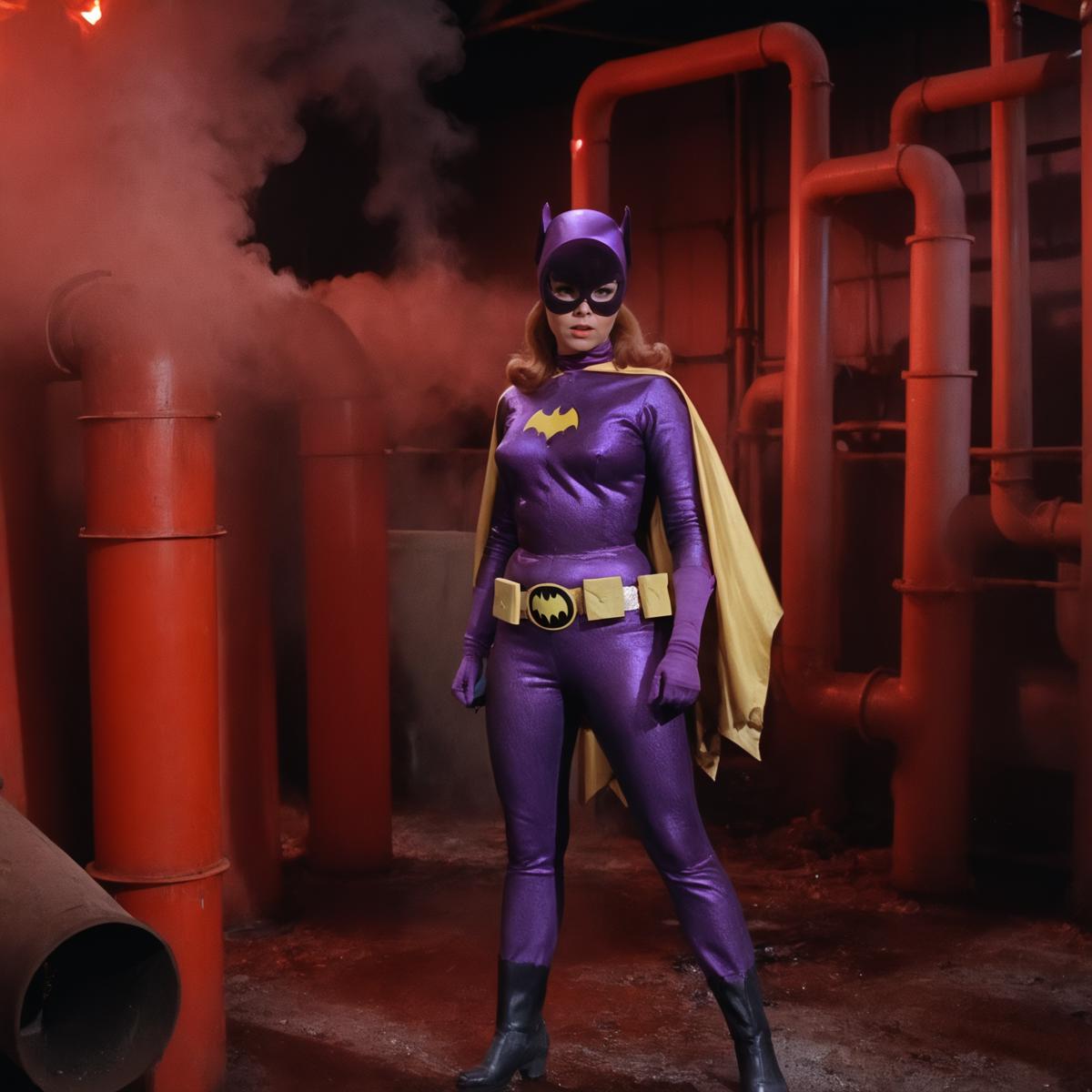
Honestly, it’s kinda wild that one purple suit and a customized Yamaha could change television history forever. When people talk about the 1966 Batman series, they usually picture Adam West’s deadpan delivery or those bright "POW!" and "ZAP!" bubbles. But for a massive chunk of the audience, the show didn't truly start until 1967. That was the year Yvonne Craig as Batgirl kicked her way into Gotham City.
She wasn't just a sidekick.
Actually, she was a hail-mary pass from a studio desperate to save a dying show. By the time Season 3 rolled around, the "Bat-mania" that gripped America was cooling off. Ratings were tanking. ABC was looking for the exit door. Producer William Dozier needed a miracle, and he found it in a 5-foot-4-inch former ballerina with a "cartoon voice" and enough charisma to power a small city.
The Librarian With a Secret Closet
Most fans remember Barbara Gordon as the daughter of Commissioner Gordon, working in the Gotham City Public Library. It's a classic setup. But what’s weird is that Batgirl actually debuted in the comics specifically because of the TV show. Dozier asked DC Comics editor Julius Schwartz to whip up a female hero so they could put her on screen.
It was a total marketing move.
Basically, the studio wanted to hook two very different demographics: prepubescent girls who wanted a hero and men over 40 who... well, they just liked looking at Yvonne Craig. She knew it, too. In interviews later in her life, she was always pretty blunt about being "eye candy" for the dads and a "role model" for the daughters. It was a bizarre tightrope to walk.
That Iconic Suit (and Why it Was a Pain)
The purple costume is legendary. It was made of a material called "Lurex," which was basically a glittery, stretchy fabric that looked great under studio lights but felt like wearing a brillo pad. It was scratchy. It was hot. And the mask? It was a nightmare.
Initially, the mask was so tight it left deep indentations on her face. If she took it off for lunch, she looked like she’d been crying for three hours. They eventually had to redesign it, opening up the eyes so she could actually see where she was swinging her legs.
She Did Her Own Stunts (Mostly)
Here’s something that usually shocks people: Yvonne Craig did almost all her own stunts.
Because of her background with the Ballet Russe de Monte Carlo, she had this incredible sense of balance and physical grace. She didn’t just "fight"; she danced through the scenes. While Adam West and Burt Ward had stunt doubles doing the heavy lifting, Craig was out there doing the high-kicks herself.
- The "Bat-Roll": She perfected a signature move where she’d tumble into a room and pop up ready to fight.
- The High Kicks: She refused to use "brute force" because she thought it wasn't "feminine" for the time. Instead, she used her legs.
- The Batcycle: This was her one true enemy. The bike was a 250cc Yamaha YDS-5 with massive fiberglass wings and ruffles that made it weigh over 300 pounds. It was top-heavy and terrifying. She once said they took the shock absorbers off to fit the wings, so every bump felt like "jumping off a table stiff-legged."
The Wage Gap Nobody Talked About
You’ve probably seen that 1973 Public Service Announcement where Batgirl refuses to save Batman and Robin until she gets equal pay. It’s a classic clip. But it wasn't just a script—it reflected a real-world frustration.
In Season 3, Yvonne Craig was making about $1,500 a week. Compare that to Adam West, who was pulling in $2,250 a week.
Now, $1,500 was a fortune in 1967, especially for a supporting actress. It was way more than Burt Ward ($450) or the veteran actors playing Alfred and Commissioner Gordon ($650–$750). But the fact that she was the "third star" and doing her own stunts while getting paid significantly less than West stayed with her. She became a huge advocate for equal pay and women’s rights long after the cowl was retired.
Why the Show Was Cancelled Anyway
A lot of people think adding a female lead "jumped the shark." That’s just wrong. If anything, Batgirl is the only reason Season 3 exists at all. The real problem was the budget.
To save money, the producers cut the show from two nights a week down to one. They got rid of the iconic cliffhangers. The sets looked cheaper. The scripts got sillier. By the time NBC tried to buy the show to save it, someone had already ordered the destruction of the expensive Batcave set. It was a literal wrecking ball that ended the series, not the new character.
Beyond the Batcave
After the show ended in 1968, Yvonne didn't just disappear. She guest-starred on every major show from The Man from U.N.C.L.E. to Star Trek. In fact, Star Trek fans know her as Marta, the green-skinned Orion slave girl who tried to kill Captain Kirk.
She eventually left acting to sell real estate and run a business with her sister. She was a powerhouse. When she passed away in 2015, she left behind a legacy of being the first woman many girls ever saw who could take care of herself.
Actionable Insights for Fans and Collectors
If you're looking to dive deeper into the history of Yvonne Craig as Batgirl, here is how to actually find the good stuff:
- Watch the "Lost" Pilot: There is an 8-minute presentation film used to sell the character to ABC. It features the Killer Moth and a much "flippanter" version of Batgirl. It’s widely available on YouTube and in the 2014 Blu-ray box sets.
- Read her Memoir: From Ballet to the Batcave and Beyond is the only place to get the unfiltered truth. She’s honest about her time with Elvis, her thoughts on Adam West’s "ego," and the reality of being a woman in 60s Hollywood.
- Check the "Equal Pay" PSA: It's one of the earliest examples of a superhero being used for social advocacy. It’s a fascinating time capsule of the feminist movement's intersection with pop culture.
- Avoid the "Missing Costume" Myths: There are tons of rumors about where the original purple suit went. Most were destroyed or sold off in the 70s during studio liquidations. If you see one for sale today, it's almost certainly a high-end replica or a composite piece.
Yvonne Craig didn't just play a character; she built a blueprint. Every time you see a female hero on screen today who doesn't need a man to rescue her, you're seeing a little bit of what Yvonne started in a scratchy purple suit back in 1967.



