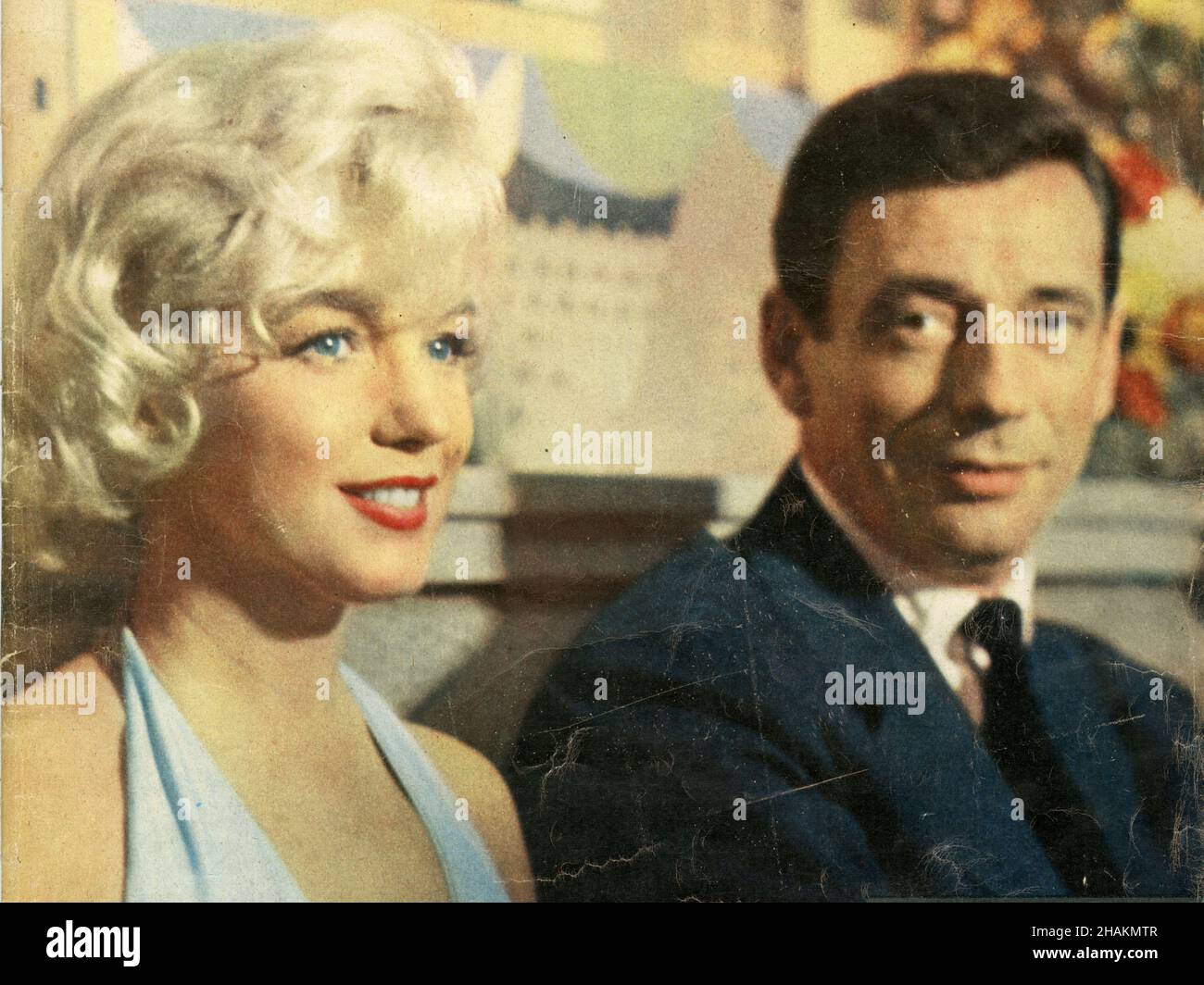
Hollywood thrives on myths, but the 1960 collision of Yves Montand and Marilyn Monroe wasn't some studio-manufactured fairy tale. It was messy. It was desperate. Honestly, it was a slow-motion train wreck involving four of the most famous people on the planet.
Imagine the setup. You’ve got the world’s ultimate sex symbol, Marilyn, married to the towering American intellectual, Arthur Miller. Then you bring in the "French Frank Sinatra," Yves Montand, who arrives in Los Angeles with his wife, the powerhouse Oscar-winner Simone Signoret. They didn't just work together; they lived in adjoining bungalows (numbers 20 and 21) at the Beverly Hills Hotel. They ate dinner together every single night.
But behind the champagne toasts for the movie Let’s Make Love, things were falling apart.
The Loneliness of "Let’s Make Love"
The film title was prophetic, though the production itself was a nightmare. Marilyn didn't even want to do it. She was forced into it by 20th Century Fox to fulfill an old contract. She hated the script. She thought it was "thin."
Meanwhile, Montand was terrified. He was a god in France but a nobody in America. His English was shaky at best. He felt like a fraud in a big Hollywood musical.
That shared anxiety became the glue.
When Simone Signoret had to leave for a shoot in Italy, and Arthur Miller headed to Nevada to prep The Misfits, the two stars were left alone in those adjoining bungalows. It didn’t take long. In April 1960, the "tender" relationship Montand later described turned into a full-blown affair.
Did Arthur Miller and Simone Signoret Know?
Simone Signoret's reaction is legendary in the world of celebrity gossip for its sheer, brutal pragmatism. When the press started hounding her about her husband’s infidelity with the most famous woman in the world, she didn’t throw a fit. She famously told a reporter:
"If Marilyn is in love with my husband it proves she has good taste, for I am in love with him too."
But don't let the cool exterior fool you. Friends said she was devastated. Years later, her nephew mentioned that there was a "before and after" for Simone—she seemed to age overnight once the betrayal went public.
Arthur Miller was a different story. He was already emotionally checking out of his marriage to Marilyn. He’d seen her spirals, her pill-taking, and her erratic behavior on set. Some say he didn't even fight for her when he found out about Montand. Marilyn allegedly resented that lack of jealousy. She wanted him to save her; he was just trying to survive the production.
The Cold Reality of the Breakup
Marilyn fell hard. She really thought Montand might be "the one." She saw him as a mix of the intellectual depth she craved (like Miller) and the rugged masculinity she admired (like DiMaggio).
Montand, however, had zero intention of leaving his wife.
As soon as the cameras stopped rolling on Let's Make Love, the fantasy evaporated. Montand went back to France. He basically told the press that Marilyn was the one who got confused—that she had "mistaken" the seriousness of their fling. He even suggested he only did it for the publicity, which is just about the most heartbreaking thing you could say to someone as fragile as Monroe.
Why the Yves Montand and Marilyn Monroe Connection Still Matters
We look back at this today and see the cracks in the "Golden Age" of Hollywood. It wasn't just a scandal; it was a symptom of two people drowning in their own fame.
- The Power Dynamic: Fox used the affair to sell tickets. They actually leaned into the rumors to drum up interest for a movie that wasn't very good.
- The Emotional Fallout: This affair was the final nail in the coffin for the Monroe-Miller marriage. They divorced shortly after filming The Misfits.
- The Human Cost: Marilyn felt used. Again. Montand went back to his life, and Simone Signoret stayed with him until her death in 1985, though the "champagne-colored silk scarf" Marilyn once gave her remained a bittersweet keepsake in her drawer for decades.
How to See the History Yourself
If you're a classic film buff or a Marilyn historian, you can actually trace the tension on screen.
- Watch the "My Heart Belongs to Daddy" number. It's the peak of Marilyn's performance in the film, and you can see why Montand (and everyone else) was mesmerized.
- Read "Nostalgia Isn't What It Used to Be." That's Simone Signoret’s autobiography. It’s a masterclass in dignity and subtle shade regarding the whole 1960 debacle.
- Check out the John Bryson photos. He was the photographer on set who captured the "candid" moments between the two stars. The body language tells the story the studio tried to hide.
The story of Yves Montand and Marilyn Monroe isn't a romance. It’s a study in what happens when two people who are "afraid of the camera" find comfort in the wrong places. It didn't save Marilyn, and it didn't make Montand an American superstar. It just left four people very, very lonely.
To dig deeper into the era, you should compare the on-set atmosphere of Let's Make Love with Marilyn’s final completed film, The Misfits. The contrast in her physical and emotional health between these two 1960-1961 productions is the most honest record of her final years.