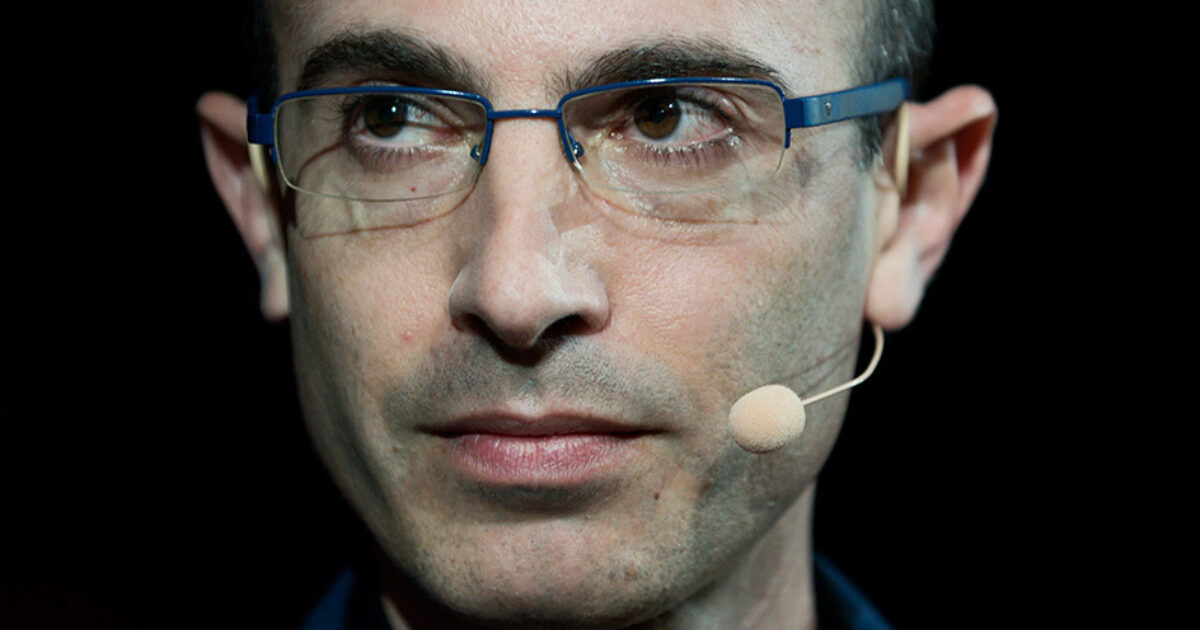
He isn't just a professor. He's a phenomenon. If you’ve stepped into an airport bookstore or scrolled through a high-profile "must-read" list in the last decade, you've seen his face. Lean, intense, and usually wearing a look of mild concern for the species, Yuval Noah Harari has become the go-to guy for anyone trying to figure out why humans are so weird—and where we're headed.
But here is the thing.
Most people call him a historian because of Sapiens: A Brief History of Humankind. That’s the book that launched him into the stratosphere, selling over 40 million copies. Honestly, though? Calling Harari a historian is like calling Elon Musk a car salesman. It’s technically true, but it misses the entire point of what he’s actually doing. He’s using the past to build a roadmap for a future that looks increasingly terrifying.
The Sapiens Secret: It's All About the Stories
Why did Sapiens explode? It wasn't because he discovered some new fossil in the Great Rift Valley. It’s because he told us that we are all living in a collective hallucination.
Harari’s big idea is "fictions." He argues that what separates us from chimpanzees isn't just our bigger brains or our ability to make tools. It’s our ability to believe in things that don’t exist in the physical world. Think about it. You can’t show a chimpanzee a dollar bill and explain that it represents a share of a global economy based on debt and future growth. The chimp just sees a piece of paper. He'd rather have the banana.
But humans? We’ll die for a flag. We’ll work 80 hours a week for "corporate equity." We follow laws written by people who died centuries ago. Harari calls these inter-subjective realities. They only exist because we all agree they exist. Religion, nations, money, human rights—they're all stories.
This isn't just academic fluff. It’s a radical way of looking at power. If you control the story, you control the humans. And that brings us to why he’s so worried about the next few decades.
Why Silicon Valley Obsesses Over Him
It’s kinda ironic. The very people Harari warns us about—the tech giants in Palo Alto and Seattle—are his biggest fans. Mark Zuckerberg put Sapiens on his book club list. Bill Gates is a vocal supporter. Barack Obama famously praised his work.
Why do the architects of the future love a guy who spends so much time talking about the Stone Age?
Because Harari shifted the conversation from "what can we build" to "what will the building do to us." In his follow-up book, Homo Deus, he stops looking back and starts looking forward. He suggests that we are on the verge of upgrading ourselves into gods. Or, at least, some of us are.
Through biotechnology and AI, we’re moving toward a world where "dataism" becomes the new religion. He’s been very vocal about the "useless class"—a term that gets him into a lot of trouble with critics. He isn't saying people are worthless. He’s saying that in an AI-driven economy, millions of people might become economically irrelevant. If an algorithm can diagnose cancer better than a doctor and drive a truck better than a human, what happens to the doctor and the driver?
The Controversy: Is He Actually Right?
You can't be this famous without making enemies.
Some scientists, like evolutionary biologist Jerry Coyne, have been pretty brutal. They argue that Harari oversimplifies complex science to make a good point. They say he’s more of a "storyteller" than a rigorous researcher. And they have a point. When you’re covering 70,000 years of history in 400 pages, you’re going to gloss over some details. You’re going to paint with a very, very wide brush.
Then there are the political critics. Because Harari talks about "hacking humans" and the end of free will, some people in the "tinfoil hat" corners of the internet think he’s a mastermind for the World Economic Forum (WEF). They see his warnings as a blueprint for a dystopian future.
If you actually listen to him, though, he sounds less like a villain and more like a guy frantically waving a red flag. He’s obsessed with the idea that AI won’t just take our jobs—it’ll take our thoughts. If an algorithm knows your political leanings, your sexual orientation, and your deepest fears better than you do, do you still have free will? Or are you just a biological system being "hacked" by a more efficient digital one?
The Daily Life of a Doom-Seeker
For a guy who writes about the end of humanity as we know it, Harari’s personal life is surprisingly... quiet.
- He doesn't have a smartphone. Seriously. In 2026, that feels like a superpower.
- He practices Vipassana meditation for two hours every single day.
- He goes on a long meditation retreat for a month or two every year. No email. No books. No writing. Just sitting.
He’s a vegan, lives with his husband Itzik (who is also his manager) near Jerusalem, and seems generally uninterested in the trappings of fame. He’s basically a monk with a massive platform. This lifestyle informs his writing. He’s trying to find objective truth in a world that he believes is built on layers of lies and myths.
What He's Saying Right Now (The 2026 Perspective)
Lately, Harari has pivoted toward the immediate threat of AI. He isn't worried about Terminator robots coming to kill us. He’s worried about AI "collapsing" the human conversation.
In his latest work, Nexus, he looks at how information networks—from the Bible to Facebook—have shaped history. His takeaway is pretty grim: more information doesn't mean more truth. Usually, it just means more bureaucracy and more sophisticated lies. He points out that the Nazis had great information technology for their time (Hollerith punch cards). The Soviet Union had massive information networks. Information doesn't make us "better." It just makes us more efficient at whatever we're already doing.
He’s currently pushing for a "slow down" in AI development. He’s argued that we shouldn't release powerful AI into the public sphere until we have safety protocols that match the technology’s power. You wouldn't release a new drug without years of testing, right? So why are we releasing "socially transformative" algorithms in a weekend?
How to Actually Apply Harari’s Ideas
Reading Harari can leave you feeling a bit hopeless. If everything is a fiction and we’re all about to be replaced by bots, why bother? But there’s a practical side to his philosophy.
First, audit your "stories." Recognize that many of the things causing you stress—your credit score, your job title, your "brand"—are inter-subjective realities. They are useful tools, but they aren't real like the air you breathe or the food you eat. Distinguishing between the biological reality and the social fiction is the first step to mental clarity.
Second, protect your attention. Harari is a massive advocate for meditation and "turning off." In an age where your attention is the most valuable commodity on Earth, giving it away for free to a scrolling feed is a tactical error. If you can’t sit with your own thoughts for ten minutes, you’ve already been "hacked."
Third, focus on "C-skills." He often talks about the four Cs of 21st-century education: Critical thinking, Communication, Collaboration, and Creativity. Since we can’t predict what the job market will look like in ten years, the only real strategy is to be adaptable. Don't learn a specific software; learn how to learn.
The Bottom Line
Yuval Noah Harari isn't a prophet, though he sometimes sounds like one. He’s a synthesizer. He takes the complex threads of biology, history, and tech and weaves them into a narrative we can actually understand. Whether you think he’s a genius or a high-level "pop" philosopher, you can't ignore the questions he’s asking.
They are the only questions that really matter for the next century.
Next Steps for Deepening Your Understanding:
- Read the "Big Three" in order: Start with Sapiens (the past), move to Homo Deus (the future), and finish with 21 Lessons for the 21st Century (the present).
- Watch the 2018 TED Dialogue: It’s one of the best distillations of his views on the "hacking" of humans and remains incredibly relevant today.
- Practice Information Hygiene: Take a 24-hour digital fast. Use that time to observe how your brain reacts to the lack of "stories" being fed to it by an algorithm.
- Explore the counter-arguments: Check out critiques by researchers like Camille Paglia or the late Christopher Hitchens (on religion/history) to see where Harari's "broad brush" might be missing the mark. This builds the critical thinking skills he advocates for.