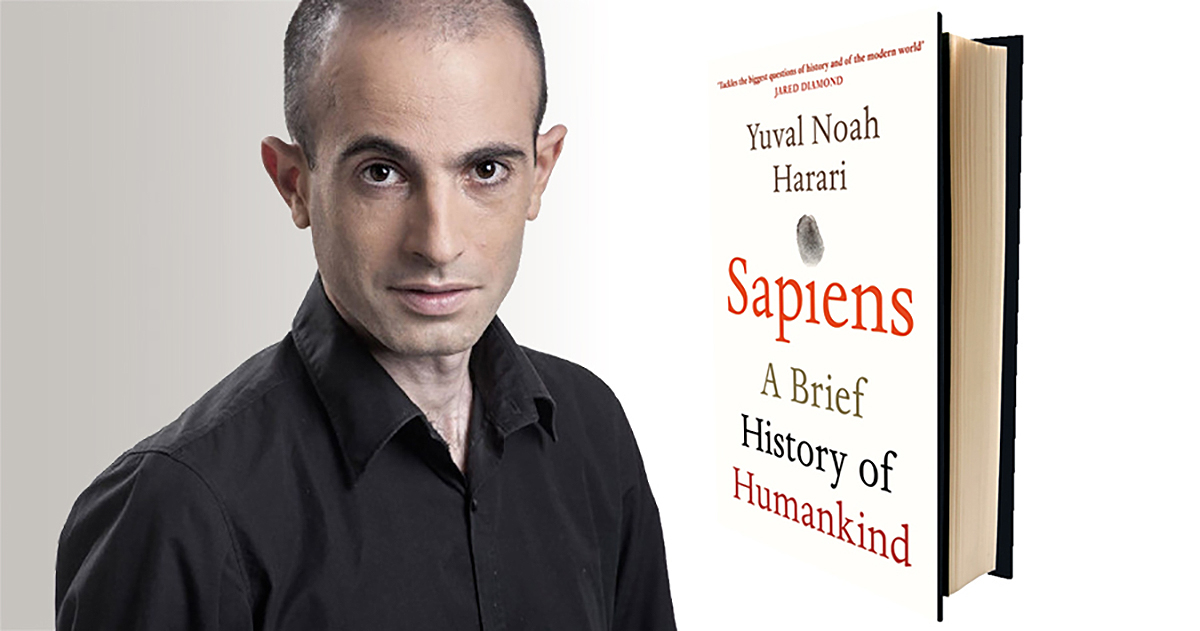
You’ve probably seen it. That bright yellow spine or the stark, white cover with a single fingerprint. It sits on the nightstands of billionaires and gets tossed into backpacks by college students. Yuval Noah Harari Sapiens a brief history of humankind isn't just a book anymore; it's a cultural landmark.
But honestly? A lot of people talk about it without actually getting it. They think it’s just a timeline of when we learned to use fire or why we stopped being nomads. It’s way weirder than that.
The Myth of Being Special
Harari starts by punching a hole in our collective ego. We like to think of "human" as a solo act. We're the only ones here, right? Well, 100,000 years ago, there were at least six different species of humans.
Six.
Imagine walking into a cafe and seeing a Neanderthal. They weren't "primitive" versions of us; they were a different kind of person. They were bulkier, probably stronger, and definitely had bigger brains in some cases. So, why are we the ones writing books and they’re just museum exhibits?
Harari’s big swing is the Cognitive Revolution. Somewhere around 70,000 years ago, a random genetic mutation basically rewired our brains. It gave us a "fictive language." This is the cornerstone of the whole book. Most animals can say, "Look, a lion!" Sapiens can say, "The lion is the guardian spirit of our tribe."
That’s the secret sauce.
Why Your Mortgage is a Fairy Tale
This is where the book gets really provocative. Harari argues that everything that makes us successful—money, nations, human rights, corporations—is just a "shared myth."
Take a $20 bill. It has no intrinsic value. You can’t eat it. You can’t build a house with it. It only works because millions of people collectively agree it has value. If we all woke up tomorrow and decided it was just green paper, the global economy would vanish in seconds.
He applies this to everything.
- Limited Liability Companies (LLCs): They don’t exist in the physical world. You can’t touch "Apple Inc." You can touch a phone or a store, but the company itself is a legal fiction created by lawyers.
- Human Rights: Biology doesn’t know what a "right" is. Evolution creates different bodies, not equal ones. We invented equality so we could live together without stabbing each other.
It’s a cynical view, sure, but also kind of beautiful. We cooperate with total strangers because we share the same stories. It’s why 50,000 people can sit in a stadium and not riot. They all believe in the "myth" of the sports team or the nation.
The Agricultural Revolution: History’s Biggest Fraud
Most history books treat the move from hunting to farming as a massive win. We got bread! We got permanent houses!
Harari calls it a trap.
Think about it. Hunter-gatherers worked maybe 15 to 20 hours a week. They had a varied diet, low stress, and rare diseases. Then came wheat. Suddenly, humans were breaking their backs in fields from dawn to dusk. Our spines weren't built for weeding and hauling water.
Plus, we became dependent on a single crop. If the rain didn't come, everyone starved. This "luxury" led to a population explosion, which meant we couldn't go back to foraging even if we wanted to. We were stuck. We didn't domesticate wheat; wheat domesticated us. ## The "E-E-A-T" Reality Check Now, I have to be real with you. If you talk to an actual evolutionary biologist or a hardcore anthropologist, they might roll their eyes at some of this.
Dr. Darshana Narayanan and other critics have pointed out that Harari plays fast and loose with facts to make a good point. For example, he once claimed chimpanzees hunt "shoulder to shoulder" with cheetahs. They don't. They live in different habitats.
The book is "big history." It zooms out so far that it loses the nuances of specific cultures. It’s been criticized for being "Eurocentric" and for treating speculative theories from evolutionary psychology as settled science.
Does that make it a bad book? No. It just means you should treat it as a philosophical framework rather than a biology textbook.
The Future of Sapiens
The final act of the book is where things get spooky. We spent 4 billion years evolving through natural selection. Now, we’re switching to Intelligent Design.
Not the religious kind, but the lab-grown kind.
With CRISPR, AI, and brain-computer interfaces, we are starting to rewrite the code of life. Harari’s follow-up work, Homo Deus, dives deeper into this, but the seeds are all in Sapiens. We are becoming "gods" in the sense that we can create life and destroy the planet. But as he famously asks at the end: "Is there anything more dangerous than dissatisfied and irresponsible gods who don’t know what they want?"
How to Actually Use This Knowledge
If you want to apply the insights from Sapiens to your own life in 2026, stop looking at the world as a collection of fixed objects and start seeing the narratives.
- Audit Your "Myths": Look at your career or your lifestyle. How much of it is driven by stories you’ve been told (like "success equals a big house") versus actual biological needs?
- Understand the 150 Rule: Harari discusses "Dunbar’s Number." Humans struggle to maintain stable social relationships with more than 150 people. If your business or community is feeling chaotic, it’s probably because you’ve passed that threshold and haven't built a strong enough "shared myth" to hold it together.
- Question the "Progress" Narrative: Just because something is new or more efficient doesn't mean it makes you happier. The farmers thought they were winning, but they ended up with sore backs and bad diets. Check if your latest "upgrade" is actually a "luxury trap."
To get the most out of these ideas, try re-reading the "Scientific Revolution" section. Pay close attention to his argument that modern science began with the "discovery of ignorance"—the admission that we don't know everything. That single shift in mindset is what actually built the modern world.