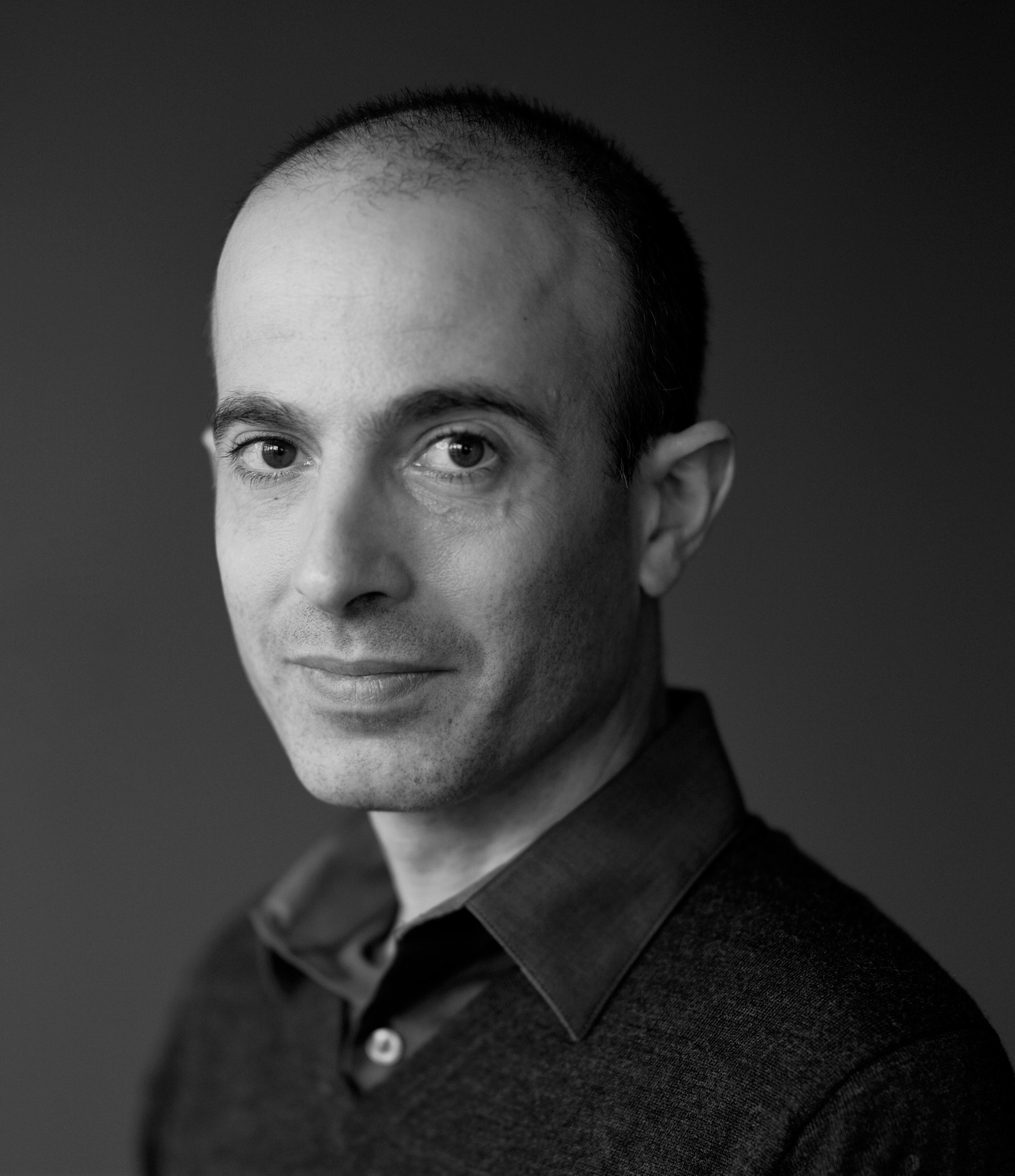
He lives in a house full of books but doesn't have a smartphone. That’s the first thing you notice about Yuval Noah Harari. For a guy who spends most of his waking hours warning us about the digital apocalypse, it’s a pretty on-the-nose lifestyle choice. He’s not just a historian. Honestly, he’s more like a secular prophet who uses the past to scare the absolute hell out of us regarding the future. You’ve probably seen his face on every airport bookstore shelf for the last decade. Sapiens was the big one. Then came Homo Deus. Then 21 Lessons for the 21st Century. And now? He’s tackling the very fabric of how information—and AI—might actually be the thing that ends the human story as we know it.
It's weird.
Most history professors live quiet lives in dusty archives. Harari, however, hangs out with Mark Zuckerberg and gets invited to the World Economic Forum in Davos to tell the global elite that their jobs might be obsolete in thirty years. People love him. People hate him. But nobody is ignoring him.
The Myth-Maker of Jerusalem
Harari didn’t start out as a global celebrity. He was a specialist in medieval military history at the Hebrew University of Jerusalem. Boring stuff for most people, right? He was writing about knights and crusades. But something clicked. He realized that the tiny details of history didn't matter as much as the "big stories" we tell ourselves.
He argues that humans took over the planet not because we’re smarter—an individual Neanderthal was likely just as clever and probably stronger—but because we can cooperate in large numbers. How? By believing in things that don't exist. Concepts like money, nations, and human rights.
Think about it.
A dollar bill is just a piece of paper. It has no intrinsic value. You can’t eat it. You can’t wear it. But because we all agree it’s worth something, we can build civilizations around it. This is what Harari calls "inter-subjective reality." It’s the glue. Without these shared myths, we’re just a bunch of hairless apes screaming at each other in the woods.
Why Sapiens Changed Everything
When Sapiens: A Brief History of Humankind dropped in English in 2014, it was like a grenade. It took a 70,000-year timeline and condensed it into a page-turner. He made big claims. He said the Agricultural Revolution was "history's biggest fraud" because it made the average person's life harder, not easier. We went from wandering around eating 150 different types of plants to breaking our backs in fields to grow wheat.
The wheat domesticated us, he says. Not the other way around.
This kind of counter-intuitive thinking is why he’s a lightning rod. Critics, like the anthropologist Christopher Hallpike, have called his work "infotainment" or argued that he plays fast and loose with archaeological data. But for the general public? It was a revelation. It offered a bird's-eye view of our species that felt both ancient and incredibly modern.
The AI Obsession and Nexus
Fast forward to today. Yuval Noah Harari has moved on from the stone age. He’s obsessed with the silicon age. In his most recent work, Nexus, he pivots from how we tell stories to how we process information. And he’s genuinely terrified.
He doesn't think AI is going to be like the Terminator. It won't be a killer robot with a red eye. Instead, he views AI as a "non-human intelligence" that can create its own myths. If humans rule the world because we control the stories, what happens when an algorithm starts writing the stories better than we do?
He’s worried about the end of democracy.
Democracy is basically a conversation. If an AI can manipulate that conversation by flooding the zone with tailored misinformation, the conversation dies. He points out that dictatorships of the past, like Nazi Germany, were limited by the fact that humans had to process information. Now? Data is everywhere. It’s a "silicon curtain."
He’s not just a doomer for the sake of it, though. He’s trying to wake us up. He talks about how we need "proof of humanity" online. If you're talking to someone on the internet, you should know if they have a pulse or a processor. It sounds simple, but in 2026, the line is getting blurrier by the second.
What Most People Get Wrong About Harari
One of the biggest misconceptions is that he’s a cheerleader for the future. People see him at tech conferences and assume he’s a "transhumanist" who wants us all to become cyborgs.
Actually, he’s terrified of it.
When he talks about Homo Deus—the idea of humans becoming gods through biotechnology—he isn't saying it’s a good thing. He’s saying it’s an inevitable consequence of our current path if we don't change direction. He sees a future where the rich can literally buy eternal life or cognitive upgrades, creating a massive biological gap between the "elites" and a new "useless class" of people who have no economic value because AI does everything better.
"Useless" is a harsh word. It got him a lot of flak. But he isn't saying people don't have worth; he’s saying the current economic system won't have a use for them. That’s a massive distinction. It’s a critique of capitalism, not a dismissal of human life.
The Meditation Factor
You can't understand this guy without knowing he spends two hours every day in silence. He practices Vipassana meditation. No books, no music, no talking. Just watching his breath. He even goes on long retreats for a month or two every year.
He credits this for his ability to see the "big picture." While everyone else is reacting to the latest tweet or news cycle, he’s trying to see the patterns that last for centuries. It’s a weird paradox. The man who writes about the most advanced technology in human history spends his time trying to get away from all technology.
Maybe he's onto something.
The Backlash: Is He Actually a Historian?
Not everyone is a fan. If you go into a history department at a major university, you’ll find plenty of professors who roll their eyes at the mention of Harari.
The main complaints:
- He generalizes way too much.
- He ignores the nuances of specific cultures to fit a broad narrative.
- He’s more of a philosopher than a scientist.
For instance, his take on the "Scientific Revolution" as a "Revolution of Ignorance"—the idea that humans only started making progress once we admitted we didn't know everything—is brilliant but arguably oversimplified. Science didn't just appear out of nowhere in 1500; it was a slow burn.
But Harari doesn't seem to care about being the "most accurate" in the sense of footnotes. He cares about being "useful." He wants to give us a mental map of where we are. Maps are never 100% accurate; they're abstractions. If a map showed every single blade of grass, it would be useless. He’s drawing the highways.
Why He Still Matters in 2026
We are currently living through the things he predicted ten years ago. We’re seeing the rise of "surveillance capitalism." We’re seeing gene editing (CRISPR) move from labs to real-world applications. We’re seeing AI generate art, code, and political propaganda.
Harari matters because he provides a vocabulary for these anxieties. When we feel that "itch" that something is wrong with how much time we spend on our phones, he’s the one explaining that the phone is actually an "attention extraction machine" designed to hack our evolutionary biology.
He’s also one of the few people talking about the "Global South." He warns that while Silicon Valley gets rich off AI, countries that rely on cheap manual labor will be devastated. If a robot can sew a shirt cheaper than a person in Bangladesh, what happens to Bangladesh? These are the questions he forces us to look at.
The Power of "I Don't Know"
One of the most human things about Harari is his willingness to admit when he’s wrong or when he doesn't have an answer. In interviews, he often pauses. He thinks. He doesn't have canned political talking points.
He once said that the most important skill for a child today is "mental flexibility." Not coding. Not learning a specific language. But the ability to reinvent yourself over and over again. Because by the time that child is 40, the world will be unrecognizable.
Actionable Insights: How to Live in Harari's World
If you take his warnings seriously, you can’t just keep living the same way. Here is how to actually apply some of these "Harari-isms" to your life:
Protect Your Attention Your attention is the most valuable resource you have. Algorithms are literally fighting a war to control it. Harari suggests setting hard boundaries. If you can’t do two hours of meditation, try twenty minutes of "no-input" time. No podcasts, no scrolling. Just your own thoughts.
Diversify Your Identity Don't define yourself by your job title. If you are "a software engineer" and AI starts writing code, your identity collapses. Define yourself by your values, your relationships, and your ability to learn. Be a "learner" first.
Question the Narratives Next time you feel a strong emotion about a political issue or a brand, ask: "What story am I believing right now?" Is it a myth that serves you, or a myth that serves someone else? Realizing that money, corporations, and even countries are "fictions" doesn't mean they aren't real—it just means they are tools. Use them; don't let them use you.
Focus on Information Quality In the age of AI, "more" information is actually bad. It’s like food. In the past, we died of starvation. Now we die of obesity. We are currently "informationally obese." Stop consuming the "junk food" of clickbait and short-form outrage. Go for the long-form, the peer-reviewed, and the historically grounded.
Yuval Noah Harari hasn't saved the world yet. He might not. But he’s given us a mirror. And even if we don't like what we see—the "useless" classes, the AI gods, the hacked humans—at least we’re finally looking.
The story isn't over. We’re still the ones writing it. For now.