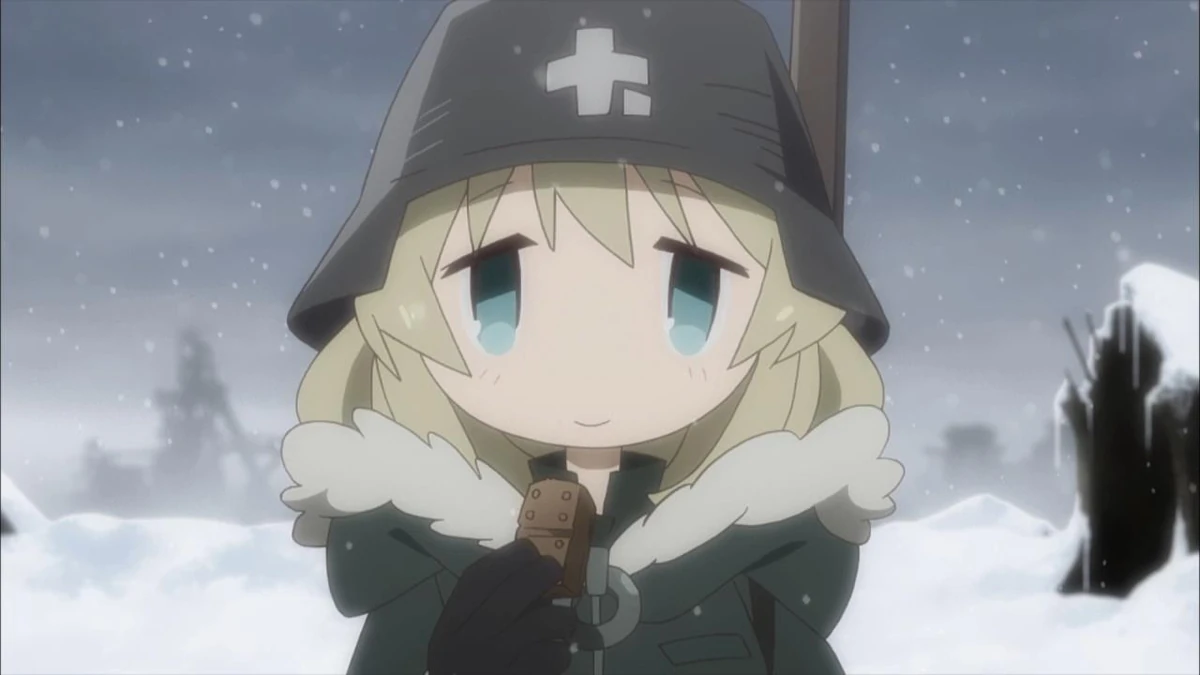
She’s the one holding the gun. Not because she’s violent, but because she’s the muscle of the duo. Yuuri—or Yuu, as Chito calls her—is half of the last heartbeat of humanity in Tsukumizu’s Girls' Last Tour. While the world around them is a multi-layered concrete graveyard of rusted tanks and hollow shells, Yuu is surprisingly... fine.
Most post-apocalyptic stories focus on the "why." Why did the world end? Who pulled the trigger? Yuuri doesn’t care. Honestly, she probably couldn't tell you the difference between a war of resources and a war of religion. To her, a tank is just a bedroom on treads. A library is just a pile of fuel for a fire. This isn't because she’s stupid, though Chito might argue that point. It's because Yuuri represents the ultimate survival mechanism: total acceptance of the present moment.
The Philosophy of "Getting Along With Hopelessness"
You’ve probably seen the memes of the two girls dabbing in front of a desolate wasteland. It looks cute. It’s actually devastating. Yuuri is the engine of that devastation because she refuses to let the weight of a dead civilization crush her spirit.
There's a specific scene where Yuu eats the last piece of a ration bar that Chito was saving. It’s infuriating. Chito is the keeper of history, the one who writes in the diary, the one who understands that "the past" exists. Yuuri lives in a permanent "now." If there is food now, you eat it. If there is a bath now, you take it. If there is a giant hole in the ground, you look into it.
Why Yuu’s Ignorance is a Superpower
Think about it. If you were the last person on Earth and you had Chito’s brain—full of history, literature, and the knowledge of everything we lost—you’d probably lose your mind. Chito suffers. She feels the void. Yuuri? She just feels hungry.
She's basically a Zen master without trying.
- She values experience over preservation.
- She views tools as extensions of her body, not artifacts.
- She prioritizes the physical comfort of her partner over the abstract concept of "progress."
Tsukumizu, the creator, often uses Yuuri to challenge our own obsession with "stuff." We hoard digital photos, books, and memories. Yuuri burns them to stay warm. It’s a brutal, honest take on what it means to actually survive when there is no future.
The Kettenkrad and the Gun
The dynamic between the girls is perfectly balanced by their gear. Chito drives the Kettenkrad (the Sd.Kfz. 2). Yuuri carries the Type 38 rifle. This isn't just a "driver and scout" trope. It’s a commentary on their roles in this dead world.
Chito manages the technology. She maintains the machine that keeps them moving. She is the link to the industrial past. Yuuri, however, is the protector. But what is she protecting? There are no monsters in Girls' Last Tour. There are no marauders or zombies. Yuuri carries a rifle to shoot at fish or perhaps just to feel the weight of something that can change the environment.
One of the most striking moments in the manga involves Yuuri almost shooting a god-like creature simply because she was curious. She doesn't have the "moral" hang-ups we do because those morals were built for a society that no longer exists. She is post-moral. She is pure instinct wrapped in a heavy winter coat.
Learning from the "Bakka"
Everyone calls her an idiot. Chito calls her a "bakka" (idiot) at least once an episode. But is she?
When they encounter Kanazawa, a man who has spent his life mapping the dying city, he loses his maps in a fall. He almost jumps after them. He wants to die because his "meaning" is gone. Yuuri is the one who snaps him out of it. Not with a speech about hope, but by simply existing. She reminds him that as long as he’s alive, he can eat.
It’s dark. It’s incredibly dark. But it’s the only truth left.
The Visual Language of Yuuri’s Design
Look at her eyes. In the anime, produced by White Fox, Yuuri’s eyes are these wide, blank orbs. They don't reflect the complex sorrow you see in Chito’s expressions. They reflect the sky.
The character design by Tsukumizu is intentionally "moe"—it’s soft, round, and cute. This creates a cognitive dissonance. You see these "blobs" (as fans affectionately call them) navigating a world designed by brutalist architects. The contrast makes Yuuri’s occasional moments of profound insight hit ten times harder.
When Yuu says, "The world is ending, but it’s not all bad," she isn't being optimistic. She’s being literal. There is music in the rain hitting empty cans. There is beauty in the way the light hits the frosted glass of a broken skyscraper. Because she doesn't know what these things used to be, she can see them for what they are.
Misconceptions About Yuuri’s Character
People often think Yuuri is just "the comic relief." That’s a mistake. If Chito is the soul of the story, Yuuri is the body. Without Yuuri, Chito would have withered away in a corner of the lower levels, paralyzed by the enormity of their loneliness.
Yuuri provides:
- Physical Momentum: She pushes them forward when Chito wants to stop.
- Emotional Buffer: She absorbs the dread of their situation and turns it into a joke or a snack.
- Perspective: She reminds the viewer that "meaning" is a human invention.
There is a theory among some readers that Yuuri represents the "new human." A creature that has finally evolved past the need for the baggage of the 20th and 21st centuries. She doesn't need a flag. She doesn't need a god. She needs Chito.
The Final Climb
Without spoiling the absolute end of the manga (which differs slightly in tone from the anime’s stopping point), Yuuri’s role becomes even more pivotal. As the world gets colder and the air gets thinner, her simplicity becomes their only fuel.
She isn't looking for a "New World" or a "Secret Base." She is just looking for the top. Why? Because it’s there. That’s it. That is the entirety of her drive. It’s the most human thing about her. We climb because we can. We survive because we don't know how to stop.
How to Apply Yuuri’s Logic to Your Own Life
You don't have to live in a concrete wasteland to use Yuuri’s "Getting Along With Hopelessness" philosophy. We live in a world that feels like it's constantly on the brink of something terrible. Information overload is real.
Sometimes, you have to be Yuuri.
- Focus on the immediate: When things feel overwhelming, look at what’s right in front of you. Do you have food? Are you warm? Is there someone with you?
- Let go of the "Why": Not everything needs an explanation. Sometimes the "why" just makes you miserable.
- Value the person over the thing: In the end, Yuuri doesn't care about the books. She cares about Chito.
If you want to really understand the depth of this character, watch the "Rain Song" sequence in episode 5. It’s the perfect distillation of her character. She turns a random, annoying weather event into a rhythmic masterpiece. She finds the song in the scrap metal.
To truly appreciate Girls' Last Tour, you have to stop pitying the girls. They don't want your pity. Yuuri definitely doesn't. She’s having a decent time, all things considered. She has a friend, a full stomach (usually), and a view that most of us would pay a fortune for.
Next Steps for Fans and Newcomers:
Start by reading the original manga by Tsukumizu. While the anime is a masterpiece of atmosphere and sound design, the manga's rough, sketchy art style captures Yuuri’s internal world much better. It feels more fragile, like a memory that’s fading as you look at it. After that, look into the concept of mono no aware—the pathos of things. It’s the Japanese aesthetic that defines Yuuri’s entire existence: a bittersweet realization that everything is temporary, and that’s exactly what makes it beautiful.
Finally, go outside and look at something man-made that’s starting to crumble. A cracked sidewalk with a weed growing through it, or a rusted fence. Try to look at it without thinking about who built it or how it broke. Just look at the colors. That’s how Yuuri sees the world. It’s a lot quieter that way.



