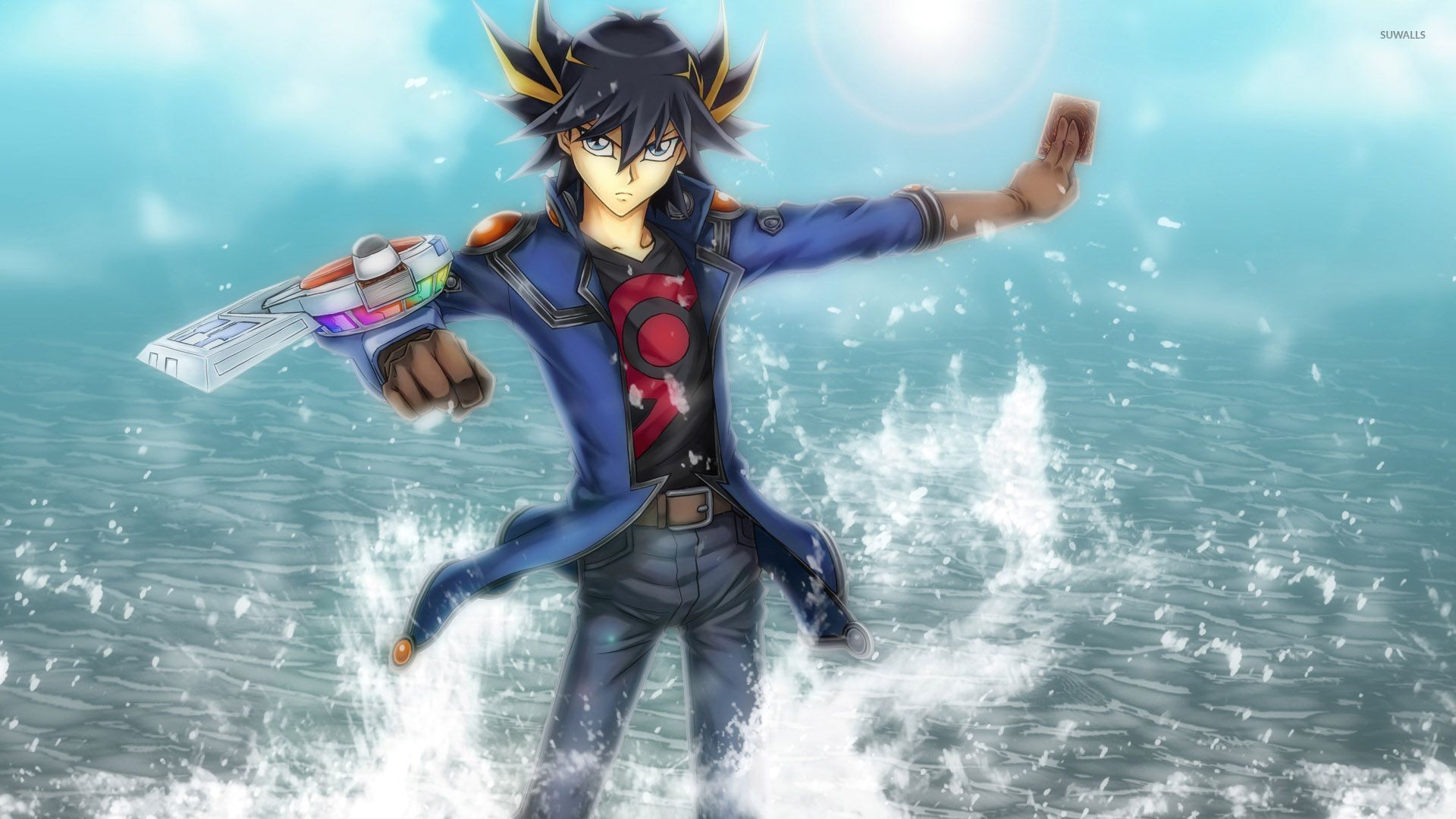
He didn't have a billionaire's trust fund like Seto Kaiba. He wasn't some ancient Pharaoh reincarnated into a high schooler's body with a penchant for leather straps and hair gel. Yusei Fudo was just a kid from the scraps. If you grew up watching Yu-Gi-Oh! 5D’s, you remember that first time he revved up his Duel Runner. It felt different. Darker. Grittier.
Honestly, the transition from GX to 5D’s was a massive tonal whiplash for the franchise. We went from a colorful dueling academy on a tropical island to a dystopian class struggle where the protagonist literally had a criminal mark on his face. Yu-Gi-Oh! Yusei stories aren't just about card games; they're about engineering, social inequality, and the weirdly specific physics of playing a trading card game at 120 miles per hour.
The Satellite Struggle and Why It Matters
Yusei’s origin story is basically a masterclass in building an underdog. He lives in Satellite, a literal trash heap for Neo Domino City. While the elite play with pristine cards, Yusei builds his deck out of discarded junk. Literally. His "Junk" archetype isn't just a cool name—it’s a reflection of his environment.
The social commentary in those early episodes was surprisingly heavy for a "kids' show." You have this stark divide between the haves and the have-nots. Yusei represents the idea that your "worth" isn't determined by where you're born or how much your deck costs. He’s a mechanical genius. He built his own Duel Runner, the Yusei Go, from spare parts he found in the gutter. That’s a level of agency we hadn't really seen in the franchise before. Yugi relied on the Puzzle; Jaden relied on his gut; Yusei relied on his wrench.
The Mechanics of a Legend: Stardust Dragon and Beyond
Let’s talk about the cards because, let’s be real, that’s why we’re here. Yusei introduced the world to Synchro Summoning. Before 2008, the game was slower. You Tribute Summoned, you Fused, maybe you Special Summoned a Cyber Dragon if you were feeling spicy. Then came the "Green Cards."
Stardust Dragon is arguably one of the most balanced and iconic "boss monsters" ever printed. It didn't just have high attack points. It had a selfless effect: it sacrificed itself to protect other cards. This fits Yusei’s personality perfectly. He’s the ultimate teammate. Unlike the selfish power-fantasy of many anime protagonists, Yusei’s deck revolves around "low-level" monsters coming together to form something greater.
Think about Tuningware, Quillbolt Hedgehog, and Speed Warrior. Individually? They’re trash. Together? They’re a level 8 Synchro play that wins the game. This philosophy of "the bonds between friends" is a tired trope in anime, sure, but 5D’s actually baked it into the game mechanics. Synchro Summoning is the literal embodiment of two or more entities combining their levels to reach a higher state.
That Weird Period Where Everyone Was a Cultist
The Dark Signer arc is frequently cited by fans as the peak of the entire Yu-Gi-Oh! multiverse. It was bleak. We’re talking about antagonists who were literally zombies of people who had died in tragic accidents. Yusei had to face his best friend, Kalin Kessler, who blamed Yusei for his death and imprisonment.
This is where the Yu-Gi-Oh! Yusei character arc gets some real meat. He carries an immense amount of guilt. He blames himself for the Zero Reverse—the disaster that destroyed the city and killed his parents. Seeing a protagonist deal with actual PTSD and survivor's guilt made him feel like a real person. He wasn't just "The King of Games." He was a guy trying to fix a broken world he felt responsible for breaking.
The duels during this era were high-stakes, too. Losing didn't just mean your life points hit zero; it meant your soul was being fed to an Earthbound Immortal. The sheer scale of the monsters, like Wiraqocha Rasca or Ccapac Apu, made Yusei's scrappy Synchro plays feel like true David vs. Goliath battles.
Accel Synchro and the Limit Over Accel
If you haven't seen the Japanese version of the show (subbed), you're missing out on the "Clear Mind" soundtrack. It’s iconic. By the time we get to the World Racing Grand Prix (WRGP), Yusei isn't just Synchro Summoning. He’s reaching for "Accel Synchro."
This involved Synchro Summoning using two Synchro Monsters during the opponent's turn. It was a revolutionary concept in the real-world TCG. It taught players about "Quick Effects" and "Chain Links" in a way that felt intuitive. Shooting Star Dragon was the result, a monster that could attack multiple times based on the number of Tuners in the top five cards of your deck. It was high-risk, high-reward, and peak entertainment.
Then came the finale against Z-one. The Shooting Quasar Dragon moment. Yusei literally flew into space. He combined five Synchro Dragons into one ultimate lifeform. It sounds ridiculous when you type it out, but in the moment, it felt earned. It was the culmination of three years of storytelling about human potential and the "Momentary" energy that powers their world.
What Most People Get Wrong About Yusei
People call him "Mary Sue" or "Gary Stu" sometimes because he rarely loses. It’s true, Yusei’s win-loss record is incredible. But a "loss" in 5D’s isn't always about the life points. Yusei loses his confidence. He loses his friends. He loses his sense of purpose.
His stoicism is often mistaken for a lack of personality. I’d argue it's the opposite. He’s the "cool-headed" leader because he has to be. If he breaks, the whole team (Team 5D’s) falls apart. He’s the glue. When you look at his interactions with Akiza (Aki in Japan), you see a much softer side. He was the first person to look at her not as a monster or a "Black Rose Witch," but as a person. That empathy is his real superpower, not his ability to top-deck a Junk Synchron.
The Real-World Legacy of the 5D's Era
The impact of Yu-Gi-Oh! Yusei on the competitive card game cannot be overstated. Before his era, the "Extra Deck" (then called the Fusion Deck) was mostly just a place to keep your Thousand-Eyes Restrict or Elemental HEROes. Yusei made the Extra Deck the centerpiece of every single strategy.
- The Speed of the Game: Synchro Summoning accelerated the game. It allowed for "one-card combos."
- Generic Boss Monsters: Cards like Brionac, Dragon of the Ice Barrier and Goyo Guardian (which Yusei famously faced) became staples in every deck, regardless of the archetype.
- The Tuner Sub-type: This added a whole new layer to deck building. You couldn't just throw "good cards" together; you needed the right mathematical ratios.
Even in 2026, you’ll see "Synchro Turbo" decks in Master Duel or the TCG that owe their entire existence to the foundations laid down during the 5D's run. People still play Stardust Dragon variants because the protection effect is just that timeless.
How to Channel Your Inner Yusei Today
If you're looking to dive back into the world of Yusei Fudo, you don't need a motorcycle or a criminal record.
- Build a "Junk" Deck in Master Duel: It’s surprisingly viable in lower ranks and incredibly fun to pilot. The combos are non-linear and require a lot of "big brain" math.
- Watch the Subbed Version: No disrespect to the 4Kids dub, but the original Japanese score and the uncut Dark Signer deaths hit way harder.
- Look into the Manga: The 5D’s manga is a completely different story. Yusei has different cards (like Stardust Spark Dragon) and a different backstory. It’s a fresh take for anyone who thinks they know everything about the character.
Yusei Fudo remains the most "adult" protagonist in the franchise. He didn't want to be the best; he wanted to protect his home. He didn't play for glory; he played for survival. That’s why, decades later, when we hear that engine rev, we still get chills. He taught a generation that even if you're starting with "junk," you can still build something that reaches the stars.
Essential Steps for Modern Synchro Duelists
To effectively play a Yusei-inspired deck in the current format, focus on maximizing your "Tuning" searchers and "Synchron" tuners. Junk Speeder is your most important card—if its effect resolves, you basically win. However, it's a "hand trap" magnet. Always carry "Called by the Grave" or "Crossout Designator" to protect your Speeder from an Ash Blossom.
Lastly, understand the math of your Extra Deck. You need a ladder. Start with level 2 and 3 non-tuners, hit your level 5 Junk Speeder, and use its effect to summon a variety of tuners (levels 1 through 4) to branch out into your level 8, 10, and 12 boss monsters. It takes practice, but once you master the "Synchro Climb," you'll understand why Yusei was the undisputed king of the tracks.



