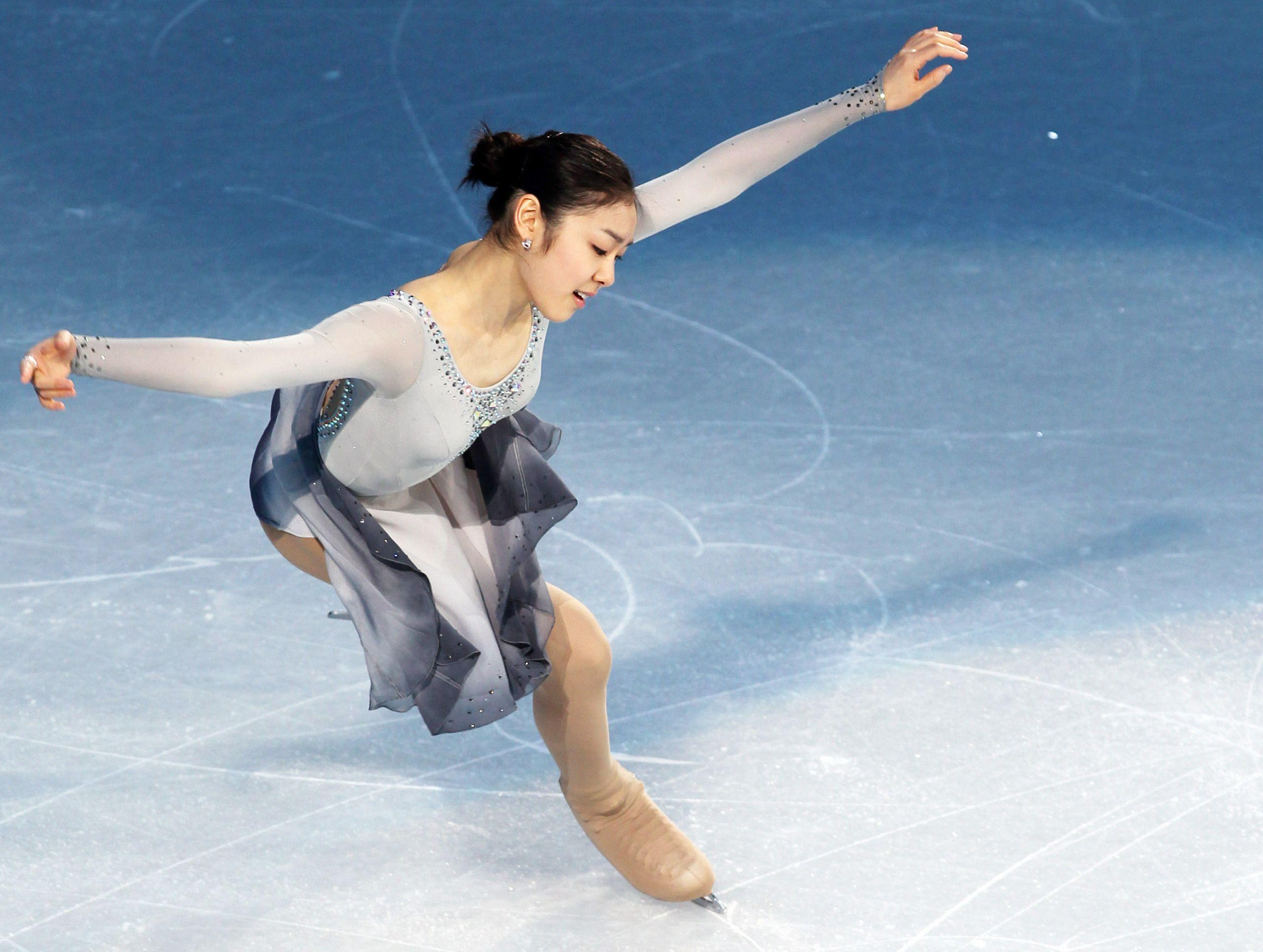
Honestly, if you ask any skating purist who the greatest of all time is, the name Yuna Kim usually drops within the first five seconds. It's not just about the medals, though the gold and silver are heavy enough to prove the point. It’s about how she changed the physics of the sport.
People call her "Queen Yuna" for a reason.
In South Korea, she’s basically a living legend. But globally? She is the benchmark. Most skaters today are still trying to figure out how she landed jumps that looked like they were filmed in slow motion while she was actually flying across the ice at 20 miles per hour.
The Textbook Jump That Nobody Can Copy
You’ve probably seen a triple Lutz-triple toe loop combination before. It’s a staple. But Yuna Kim’s version? It was a mathematical anomaly. Most skaters slow down to prepare for a big jump. They "telegraph" it. Yuna did the opposite. She actually gained speed.
Expert analysts like Scott Hamilton have pointed out that her edge quality was more like a calligrapher than an athlete. She didn't just "hit" the ice; she carved it.
The most ridiculous part of her technical arsenal was the "Yuna Camel." It’s a bent-leg layover camel spin that requires core strength most of us can’t even imagine. While other skaters were struggling to keep their balance, she was making artistic choices in the middle of a high-speed rotation.
That 2010 Vancouver Performance (The One Everyone Remembers)
If you haven’t watched her 2010 Olympic free skate to George Gershwin’s "Concerto in F," go do it. Now.
She scored 150.06 points for that long program. At the time, that was a world record that felt like it was set in another galaxy. Her total score of 228.56 stayed the highest for years. It was the first time a woman had ever broken the 200, 210, and 220-point marks.
She didn't just win; she humiliated the competition by over 20 points.
What’s wild is that Yuna never finished off the podium in her entire career. Ever. From her junior debut in 2004 to her final skate in Sochi in 2014, she was always in the top three. In a sport where a single caught edge or a shaky landing can ruin a season, that kind of consistency is borderline supernatural.
What Really Happened in Sochi?
Let’s talk about the 2014 Sochi Olympics because people are still salty about it. Even now, over a decade later, the controversy hasn't fully cooled down.
Yuna skated a clean, elegant program. Adelina Sotnikova of Russia won the gold.
The math technically favored Sotnikova because of a higher "base value"—she did seven triples to Yuna’s six. But the "Grade of Execution" (GOE) and the "Program Component Scores" (the artistry marks) were where the world lost its mind.
- The Scoring Gap: Sotnikova won by 5.48 points.
- The Judges: One of the judges was married to the head of the Russian Skating Federation. Another had previously been suspended for score-fixing.
- The Reaction: Over 1.7 million people signed a petition on Change.org to investigate the results.
Yuna’s reaction? "The score is given by the judges. I’m not in the position to comment." Total class act. While the world was screaming, she was already looking toward retirement.
Life After the Rink: The PyeongChang Legacy
Retirement for Yuna didn't mean disappearing. She was the face of the 2018 PyeongChang Winter Olympics bid. When she delivered that presentation to the IOC in Durban back in 2011, she wasn't just a skater; she was a diplomat.
She basically willed those Games into existence for South Korea.
And then there was the Opening Ceremony. Seeing her at the top of the stadium, lighting the Olympic cauldron on a tiny patch of ice, was the ultimate "full circle" moment. She’s also been a massive philanthropist, working as a UNICEF Goodwill Ambassador and donating millions to disaster relief and youth sports.
Why We Are Still Talking About Her
You might think that with the era of quadruple jumps in women’s skating, Yuna’s triple-triples would feel "old school." Kinda. But actually, no.
The sport has shifted toward "rotation over quality." Many modern skaters have higher technical ceilings, but they lack the flow and the deep edges that Yuna mastered. She proved that you don’t need to do four rotations in the air if your three rotations are executed with absolute perfection.
She is the only female skater to complete the "Super Grand Slam." This means she won:
- Junior Grand Prix Final
- Junior World Championships
- Four Continents Championships
- Grand Prix Final
- World Championships
- The Olympic Gold
It’s the rarest collection of hardware in the sport.
How to Watch Skating Like an Expert (The Yuna Method)
If you want to understand why she was so good, don't look at the jumps. Look at the feet.
Next time you watch a highlight reel of Yuna Kim figure skater footage, watch her speed after she lands. Most skaters lose momentum on the landing. Yuna actually seemed to accelerate out of her jumps. It’s a technique called "flow-out," and she was the queen of it.
If you’re a new fan of the sport, start by watching her "James Bond Medley" from 2010. It’s the perfect blend of high-stakes athleticism and pure theater.
Practical Steps to Appreciate Figure Skating History:
- Study the ISU Judging System (IJS): Look at the difference between "Base Value" and "Grade of Execution." This explains why Yuna could beat skaters who attempted "harder" tricks.
- Watch the "Danse Macabre" (2009): This short program is widely considered one of the most intense and technically perfect routines ever performed.
- Follow Current International Skating: Compare the landing positions of today's top skaters to Yuna's. You’ll notice her back was always straighter, her leg extension higher, and her landings quieter.
Yuna Kim didn't just win medals; she created a blueprint for what figure skating is supposed to look like when it's done right. Whether it's 2010 or 2026, her impact on the ice isn't going anywhere.