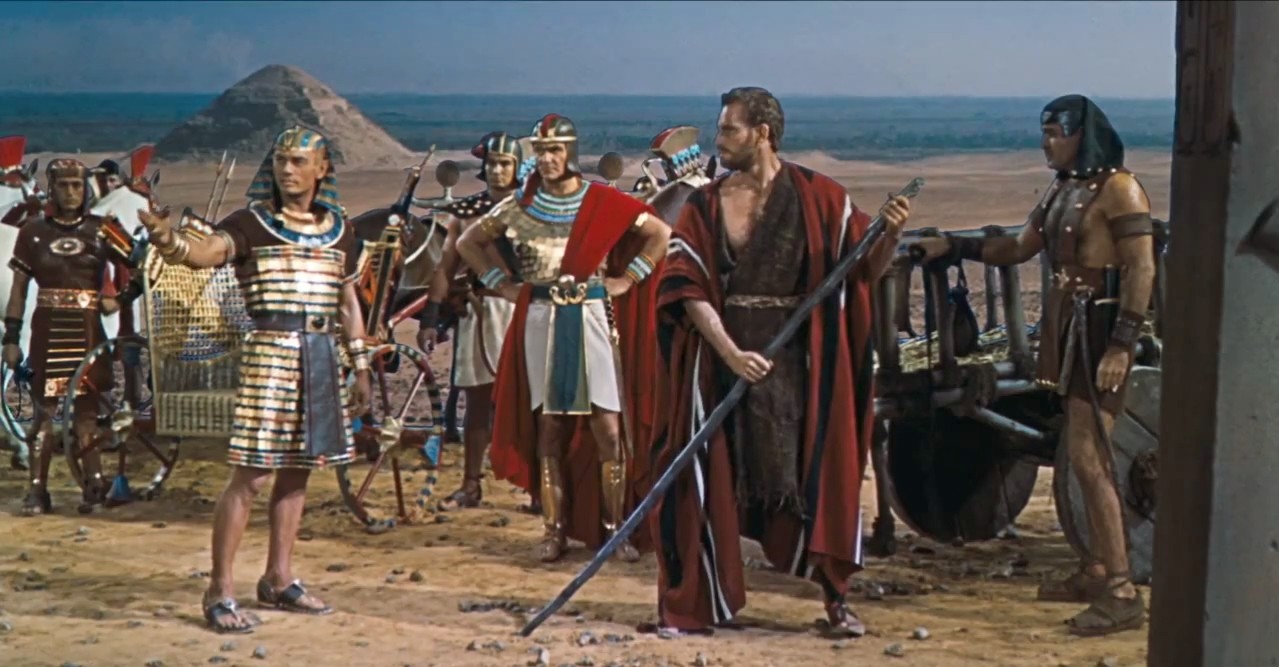
If you turn on the TV around Easter or Passover, you’re almost guaranteed to run into the 1956 epic The Ten Commandments. It is massive. It is loud. It is four hours of Cecil B. DeMille’s technicolor fever dream. But while Charlton Heston’s Moses is the guy on the poster with the stone tablets, it’s really Yul Brynner who keeps your eyes glued to the screen. Honestly, his Rameses II is one of the most charismatic villains in cinema history.
Most people remember the shaved head and the booming voice. Yet, the story of how Brynner actually got into that role—and the sheer physical effort he put into it—is kinda wild. He wasn’t just an actor playing a king; he was a man obsessed with not being "the little guy" next to Charlton Heston.
The Intense Prep for Yul Brynner in The Ten Commandments
Brynner was already a star on Broadway for The King and I when DeMille came calling. He actually had to fly back and forth to keep up with his stage commitments. But when he saw the script for The Ten Commandments, he noticed something. He’d be spending a lot of time shirtless.
And he’d be standing next to Charlton Heston.
Heston was a big guy. Broad-shouldered, tall, and basically built like a statue. Brynner was no slouch, but he was shorter. He reportedly became obsessed with the idea that Rameses shouldn't look physically inferior to Moses. If Moses had the power of God, Rameses needed the power of the gym.
He started a brutal weightlifting regimen. He didn't just want to be fit; he wanted to look like an Egyptian god carved out of granite. You can see it in those scenes where he’s wearing nothing but a loincloth and fifty pounds of gold jewelry. The man is ripped. It’s a physical presence that feels modern even now. He brought a sort of "alpha" energy to the set that made the rivalry between the two leads feel dangerously real.
Why the Shaved Head Mattered
It sounds funny to talk about a haircut as a career move, but for Brynner, it was everything. He had originally shaved his head for the stage version of The King and I in 1951. Before that, he actually had a full head of hair. But DeMille loved the look. He felt it gave Rameses an "exotic" and timeless authority.
Brynner kept it for the rest of his life. It became his brand. In the 1950s, leading men were supposed to have thick, oily pompadours. Brynner went the opposite way and became a sex symbol because of it.
The Complicated Dynamic With Cecil B. DeMille
DeMille was a dictator on set. He was old-school, demanding, and didn’t care about your feelings. But he respected Brynner. Why? Because Brynner was a pro.
There’s a famous story about the filming of the chariot scenes. These weren't CGI. They were real horses, real chariots, and real danger. Brynner insisted on doing much of his own driving. He wanted that "laser-guided" focus to show on his face. He didn't just stand there; he inhabited the arrogance of a man who truly believed he was a living god.
Interestingly, Brynner’s background was a bit of a mystery at the time. He used to tell people he was part-Japanese, or born on a remote island. In reality, he was born in Vladivostok, Russia. That "racially ambiguous" look was perfect for DeMille’s Egypt. It allowed the audience to see him as something "other"—a powerful, foreign monarch who was the perfect foil to Heston’s more "American-style" hero.
Making the Villain Likable (Sorta)
What really makes the performance work is the nuance. Rameses isn't just a mustache-twirling bad guy. He’s a son trying to live up to his father, Sethi. He’s a husband dealing with a wife (Nefretiri) who is openly in love with his worst enemy.
You almost feel for the guy. Almost.
Brynner plays Rameses with a specific kind of "Shakespearean" weight. While other actors in the film are sometimes a bit campy or overly dramatic, Brynner is cold. He’s precise. When he delivers the famous line, "So let it be written, so let it be done," it doesn't sound like a movie line. It sounds like a law of nature.
The Gear and the "Drip"
We have to talk about the costumes. The wardrobe department went all out for Rameses. His battle armor, featuring the twin brass falcons, is a masterpiece of 1950s costume design.
- The Falcon Armor: Designed to be assembled quickly on camera to show his status.
- The Silk Capes: Used to emphasize his movement and make him seem larger than life.
- The Jewelry: He wore massive amounts of actual weight in gold-plated accessories, which helped him maintain that stiff, royal posture.
The Legacy of Rameses
Even though the movie is 70 years old, Brynner’s performance is the one that sticks. He won the National Board of Review Award for Best Actor in 1956, partially for this role and partially for Anastasia and The King and I. It was the year of Yul.
If you’re a filmmaker today, you look at this performance to see how to hold the screen without saying a word. It’s all in the eyes. It's in the way he stands. He proved that a villain could be the most interesting person in the room.
If you want to dive deeper into the world of 1950s epics, the best way is to watch the 4K restoration of the film. You can actually see the sweat on his brow during the Red Sea sequence. It makes the "legend" feel a lot more human. Alternatively, look up the behind-the-scenes photography by Arnold Friberg, who did the original costume sketches. You’ll see just how much of Brynner’s own physicality inspired the final look of the character.
Actionable Insight: Next time you watch the film, ignore Moses for a second. Watch Rameses’ reactions in the background of the court scenes. Brynner is almost always "acting" even when he isn't speaking, using his posture to signal his shifting power over the other characters. It's a masterclass in non-verbal storytelling.



