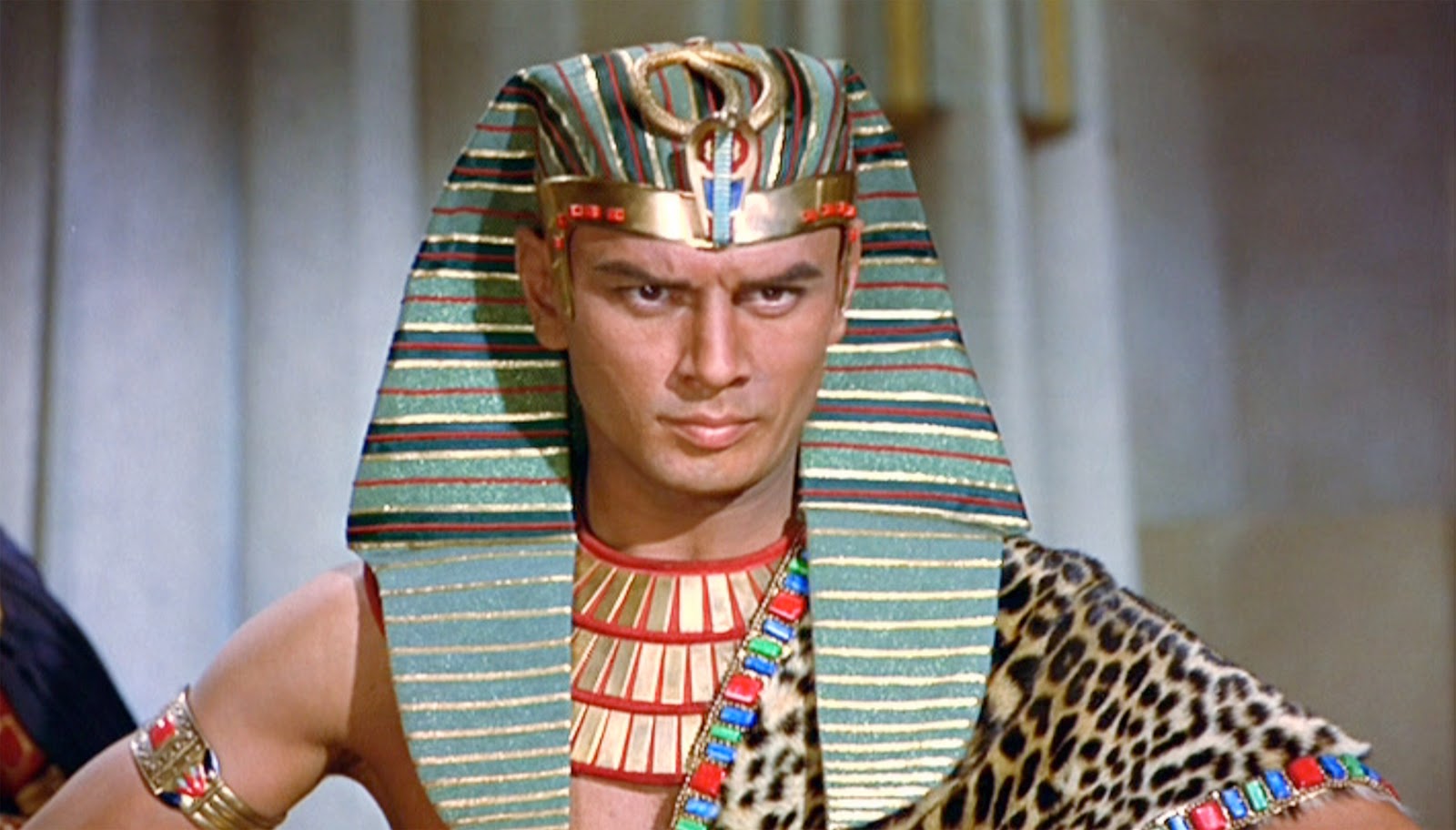
You know that feeling when a villain walks on screen and suddenly the hero seems... well, a bit boring? That’s basically the Yul Brynner effect. When we talk about Yul Brynner in The Ten Commandments, we’re talking about a performance so massive it practically threatened to pull the pyramids right off the screen.
Charlton Heston had the staff and the booming "voice of God" thing going for him, sure. But Brynner? He had the presence. He didn't just play Rameses II; he owned the very air the Pharaoh breathed.
Honestly, most people watch Cecil B. DeMille’s 1956 epic for the parting of the Red Sea. It’s the big "water" moment everyone remembers. But if you're looking for the heart of the movie, it’s in that weirdly intense, almost magnetic rivalry between the two princes. Brynner brought a jagged, modern edge to a story that's thousands of years old. It worked. It worked so well that even now, 70 years later, his performance is the gold standard for cinematic royalty.
The Secret Battle of the Biceps
Here’s a bit of trivia you might not know: Yul Brynner was actually terrified of being physically overshadowed by Charlton Heston. Heston was a tall, broad-shouldered guy—basically built like a statue.
When Brynner found out he’d be spending a huge chunk of the movie shirtless (or wearing those incredibly skimpy Egyptian kilts), he didn't just sit around. He hit the weights. Hard. He started a rigorous bodybuilding program specifically so he wouldn't look small next to Heston's Moses.
If you look closely at his physique in the film, he’s absolutely ripped. That wasn't just for vanity; it was tactical. He wanted Rameses to look like a man who could actually crush a rebellion with his bare hands. That physicality changed how he moved. He didn't just walk; he strutted with the grace of a jungle cat and the arrogance of a god.
"His God is God. But my God is Pharaoh."
That line works because Brynner looks like he believes it. He isn't playing a "bad guy" in his own head. He's playing a man who truly believes the universe revolves around his throne.
The Voice That Cut Through Stone
If you close your eyes and think of Yul Brynner in The Ten Commandments, you probably hear that voice first. It’s clipped. It’s metallic. It has this strange, unplaceable accent that sounds both ancient and sophisticated.
Brynner was born in Vladivostok, Russia (though he liked to tell tall tales about being part Mongolian or born in a tent). That complex background gave him a vocal quality that Hollywood had never heard before. In a movie where everyone else is doing "theatrical Shakespearean," Brynner sounds like a laser-guided missile.
When he says, "So let it be written, so let it be done," it isn't just a line. It's a command that feels like it’s being etched into the very obelisks of Egypt.
Why the Costumes Mattered
The wardrobe department basically went to war for this movie.
- The Crown: The red and white "Double Crown" (the Pschent) symbolized the unity of Upper and Lower Egypt.
- The Jewelry: Heavy gold armlets and necklaces weren't just props; they were heavy. Brynner had to maintain that stoic, "I’m a god" posture while carrying pounds of metal on his neck.
- The Drip: Seriously, Rameses had more costume changes than a pop star. From battle armor to sheer royal robes, the clothes were designed to highlight Brynner’s intense tan and chiseled frame.
More Than Just a Villain
There’s a nuance to Rameses that often gets missed. He’s a man fueled by massive, crushing insecurity. He spent his whole life trying to earn the approval of his father, Seti I, only to watch his father clearly prefer the "foundling" Moses.
Brynner plays that jealousy with a quiet, simmering heat. You see it in his eyes when he looks at Nefretiri (played by Anne Baxter). He knows she loves Moses. He knows the people love Moses. He’s the king, but he’s the king of a heart that doesn't want him.
That makes Rameses human. Tragic, even. By the time the plagues hit and his son is taken, Brynner moves from a "dictator" to a grieving father in a way that’s actually pretty heartbreaking. It’s one of the few times in the three-and-a-half-hour runtime where the "epicness" drops away and you see a real person.
The 1956 Power Streak
1956 wasn't just a good year for Brynner; it was the year he conquered Hollywood. Think about this:
- The King and I: He won the Oscar for this.
- The Ten Commandments: The biggest movie of the decade.
- Anastasia: Another massive hit.
He played a Siamese King, an Egyptian Pharaoh, and a Russian General all in the same twelve months. Talk about range. But Rameses remains the most visually iconic of the bunch. That shaved head—which he first did for The King and I—became his trademark right here in the desert sands of Egypt.
How to Watch it Today
If you’re going to revisit Yul Brynner in The Ten Commandments, don't just put it on in the background while you fold laundry. It’s too big for that.
- Look for the 4K restoration. The colors of the Egyptian court are insane—the turquoises, the deep reds, the gold leaf.
- Watch the eyes. In the scenes where Rameses and Moses are debating, Brynner does incredible work with just his gaze. He never blinks. He stares Heston down like he's trying to set him on fire.
- Notice the blocking. DeMille was a master of the "tableau." Every scene with Brynner is composed like a classical painting.
The Takeaway
The real magic of Brynner's Rameses is that he never feels like a caricature. He’s powerful, he’s petty, he’s grieving, and he’s incredibly arrogant. He's the perfect foil because he makes the stakes feel real. Without a Rameses this strong, Moses is just a guy talking to a bush. With Brynner, the Exodus is a clash of titans.
Next time it's on TV—usually around Easter or Passover—ignore the special effects for a second. Ignore the 15,000 extras. Just watch the way Yul Brynner stands. That’s how you play a King.
If you want to dive deeper into 50s cinema, check out Brynner's work in The Magnificent Seven right after this. You’ll see the same "alpha" energy, just traded in the chariot for a horse and the crown for a black Stetson.
Actionable Insight: To truly appreciate Brynner's impact, watch the scene where he banishes Moses to the desert. Notice how he uses the whip—it's not just a prop, it's an extension of his arm. He studied the movement of dancers to make sure his "threats" looked elegant. That's the level of craft that keeps a performance alive for seven decades.



