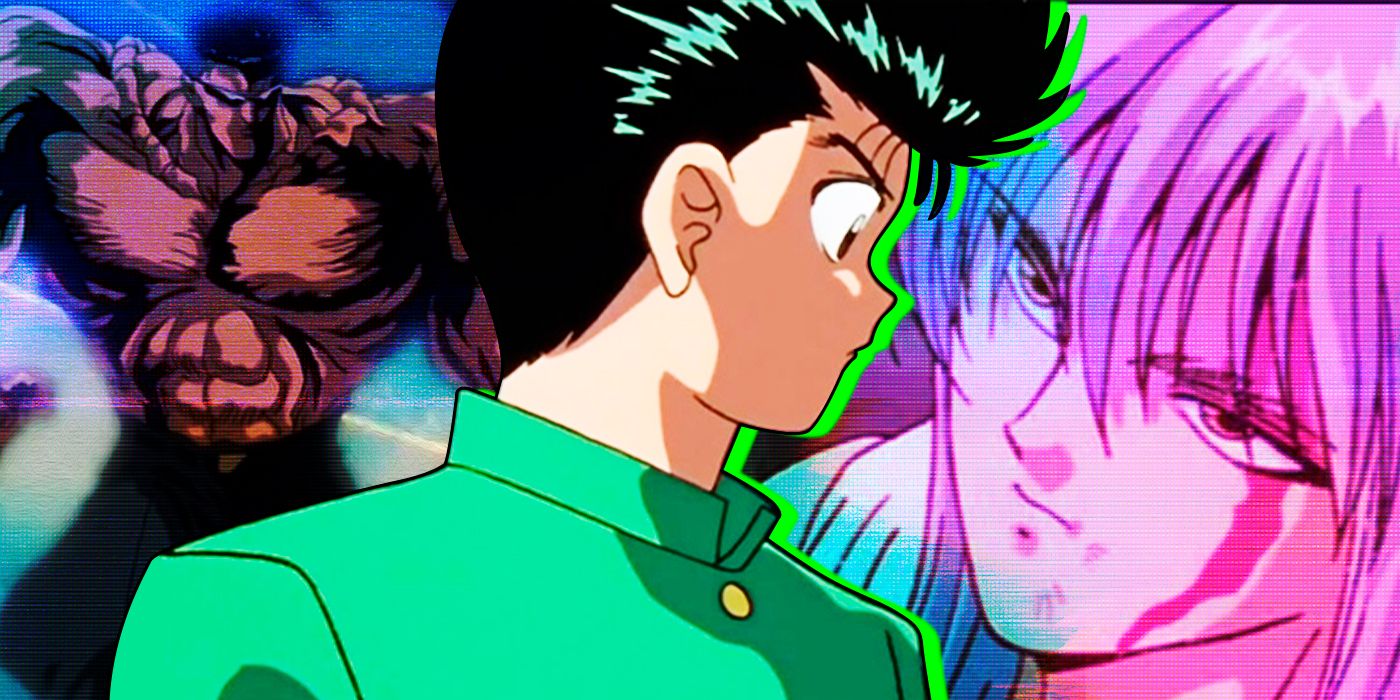
You remember that opening riff? The one that sounds like 90s nostalgia personified? Most people who grew up during the Toonami era can’t hear a saxophone without thinking of Yusuke Urameshi leaning against a brick wall. It’s been decades since the Yu Yu Hakusho anime episodes first aired in Japan, but the show refuses to die. It’s weird. Most shonen anime from that period—outside of Dragon Ball—feel like museum pieces. They’re slow, the animation is shaky, and the filler is unbearable.
But Yu Yu Hakusho is different. Don't forget to check out our previous coverage on this related article.
Honestly, it’s probably because Yoshihiro Togashi is a bit of a madman. Before he was breaking hearts with Hunter x Hunter, he was busy subverting every trope in the book with a teenage delinquent who dies in the first five minutes of the show. If you’re looking to revisit the series or you're diving in for the first time because of the live-action buzz, you’ve got 112 episodes to get through. That sounds like a lot. It’s not, though. Not when you realize there are basically zero filler arcs.
The Spirit Detective Saga is Faster Than You Remember
Most modern fans are used to the "seasonal" pace where things move at light speed. Old school anime? Not so much. Yet, the early Yu Yu Hakusho anime episodes move with a strange, frantic energy. We start with Yusuke’s death, move through his resurrection, and hit the ground running with the Spirit Detective cases. If you want more about the history here, The Hollywood Reporter offers an informative summary.
The pacing is lean. You’ve got the introduction of Hiei and Kurama—two of the coolest "villains turned allies" in the history of the medium—within the first dozen episodes. It doesn't drag. Usually, you’d expect a "monster of the week" format to last for fifty episodes. Togashi didn't have time for that. He wanted to get to the tournament.
Interestingly, the show’s director, Noriyuki Abe, kept the tone surprisingly grounded early on. While the manga had a bit more of a "ghost-of-the-week" procedural feel, the anime leans into the urban fantasy vibe. The grit of the 90s aesthetic—the oversized green school jackets, the dim streetlights, the cigarette smoke—it creates an atmosphere that feels more "Seinen" than "Shonen" at times.
Why the Dark Tournament Defines the Genre
If you ask any fan about their favorite Yu Yu Hakusho anime episodes, they are going to point to the Dark Tournament. Period. It covers episodes 26 through 66. That’s nearly half the show.
Why does it work?
Tournaments are a dime a dozen in anime. Naruto had the Chunin Exams. Dragon Ball had the World Martial Arts Tournament. But the Dark Tournament feels like a death march. There is a tangible sense of dread that starts from the moment the Team Urameshi boards that boat.
The stakes aren't just "winning a trophy." It’s survival.
Take the fight between Kurama and Karasu. It’s brutal. It’s tactical. It’s horrifying. It moves away from "who has the bigger energy blast" and into "who can outsmart the other person while their blood is literally boiling." This arc also gave us Toguro. Younger Toguro is arguably one of the best-written antagonists in anime history. He isn't some world-ending god. He’s a man who made a terrible choice and is looking for someone strong enough to punish him for it.
The Chapter Black Pivot
After the high of the Dark Tournament, most shows would have fizzled out. Instead, the Yu Yu Hakusho anime episodes took a hard left turn into psychological horror. This is where Shinobu Sensui comes in.
Sensui is the anti-Yusuke. He was the Spirit Detective before Yusuke, a kid with a black-and-white view of morality who snapped when he saw the "Black Chapter"—a tape documenting the absolute worst atrocities committed by humanity.
It’s dark. Like, really dark.
The Seven Psychics arc introduces "Territories," which are basically the precursor to "Nen" abilities in Hunter x Hunter or "Domains" in Jujutsu Kaisen. Suddenly, the fights aren't about punching hard. They’re about rules. You can’t say the word "hot." You have to win a video game. You have to keep your feet on the ground. It was revolutionary for its time. It forced Yusuke—a guy whose only strategy is "Spirit Gun to the face"—to actually think.
The Three Kings and the Rushed Finish
We have to be honest here. The final stretch of Yu Yu Hakusho anime episodes (the Three Kings Saga) is a bit of a mess.
Togashi was burnt out. He was sick, his back was failing him, and he just wanted to be done. You can see it in the writing. The buildup to the war in the Demon Plane is massive. You have three ancient powers—Raizen, Mukuro, and Yomi—on the brink of destroying everything. And then... Yusuke suggests a tournament.
Again.
While some fans find this repetitive, the anime actually handles the ending better than the manga. The Studio Pierrot team added some much-needed weight to the final battles. The fight between Yusuke and Yomi in the anime is a masterpiece of animation and emotion. It’s a sixty-minute slugfest that serves as a therapy session for two guys who don't know how to express themselves without hitting things.
The series ends not with a bang, but with a quiet afternoon on a beach. It’s perfect. It understands that these characters have earned their peace.
How to Watch the Episodes Today
If you’re planning a rewatch, there are a few things you should know about the technical side of these episodes.
- The Dub vs. Sub Debate: This is one of the few instances where the English dub is widely considered superior, or at least equal, to the original Japanese. Justin Cook (Yusuke) and Christopher Sabat (Kuwabara) brought a level of personality and "street" attitude that wasn't always present in the literal translations.
- The Aspect Ratio: Most streaming platforms offer the remastered HD version. It looks great, but make sure you’re watching in the original 4:3 aspect ratio. Some older "widescreen" versions just cropped the top and bottom of the frame, which ruins the composition of the fights.
- The Movies and OVAs: There are two movies and a recent OVA (2018) that covers the "Two Shots" and "All or Nothing" chapters. The 2018 OVA is a must-watch; it bridges the gap for Kurama and Hiei's backstory and gives the show a modern visual polish without losing the 90s soul.
Practical Steps for the Ultimate Rewatch
If you want to get the most out of the 112 episodes, don't just binge them in the background.
- Watch the first 5 episodes in one sitting. The "Spirit Guide" phase can feel slow to some, but it establishes the emotional core of the show. If you don't care about Yusuke and Keiko’s relationship by episode 5, the rest of the show won't hit as hard.
- Pay attention to the background art in the Dark Tournament. The color palettes change depending on the stadium and the "feel" of the fight. It’s a masterclass in using color to dictate mood.
- Don't skip the "Chapter Black" buildup. It’s easy to want to jump to the fights, but the mystery of the psychics is where the tension lives.
- Check out the 2018 OVAs after you finish the main series. It’s the perfect "dessert" after the main course.
The Yu Yu Hakusho anime episodes represent a specific era of animation where creators were still figuring out the limits of the genre. It’s messy, it’s loud, it’s incredibly stylish, and it has more heart than almost anything on the air today. Whether it's your first time or your fiftieth, the Spirit Gun still packs a punch.



