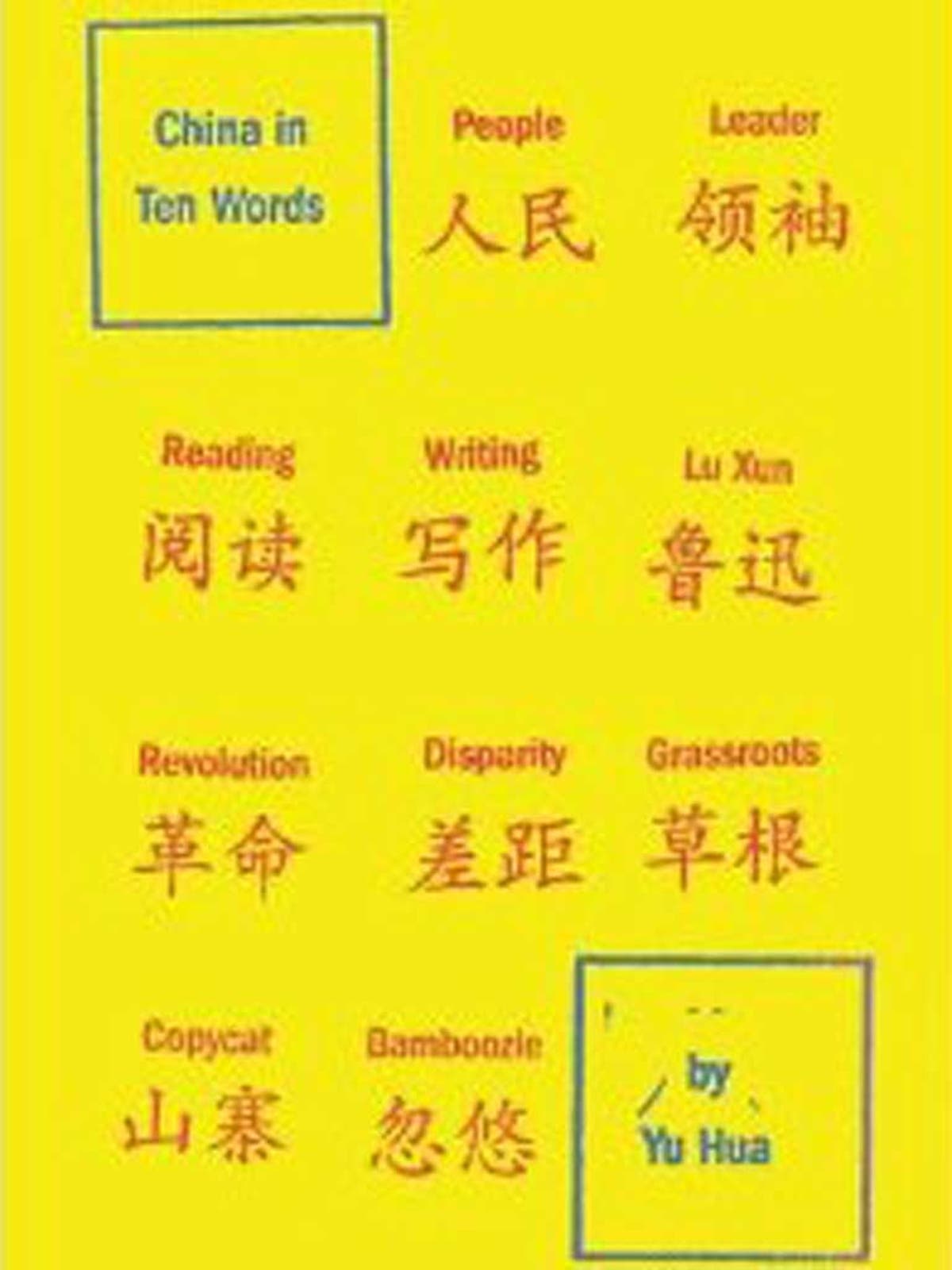
If you’ve ever tried to wrap your head around how a country goes from burning books to building hyper-loops in a single generation, you’ve probably hit a wall. It’s too big. Too fast. Honestly, it’s kinda terrifying. But then there’s Yu Hua. He’s one of China’s most famous novelists, the guy who wrote To Live, and he decided to explain his entire homeland using just ten common words.
Yu Hua China in Ten Words isn’t your typical dry history book. It’s messy. It’s funny in a dark, "I can’t believe he just said that" kind of way. He takes words like "People," "Revolution," and "Copycat" and peels back the skin to show the muscle and bone underneath.
I remember the first time I picked it up. I expected a political manifesto. Instead, I got a story about a kid growing up in a hospital morgue who used to read "big-character posters" as a form of erotica because all the actual books were banned. That’s the vibe here.
The Ten Words That Define a Nation
Yu Hua doesn’t pick fancy academic terms. He picks the words that people actually say on the street. Here is the list he breaks down:
- People (Renmin)
- Leader (Lingxiu)
- Reading (Yuedu)
- Writing (Xiezuo)
- Lu Xun (The "godfather" of modern Chinese literature)
- Revolution (Geming)
- Disparity (Chaju)
- Grassroots (Caogen)
- Copycat (Shanzhai)
- Bamboozle (Huyou)
The structure is loose. One minute he’s talking about the 1989 Tiananmen Square protests—a topic that usually gets people in trouble—and the next he’s explaining why Chinese people are obsessed with fake iPhones.
Why "People" Is the Most Complicated Word
In the first chapter, Yu Hua explains how the word "People" changed. During the Cultural Revolution, "The People" was a massive, holy concept. You were either part of The People or you were a "class enemy." There was no in-between.
But then 1989 happened.
He describes standing on a bridge in Beijing, watching thousands of ordinary citizens—unarmed, regular folks—blocking tanks with their bodies. That was the last time he felt like "The People" actually meant something collective and powerful. Nowadays? He says the word is basically a hollow shell used by officials to sound important while they drive past the actual people in tinted-window SUVs.
The Absurdity of the "Copycat" Culture
The chapter on Shanzhai (Copycat) is hilarious but also deeply sad. He explains how copycatting isn't just about making fake Nikes. It’s a rebellion. It’s the "grassroots" (another one of his ten words) saying, "If you won't give us a seat at the table, we'll build our own table and paint a fake logo on it."
He tells stories of "copycat" government buildings that look exactly like the White House or the Kremlin. It's a weird kind of anarchy. In a country where everything is controlled from the top down, the shanzhai spirit is the only place where people feel free to be creative, even if that creativity is just making a "HiPhone" instead of an iPhone.
Growing Up in a Morgue
To understand Yu Hua China in Ten Words, you have to understand Yu Hua. He was born in 1960. His parents were doctors. Because space was tight, his family lived right across from the hospital’s mortuary.
As a kid, he used to go into the morgue to keep cool during the hot summer months. He’d sleep on the stone slabs where the bodies were kept.
"For me, the dead were more peaceful than the living," he basically says.
When you grow up with death as a literal neighbor, you develop a certain type of skin. It makes his writing incredibly blunt. He doesn’t sugarcoat the violence of the 60s and 70s. He talks about witnessing public executions and how the crowd would surge forward to get a better look. It’s gruesome. But it explains why modern China is so obsessed with "surviving."
The Great Disparity
One of the heaviest sections of the book is about "Disparity." China moved from a time when everyone was equally poor to a time when some people are "Space-Elon-Musk" rich while others are literally living in sewers.
Yu Hua tells a story about his time as a "dentist." He wasn't a real dentist—he had about a year of training and spent his days pulling teeth in a small town. He describes the rusty tools and the pain. Then he contrasts that with the sleek, high-tech dental clinics in Shanghai today.
The gap isn't just about money. It's about time. It's like China is living in three different centuries at once. You’ve got a guy using a wooden plow standing next to a 5G tower. That "discontinuity," as he calls it, is what makes the country feel so chaotic.
Why You Should Care in 2026
You might think a book published years ago wouldn't matter now. You'd be wrong. The "Bamboozle" (Huyou) culture he describes is more relevant than ever. In a world of deepfakes and social media manipulation, the idea that "everything is a scam until proven otherwise" is basically a global mood.
Yu Hua isn't a dissident in the way most Westerners think. He still lives in China. He isn't trying to overthow the government; he's just trying to describe the psychological scars that 1.4 billion people are carrying.
Actionable Takeaways for Readers
If you want to actually "get" China beyond the headlines, here is how to use Yu Hua’s framework:
- Look for the "Shanzhai" spirit: Next time you see a weird knock-off or a "glitch" in a system, ask yourself if it's a form of grassroots rebellion.
- Observe the "Disparity": Don't just look at the skylines of Beijing. Look at the people delivering the food to the people in those skyscrapers.
- Question the "Bamboozle": Be skeptical of grand narratives. In Yu Hua’s world, the loudest person in the room is usually the one trying to pull a fast one on you.
Next Steps for Deeper Understanding
If this book hooked you, don't stop here. Read his novel To Live to see these themes played out in a heartbreaking fictional story. Or check out Lu Xun’s The Real Story of Ah Q—Yu Hua mentions it constantly because it's the DNA of Chinese self-critique.
The truth is, Yu Hua China in Ten Words is a mirror. It shows a country that is brilliant, broken, fast, and exhausted. It’s not a pretty picture, but it’s an honest one.
Next Steps for You
- Read the "Copycat" chapter first if you’re interested in business and innovation; it’s the most eye-opening part for Westerners.
- Focus on the "Reading" chapter if you want to understand how censorship actually feels on the ground to a creative person.
- Look up the term "Huyou" on Chinese social media today to see how the "bamboozle" has evolved in the age of AI.
This book doesn't give you answers. It gives you a vocabulary. And in a country as complex as China, having the right words is the only way to start the conversation.
Note: Yu Hua's works are frequently subject to various levels of scrutiny. While China in Ten Words was published outside of mainland China to avoid certain censorship hurdles, his novels remain staples of contemporary literature. He continues to be a vital voice for understanding the human cost of the "Chinese Miracle."
Actionable Insight: To grasp the current social climate in China, pay attention to the term "Involution" (neijuan), which acts as a modern spiritual successor to Yu Hua's "Disparity" and "Revolution" chapters—it describes the burnout of a generation running a race that has no finish line.
Final Thought: History isn't just dates. It's the way words change their meaning while we aren't looking. Yu Hua caught them in the act.