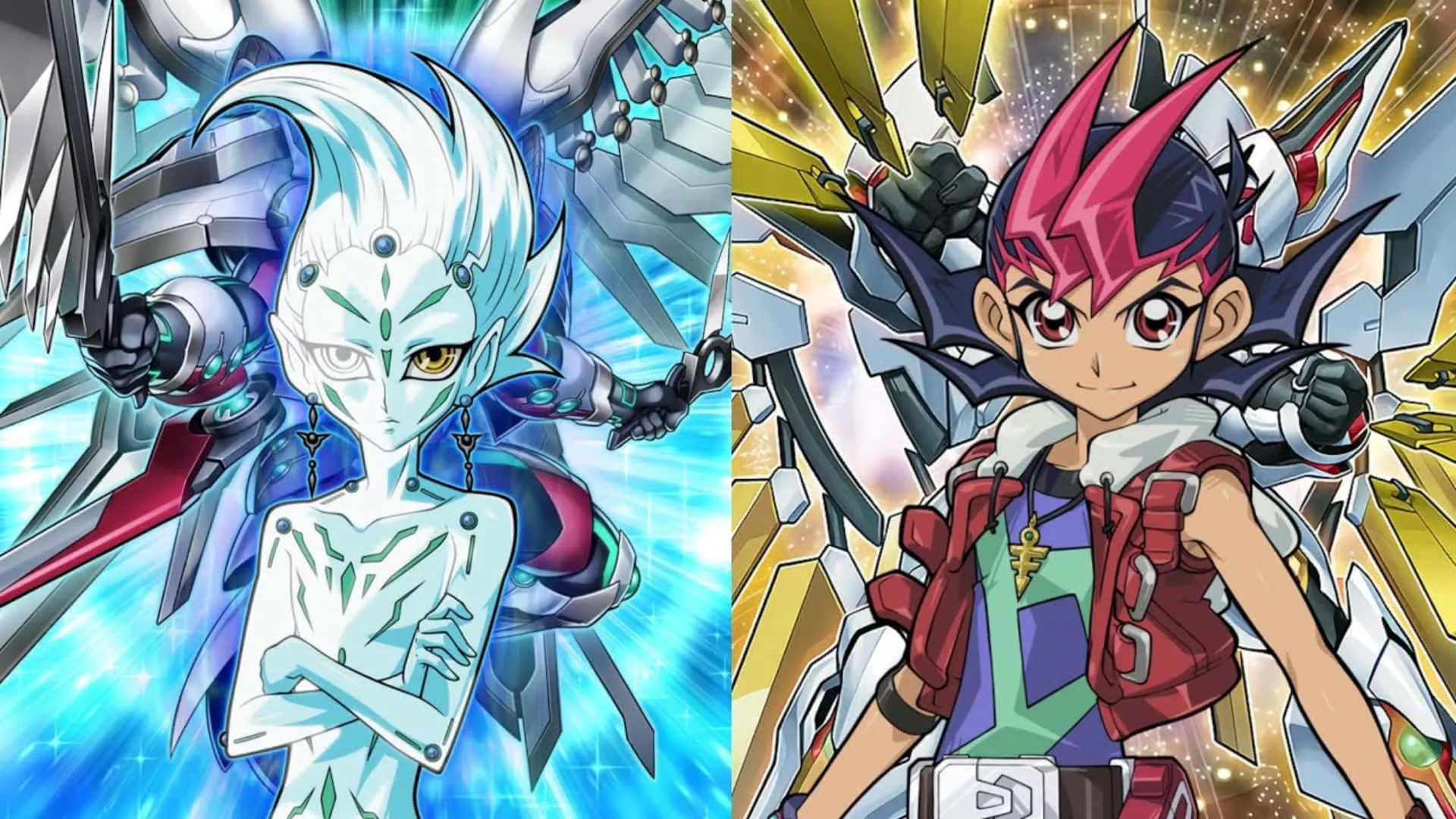
You probably remember the collective groan when Yuma Tsukumo first screamed "Kattobingu" back in 2011. It was rough. Coming off the heels of 5D’s, a show about dystopian futures and literal motorcycle duels, Yu-Gi-Oh! ZEXAL felt like a massive step backward into childish territory. Yuma was loud, he was annoying, and he didn't even know how to play the game he was the protagonist of.
But here is the thing. If you stopped watching after the first ten episodes, you missed the most cohesive, emotionally resonant story in the entire franchise.
Honestly, ZEXAL is a masterclass in the "long game." It starts as a monster-of-the-week comedy and ends as a cosmic tragedy involving the literal destruction of several dimensions. It’s weird. It's colorful. And by the time you hit the finale of ZEXAL II, it’s devastatingly sad.
What Most People Get Wrong About Yuma Tsukumo
Most Yu-Gi-Oh! protagonists are prodigies. Yugi had an ancient pharaoh, Jaden was a natural, and Yusei was basically a mechanical and tactical genius. Yuma? Yuma starts as a loser. He loses constantly. In his first duel against Shark, he would have been completely obliterated if it weren't for Astral’s intervention.
This was a deliberate choice by director Satoshi Kuwahara and the writing team. They wanted a "growth" arc that actually felt earned. When Yuma eventually becomes a world-class duelist, it’s not because of some hidden talent he was born with; it’s because he spent 146 episodes failing until he got it right.
The dynamic between Yuma and Astral is the heart of Yu-Gi-Oh! ZEXAL. It isn't the partnership of equals we saw with Yugi and Atem. It’s a teacher and a student. Astral is cold, logical, and alien. Yuma is impulsive, emotional, and very human. Their friction is what drives the plot forward, especially when the stakes shift from "winning a tournament" to "preventing the extinction of the Astral World."
The Xyz Revolution and the Meta Shift
Let’s talk about the game itself because ZEXAL introduced Xyz Summoning. Before this, we had Synchro Summoning, which required specific Tuner monsters and math that sometimes felt like a chore during a fast-paced duel. Xyz monsters changed everything. You just needed two monsters of the same level. Stick ‘em on top of each other. Done.
Black-bordered cards flooded the real-world TCG. Cards like Number 39: Utopia became iconic not just because of the anime, but because they were genuinely useful in competitive play. The "Numbers" hunt—the central plot device where Yuma must collect 100 sentient cards to recover Astral’s memory—mirrored the real-life obsession with collecting rare Ultra Rares and Ghost Rares.
The series also gave us some of the coolest archetypes in history. We got Galaxy-Eyes, Gimmick Puppets, and Chronomaly. These weren't just random cards; they were reflections of the characters' trauma. Quattro’s Gimmick Puppets are genuinely horrifying for a "kids' show," reflecting his fractured, abusive relationship with his family.
Why the Barian Onslaught Changed Everything
If the first half of ZEXAL is a bright adventure, Yu-Gi-Oh! ZEXAL II is a dark, gritty war drama. The introduction of the Barian Emperors shifted the tone completely. These weren't just villains of the week. They were tragic figures with deep backstories.
Take Vector, for example. Vector is arguably the best villain in all of Yu-Gi-Oh history. He’s a chaotic psychopath who actually succeeds in breaking the protagonist's spirit. The "Ray Shadow" twist remains one of the most shocking moments in the franchise. One minute he’s Yuma’s dorky best friend, and the next, he’s revealing that his entire existence was a lie designed to lead Yuma into a trap.
The stakes in ZEXAL II become incredibly personal. We see characters die. Not "sent to the Shadow Realm" in a vague way, but literally dying on screen as their souls are consumed. The duel between Nash and Yuma at the end of the series isn't about saving the world anymore; it's about two friends who are forced to destroy each other because their responsibilities to their respective species leave them no other choice.
The Visual Evolution
ZEXAL was the first Yu-Gi-Oh! series to heavily integrate 3D CGI into the duels. Early on, it looked a bit janky. However, by the time we got to the mid-point of the series, the production value at Studio Gallop skyrocketed. The "Augmented Reality" duels, where characters wear "D-Gazers" to see the monsters in the real world, allowed for more dynamic camera angles than we had ever seen in Duel Monsters or GX.
The monster designs were also more intricate. The Number monsters were mechanical, celestial, and often eldritch in nature. Seeing Number 92: Heart-eartH Dragon appear for the first time was a visual spectacle that 2D animation alone couldn't have captured with that level of detail.
The "Kattobingu" Philosophy
It sounds cheesy, but "Feeling the Flow" (Kattobingu) is the core message of Yu-Gi-Oh! ZEXAL. It’s about persistence. Yuma’s catchphrase is essentially an admission that life is hard, but you have to jump anyway.
In a world where many people feel overwhelmed by constant pressure, Yuma’s relentless optimism—even when he’s crying, even when he’s losing—is surprisingly relatable. He’s the most "human" of the protagonists. He has a family he loves, he goes to school, and he genuinely cares about his enemies. His ultimate victory isn't defeating the Barians; it's trying to save them.
Actionable Tips for Revisiting ZEXAL
If you're thinking about giving this series another shot, or if you're a TCG player wondering where these cards came from, here is how to handle the watch:
- Skip the dub if you can. The Japanese version (subtitled) has a much better soundtrack and the voice acting for characters like Vector and Shark is far more intense. The English dub censors some of the darker thematic elements in the later half.
- Power through the first 20 episodes. It feels like a standard shonen anime at first. Just wait until the World Duel Carnival starts. That’s where the real plot begins to simmer.
- Watch the Barian Emperor backstories. These are often told in flashbacks during duels. Pay attention to the lore of the Astral and Barian worlds; it’s more complex than a simple "good vs. evil" dynamic.
- Check out the Manga. The ZEXAL manga tells a completely different story with different villains and even different "Number" cards. It’s a great companion piece if you want more lore.
ZEXAL is a journey from immaturity to sacrifice. It’s about a boy who learned how to duel and a god who learned how to feel. Whether you’re in it for the high-stakes Xyz summons or the heavy emotional beats of the Barian war, it’s time to stop ignoring this chapter of the franchise. It’s weird, it’s loud, but it has more heart than almost any other card game anime out there.
Go back and watch the duel between Yuma and Astral in the final episode. If you don't have a lump in your throat by the time the last card is played, you weren't paying attention.
To truly appreciate the impact of this era, look at the modern Yu-Gi-Oh! Master Duel meta. You'll still see Xyz monsters like Divine Arsenal AA-ZEUS - Sky Thunder dominating boards. This mechanic, born in the ZEXAL era, fundamentally redefined how we play the game today. It taught us that any two monsters can become a god-tier threat, mirroring Yuma's own journey from a "third-rate duelist with a fourth-rate deck" to the King of Games.



