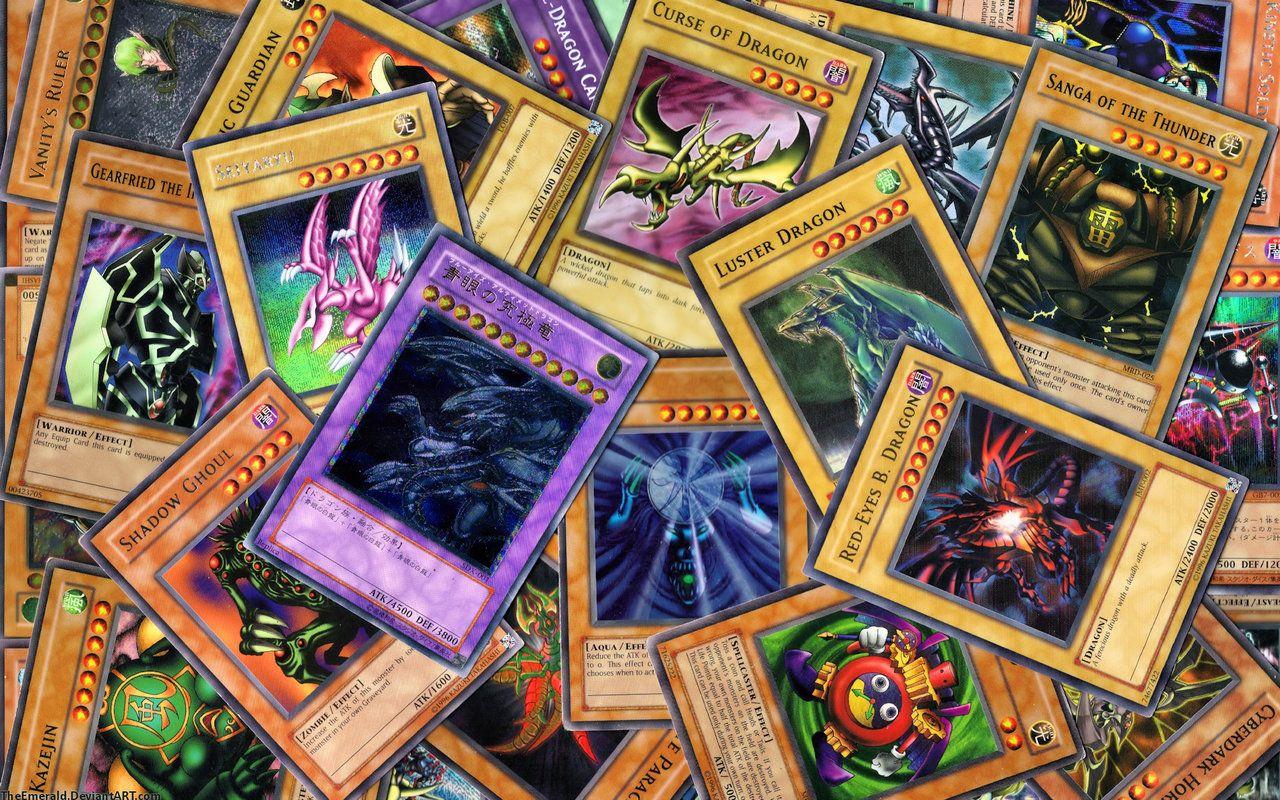
If you grew up in the early 2000s, you remember the playground hype. The schoolyard legends. The kid who swore he had a legitimate version of the Yu-Gi-Oh three Egyptian God cards but "forgot them at home." We all wanted them. Kazuki Takahashi didn't just create powerful monsters when he introduced Slifer, Obelisk, and Ra during the Battle City arc; he created a cultural phenomenon that basically redefined what an "ace card" could be.
They were untouchable.
In the anime, these cards were literal deities. If you played them, the sky turned black. Lightning struck. Usually, Seto Kaiba or Yami Yugi won the game right then and there. But back then, if you actually held the original GBI-001, GBI-002, or GBI-003 promotional cards from the Yu-Gi-Oh! Worldwide Edition: Stairway to the Destined Duel Game Boy game, you couldn't actually use them in a tournament. They had those famous colored backs—red, blue, and yellow—and the dreaded text that said "This card cannot be used in a Duel."
It was a heartbreak for every competitive player. You had the power of the gods in your hand, and Konami told you it was just a piece of cardboard for your binder.
The Real Power Shift: From Anime Myths to Legal Play
It took years for Konami to finally give us "legal" versions. We had to wait for the Shonen Jump promos and the Legendary Collection to actually sleeve these things up for a local tournament. But here is the thing: the transition from the screen to the tabletop wasn't exactly smooth.
In the show, the Yu-Gi-Oh three Egyptian God cards were essentially immune to everything. You couldn't just Trap Hole a god. You couldn't just Man-Eater Bug them away. They had layers of "Divine-Attribute" protection that the real-world trading card game (TCG) struggled to replicate without making the cards totally broken.
Obelisk the Tormentor: The Only One That Stayed Good
Honestly, Obelisk is the MVP of the trio. While the other two suffered from needing specific setups, Obelisk came out of the gate with a beefy 4000 ATK and 4000 DEF. More importantly, he had built-in protection. You can't target him with card effects. In a game where Raigeki Break or Compulsory Evacuation Device could ruin your day, that untargetability was huge.
You've probably seen the "Soul Crossing" strategy in modern decks. It’s a newer Quick-Play Spell that lets you Tribute your opponent's monsters to summon a God card. Imagine the look on someone's face when you wipe their board to drop a 4000-power blue giant. It’s satisfying. It’s also the only way Obelisk stays relevant in a 2026 meta where games end in two turns.
Slifer the Sky Dragon: The Hand Size Struggle
Slifer is Yugi’s signature god. It’s iconic. But Slifer is also incredibly finicky. Its ATK and DEF are tied to how many cards you have in your hand ($ATK = \text{Cards in hand} \times 1000$). If you’re top-decking, Slifer is a wet noodle with 0 ATK.
However, its "Second Mouth" ability is still one of the most annoying floodgates in the game. Any monster your opponent summons in Attack Position loses 2000 ATK. If their ATK hits 0, they pop. They just die. This effect is mandatory. It doesn't "activate" in a way that’s easy to chain to, making it a nightmare for "bread and butter" combo decks that rely on small monsters to bridge into bigger ones.
The Winged Dragon of Ra: The Problem Child
Ra was the king of the anime. It had three different hidden abilities that Marik Ishtar would recite like he was reading a religious text. In the TCG? Ra was a disaster for a long time.
The original legal release of Ra didn't even have its own ATK/DEF. You had to pay all but 100 of your Life Points to give it strength. If your opponent had a Magic Cylinder or a Kuriboh, you just lost the game. You literally paid your life to lose. It wasn't until the release of support cards like The Winged Dragon of Ra - Sphere Mode and The Winged Dragon of Ra - Immortal Phoenix that the sun god finally became playable.
Why Collectors Are Still Obsessed
If you look at the secondary market on sites like TCGPlayer or eBay, the prices for high-end Yu-Gi-Oh three Egyptian God cards are astronomical. We aren't just talking about the $20 reprints from a Mega Tin.
We’re talking about the 2002 Prismatic Secret Rares.
A PSA 10 graded set of the original Game Boy Color promos can fetch thousands. Why? Because these cards represent the peak of the "Golden Era." For many, they are the "Charizard" of the Yu-Gi-Oh world. Even if they aren't winning the World Championship, they are the ultimate trophy.
The rarity variants are dizzying:
- Secret Rare: The classic glittery finish.
- Ghost Rare: That eerie, 3D holographic look where the monster disappears if you tilt the card.
- 25th Anniversary Quarter Century Secret Rare: The new hotness with the "25th" watermark.
- Pharaoh’s Rare: A specific Egyptian hieroglyph pattern etched into the foil.
There is something deeply tactile about holding a Pharaoh's Rare Marik-style Ra. It feels like it belongs in a museum, not a deck box.
How to Actually Play Them Today (Without Losing)
Look, if you try to build a deck using all three gods at once, you’re going to have a bad time. "Brick" is an understatement. You’ll end up with a hand full of Level 10 monsters that you can’t summon because you haven't found your Tributes yet.
But if you’re dead set on using the Yu-Gi-Oh three Egyptian God cards, you have to use the dedicated support Konami released recently.
- The Poker Knight Engine: The "Face Card" Knights (Queen’s Knight, King’s Knight, and Jack’s Knight) were literally designed to facilitate summoning Slifer. They swarm the field and add cards back to your hand. It’s the most "Yugi" way to play.
- The Slime Strategy: Guardian Slime is a godsend. It has high DEF, can special summon itself when you take damage, and can be Tributed for Egyptian God Slime, which counts as three Tributes for a God card. It’s basically a one-card setup for Obelisk or Ra.
- Mound of the Bound Creator: This Field Spell is mandatory. It protects Level 10 or higher monsters from being destroyed or targeted by effects. It gives the God cards back the "anime protection" they should have had from the start.
Most people get it wrong by trying to play "fair" Yu-Gi-Oh. You can't play fair with these cards. You have to cheat them out. You use Ancient Chant to search Ra and gain extra Tributes. You use The True Name to stack your deck and get a free summon.
The Misconception of "Divine" Typing
Newer players often get confused by the "Divine-Beast" Type and "Divine" Attribute. In the history of the game, only a handful of cards have ever used these classifications. Outside of the Yu-Gi-Oh three Egyptian God cards, you really only see it on Horakhty, the Creator of Light (the fusion of all three) and occasionally a "Wicked God" or "Sacred Beast" variant—though the Sacred Beasts are actually Fiend-type.
This makes them immune to certain "Type-specific" hate cards. You can't use Zombie World to mess with their typing easily if they are already on the board. They exist in a vacuum of game mechanics.
The Verdict on the Trio
Are they the best cards in the game? No. Not by a long shot. The modern game is defined by "Hand Traps" like Ash Blossom & Joyous Spring or Infinite Impermanence. Spending three monsters to summon one big guy is often a recipe for disaster if your opponent just has a Nibiru, the Primal Being waiting in their hand.
But that misses the point.
The Yu-Gi-Oh three Egyptian God cards aren't about tournament efficiency; they’re about the "heart of the cards." They are the reason many of us started playing. They represent the stakes of the original manga—ancient spirits, high drama, and overwhelming power.
Actionable Steps for Players and Collectors:
- For Collectors: Focus on the 25th Anniversary Rarity Collection. It’s the most affordable way to get "luxury" versions of these cards (like Quarter Century Secret Rares) without spending a mortgage payment.
- For Players: Pick one God and build around it. "God Card Goodstuff" doesn't work. If you want to win, go for an Obelisk-focused "Beatdown" deck or a Ra "One Turn Kill" (OTK) deck using Ra's Disciple.
- For Investors: Keep an eye on the original Retro Pack 2 or Tournament Pack versions. As the player base ages, the nostalgia for high-end, early-era God cards only goes up.
- The Golden Rule: Always check the bottom left corner of the card. If it says "This card cannot be used in a Duel," it is a purely aesthetic collector's piece. If it has an effect box and a serial number, you're ready to play.
Don't expect to win a YCS with Slifer, but if you manage to resolve its effect against a meta-sheep player at your local shop, it’ll be the only thing anyone talks about for the rest of the night. That’s the real power of the gods.