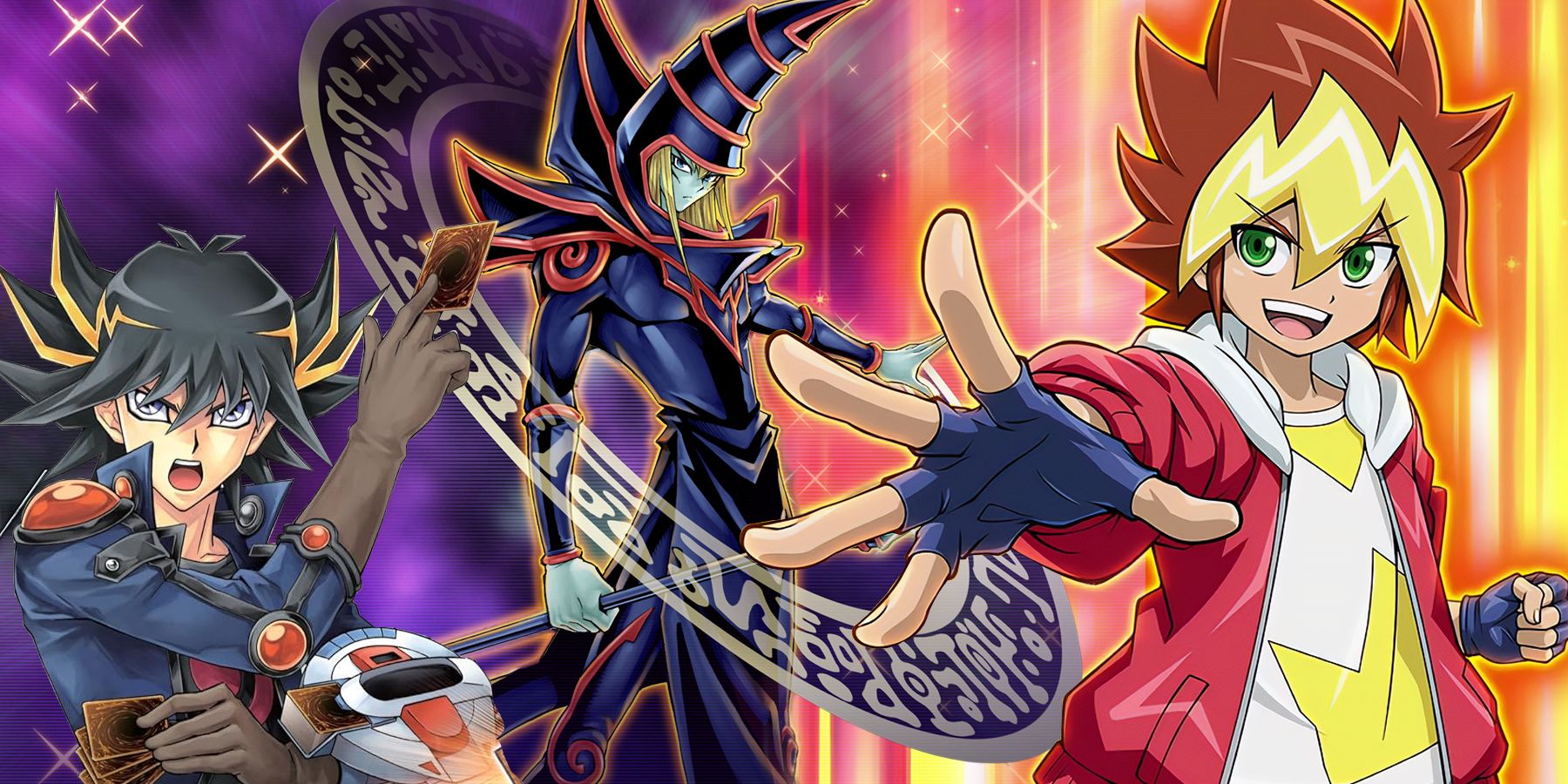
Believe it or not, trying to watch the Yu-Gi-Oh series in order is a bit of a nightmare if you’re just looking at a list of release dates. It isn't just one long story about a spiky-haired kid with a puzzle. It’s a massive, sprawling multiverse that has rebranded itself more times than a failing tech startup.
You’ve got the original 1998 "Season 0" that most people haven't even seen. Then there's the Duel Monsters era we all grew up with on Saturday morning cartoons. After that? It gets weird. Motorcycles. Alternate dimensions. Card games in space. It’s a lot. Building on this idea, you can find more in: The Last Scourge of the Screening Room.
If you’re diving back in for nostalgia or trying to see why people are still obsessed with Master Duel in 2026, you need a roadmap. This isn't just about chronology; it’s about understanding which series actually connect and which ones are basically soft reboots meant to sell a brand-new type of card.
The Confusion of the Beginning: Season 0 vs. Duel Monsters
Most fans think the story starts with Yugi fighting Kaiba on a plane. It doesn't. Experts at IGN have shared their thoughts on this trend.
Before the global phenomenon, there was the 1998 Toei Animation series. Fans call it "Season 0." It’s dark. It’s violent. Yugi basically sets people on fire or drives them insane with "Penalty Games." It barely features the card game we know today. Instead, they play random games like deadly versions of air hockey. If you want the true Yu-Gi-Oh series in order, you start here, even though it isn't technically canon to the later shows.
Then comes Yu-Gi-Oh! Duel Monsters (2000–2004). This is the one. The Pharaoh, the Egyptian God Cards, the Blue-Eyes White Dragons. This series adapted the manga but skipped the early chapters, which is why the first episode feels like you’ve missed something.
Honestly, the filler arcs in this era—like the Virtual World or the Waking the Dragons arc—are actually pretty decent, but they aren't in the original manga by Kazuki Takahashi. If you're a purist, you'll notice the tone shifts wildly between the high-stakes ancient Egyptian mysticism and the "we need to stop this guy from buying my company" corporate subplots.
Moving into the GX and 5D’s Era
After Yugi’s story wrapped, the studio didn't want to stop. They launched Yu-Gi-Oh! GX in 2004.
This was a massive shift. We went from saving the world to "Duel Academy." Jaden Yuki is a polarizing protagonist because he’s basically the opposite of the stoic Atem. He’s loud, he loves fried shrimp, and he’s... kind of an idiot? But as the series progresses into the later seasons (especially the fourth season that was never dubbed in English), it gets surprisingly dark. It explores depression and the burden of being a hero.
Then came Yu-Gi-Oh! 5D’s in 2008.
Card games on motorcycles.
People laughed. The internet lost its mind. But then the show actually aired, and it turned out to be arguably the best written of the bunch. It’s a gritty, dystopian sci-fi story about class warfare and ancient Nazca lines. Yusei Fudo is a "cool" protagonist who actually builds his own tech. If you’re following the Yu-Gi-Oh series in order, 5D's represents the peak of the original "master rule" era before things got really complicated with new summoning types.
The Divergence: ZEXAL, Arc-V, and VRAINS
This is where the timeline starts to fracture for the casual viewer.
- Yu-Gi-Oh! ZEXAL (2011): This was a hard pivot back to a younger audience. Yuma is a beginner who makes a lot of mistakes. It introduced Xyz Summoning (those black cards). It’s bright, colorful, and feels very different from the grim streets of 5D’s.
- Yu-Gi-Oh! ARC-V (2014): This is the "anniversary" series. It tries to bring everything together. It introduces Pendulum Summoning and eventually features alternate versions of characters from GX, 5D’s, and ZEXAL. It’s ambitious. Maybe too ambitious. The ending is notoriously controversial among the fanbase.
- Yu-Gi-Oh! VRAINS (2017): We go full Cyberpunk here. It’s about VR dueling and AI. The protagonist, Yusaku, is almost Sherlockian—cold, calculating, and somewhat traumatized. It’s a much more serious show, focusing on Link Summoning.
The Modern Shift: SEVENS and Go Rush
Around 2020, the franchise did something radical. They stopped making shows for the "Master Duel" format.
Yu-Gi-Oh! SEVENS and its successor Yu-Gi-Oh! Go Rush!! use "Rush Duel" rules. The art style changed. It’s more "cartoony." The logic was that the main game had become too complicated for kids to jump into. These series are mostly standalone. If you’re looking for the classic "Dark Magician" vibes, you might find these a bit jarring. They focus on drawing tons of cards and summoning multiple monsters in one turn. It’s fast. It’s chaotic. It’s weirdly charming if you give it a chance, but it’s a far cry from the Shadow Games of the 90s.
Which Order Should You Actually Watch?
The "Correct" way is usually the release order because the card game mechanics build on each other. You see the evolution from simple Tribute Summons to Synchro, Xyz, Pendulum, and Link.
- Yu-Gi-Oh! (Toei / Season 0) - Optional, but great for context.
- Yu-Gi-Oh! Duel Monsters - The core classic.
- Yu-Gi-Oh! GX - The academy years.
- Yu-Gi-Oh! 5D’s - The high-speed dystopian era.
- Yu-Gi-Oh! ZEXAL - The cosmic/interdimensional shift.
- Yu-Gi-Oh! ARC-V - The multiverse crossover.
- Yu-Gi-Oh! VRAINS - The virtual reality thriller.
- Yu-Gi-Oh! SEVENS - The Rush Duel reboot.
- Yu-Gi-Oh! Go Rush!! - The current alien-themed era.
Don't forget the movies. The Pyramid of Light is a fun side story, but Yu-Gi-Oh!: The Dark Side of Dimensions (2016) is a masterpiece. It serves as a direct sequel to the original manga (not the anime), featuring an older Kaiba who is still obsessed with Yugi. The animation is stunning. If you only watch one extra thing, make it that.
Addressing the Common Misconceptions
People often think the dubbed versions are just the original shows with English voices. They aren't.
4Kids Entertainment famously edited the hell out of the early series. They replaced guns with "invisible finger guns." They turned death into the "Shadow Realm." They cut out entire subplots involving religious imagery or violence.
If you want the real story, you have to watch the subtitled versions. The stakes feel higher. The characters feel like actual people rather than caricatures. In the Japanese version of GX, Jaden’s character arc is a tragedy about losing your childhood innocence. In the dub, he’s basically just a guy who likes dueling until the very end.
Actionable Steps for New Fans
If you're ready to tackle the Yu-Gi-Oh series in order, here is how to handle the massive time investment without burning out:
- Skip the Filler: Use a guide to skip the "Virtual World" arc in Duel Monsters if you find the pacing too slow. It doesn't affect the main Marik/Pegasus storylines.
- Watch the Sub for GX and 5D’s: The English dub for GX never finished the final season, and the 5D’s dub cut out a massive chunk of the ending. You'll literally miss the conclusion of the story if you stay with the dub.
- Check out "The Dark Side of Dimensions": Watch this after the original series. It’s the highest quality Yu-Gi-Oh content ever produced, and it pays off years of character development for Seto Kaiba.
- Understand the "Rush Duel" Split: Recognize that SEVENS and Go Rush!! are a different beast. If you don't like them, it doesn't mean you won't like the previous seven series. They are a different "branch" of the franchise.
The franchise has been running for over 25 years. It’s okay to jump around. But seeing the progression from a simple game of monsters to a multiversal war across three decades is an experience that most modern anime can't replicate. Start with the original, find the summoning mechanic that clicks with you, and don't be afraid to embrace the absolute absurdity of people gambling their souls over a children’s card game.



