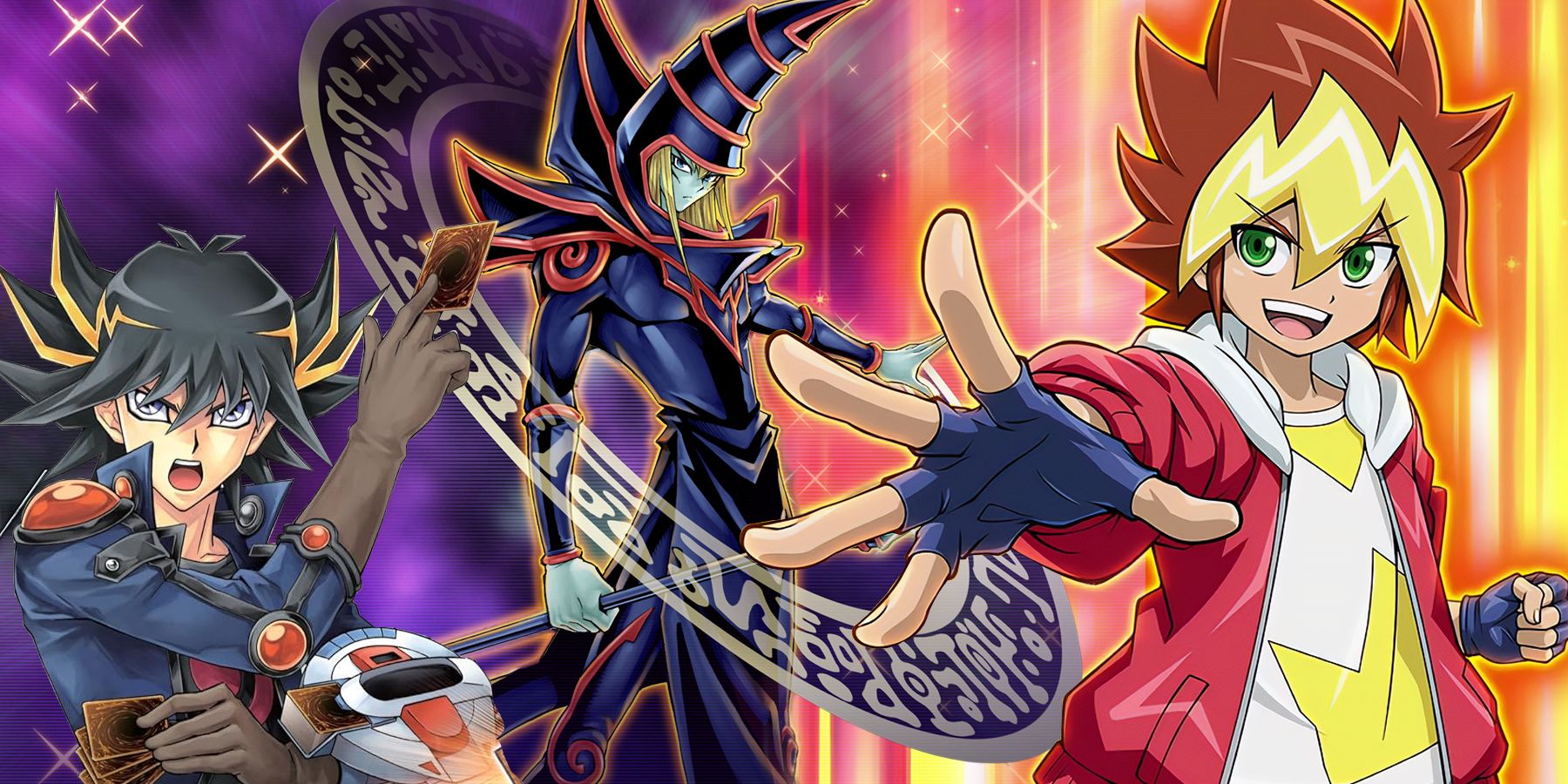
If you grew up in the early 2000s, you probably remember sitting in front of a CRT TV, watching a spiky-haired kid shout about the "Heart of the Cards" while a massive dragon made of blue light blasted a hole in a digital arena. It was peak Saturday morning vibes. But honestly, if you try to look at all Yu-Gi-Oh! series in order today, it’s a total mess of different timelines, weird spin-offs, and card mechanics that progressively get more complicated until you feel like you need a PhD in law just to play a turn.
The franchise didn't just stay in that dusty Egyptian tomb with Yugi and Kaiba. It went to space. It went to a dystopian future on motorcycles. It even went to a digital world where kids duel with "Solid Vision" that can actually hurt them. Keeping track of the chronological release vs. the actual narrative flow is a bit of a headache, especially since the first-ever show isn't even the one most Western fans remember.
The "Season 0" Mystery and the Duel Monsters Era
Before we get into the stuff everyone knows, we have to talk about the 1998 Toei Animation series. Most people call this Yu-Gi-Oh! Season 0. It’s weird. It’s dark. Yami Yugi isn't just a card game expert here; he’s basically a vigilante who subjects bullies to "Penalty Games" that result in hallucinations or literal insanity. The card game? It barely exists. It’s just one of many games they play. Because it never officially aired in the West, it’s often skipped, but it’s the true starting point.
Then came the boom. Yu-Gi-Oh! Duel Monsters (2000-2004) is the one that defined the childhoods of millions. This is where we get the classic Pharaoh storyline, the Egyptian God Cards, and the Battle City tournament.
Kazuki Takahashi, the creator who tragically passed away in 2022, originally wrote the manga as a horror-leaning story about various games. But the "Magic & Wizards" card game (a parody of Magic: The Gathering) became so popular that the anime pivoted entirely to cards. If you're watching the Yu-Gi-Oh! series in order, this is your foundational block. It’s 224 episodes of pure nostalgia, though the "Waking the Dragons" arc is technically filler—even if it gave us the coolest dragons in the game.
GX and the Shift to Academy Life
When Duel Monsters ended, fans were skeptical. How do you replace Yugi? You don't. You go to school instead. Yu-Gi-Oh! GX (2004-2008) moved the setting to Duel Academy, an island owned by Seto Kaiba. We met Jaden Yuki (Judai in the Japanese version), a slacker who just wanted to have fun.
The tone shift was jarring at first. It felt like a "kinda" goofy Harry Potter with cards. But don't let the early episodes fool you. By the time you get to the third and fourth seasons, GX gets incredibly dark. We’re talking about interdimensional possession, characters disappearing into the void, and Jaden losing his "fun-loving" personality entirely. It also introduced Fusion Summoning as a primary mechanic, which changed how the physical TCG was played. Interestingly, the final season of GX never even got an English dub, leaving Western fans hanging for years until subbed versions became widely available online.
5D’s: Card Games on Motorcycles (Seriously)
Look, Yu-Gi-Oh! 5D’s (2008-2011) sounds ridiculous on paper. "Turbo Duels" involve playing cards while driving high-tech motorcycles called Duel Runners. People laughed. Then they watched it.
It’s arguably the best-written entry in the entire franchise.
Set in a futuristic, stratified New Domino City, it follows Yusei Fudo, a protagonist who lives in the slums (Satellite) and builds his own bike out of scrap metal. It’s gritty. It deals with class warfare and social inequality. It also introduced Synchro Summoning, a mechanic that involved adding the levels of "Tuner" monsters and non-tuners to bring out white-bordered powerhouse cards. This era broke the competitive card game for a while because it was so fast, but the anime’s story—especially the Dark Signers arc—is high-tier drama.
The ZEXAL and ARC-V Experimental Years
After 5D’s, things got... colorful. Yu-Gi-Oh! ZEXAL (2011-2014) was a blatant attempt to capture a younger audience. Yuma Tsukumo was a loud, unskilled duelist who had to be coached by an alien named Astral. The first half is a bit of a slog, but the second half, ZEXAL II, is surprisingly intense with its "Barian World" stakes. This series gave us Xyz Summoning, which used "Overlay Units." If you’ve ever seen a black card with stars on the right side instead of the left, that’s ZEXAL.
Then we got Yu-Gi-Oh! ARC-V (2014-2017). This was meant to be the "Greatest Hits" of the franchise. It introduced Pendulum Summoning and featured different dimensions based on the previous summoning methods (Fusion, Synchro, Xyz).
Honestly? It started as a masterpiece. The idea of inter-dimensional war using card games was wild. But the ending is notoriously controversial among the fanbase. It felt rushed, and the final "smile" philosophy of the protagonist, Yuya Sakaki, didn't sit well with people who wanted a more traditional payoff. It remains a polarizing chapter when looking at all Yu-Gi-Oh! series in order.
VRAINS and the Cyberpunk Digital World
By 2017, the game was getting way too fast. To fix (or further complicate) it, Konami released Yu-Gi-Oh! VRAINS (2017-2019). This series took us into Link VRAINS, a virtual reality world where people duelled on hoverboards.
The protagonist, Yusaku Fujiki (Playmaker), was a stoic hacker who suffered from PTSD due to a childhood kidnapping incident called the "Lost Incident." It was a much more mature, tech-focused show. It introduced Link Summoning, which fundamentally changed the board layout of the card game by adding "Link Zones." VRAINS was shorter than its predecessors, ending after 120 episodes, and notably, it’s the last series that follows the "Master Duel" format used in the global competitive scene.
The SEVENS and GO RUSH Pivot
If you look at the Yu-Gi-Oh! series in order from 2020 onwards, you’ll notice a massive visual shift. The art style became "rounder" and more cartoonish.
- Yu-Gi-Oh! SEVENS (2020-2022): This introduced "Rush Dueling." It’s a simplified version of the game where you can summon as many monsters as you want in one turn and draw until your hand has five cards every single turn. It was a soft reboot to make the game accessible again.
- Yu-Gi-Oh! Go Rush!! (2022-Present): This is the current series, following an alien named Yudias Velgear who comes to Earth to learn about Rush Dueling because he believes it can save his home planet.
It’s important to note that these two series are technically their own thing. They don't use the standard TCG rules we use in the West; they use "Rush Duel" rules, which is a separate physical card game in Japan.
Chronological Order vs. Release Order
Most people should watch in release order. The series aren't strictly connected in one giant timeline (though there are cameos). Duel Monsters, GX, and 5D's share a loose timeline—you see Yugi's deck in GX, and you see references to the past in 5D's. However, ZEXAL, ARC-V, and VRAINS mostly exist in their own separate universes.
If you want the "pure" experience:
- Start with Yu-Gi-Oh! Duel Monsters (skip the 1998 one if you want purely card-focused action).
- Move to GX to see the game evolve.
- Watch 5D's for the best story.
- Only dive into SEVENS or Go Rush!! if you want something lighthearted and don't mind the simplified rules.
Actionable Insights for Fans and Collectors
If you're looking to jump back into the series or the game, don't just blindly buy packs.
Watch the "Remastered" versions. Many of the original episodes have been upscaled. If you're a purist, the Japanese sub is often better because the English dub (by 4Kids) famously removed all "guns" (replacing them with invisible pointing fingers) and turned "death" into being sent to the "Shadow Realm."
Try Master Duel. If the different series' mechanics confuse you, the video game Yu-Gi-Oh! Master Duel has a solo mode that basically acts as a playable history lesson for all these different eras and archetypes. It's the easiest way to understand what a "Synchro" or "Link" monster actually does without reading a 50-page rulebook.
Check out the manga. The late Kazuki Takahashi’s art in the original manga is leagues ahead of the anime. It’s more detailed, more violent, and provides a lot of context that the shows missed.
Whether you’re in it for the tactical card play or the bizarre storylines about saving the world with a piece of cardboard, the Yu-Gi-Oh! legacy is massive. It’s a franchise that refused to die, constantly reinventing itself even when the mechanics seemed to break under their own weight.
Ready to start? Look up the "Dark Side of Dimensions" movie after you finish the original series. It’s a direct sequel to the manga and features some of the most beautiful animation in the entire franchise, serving as a perfect "final" goodbye to the Yugi and Kaiba rivalry.



