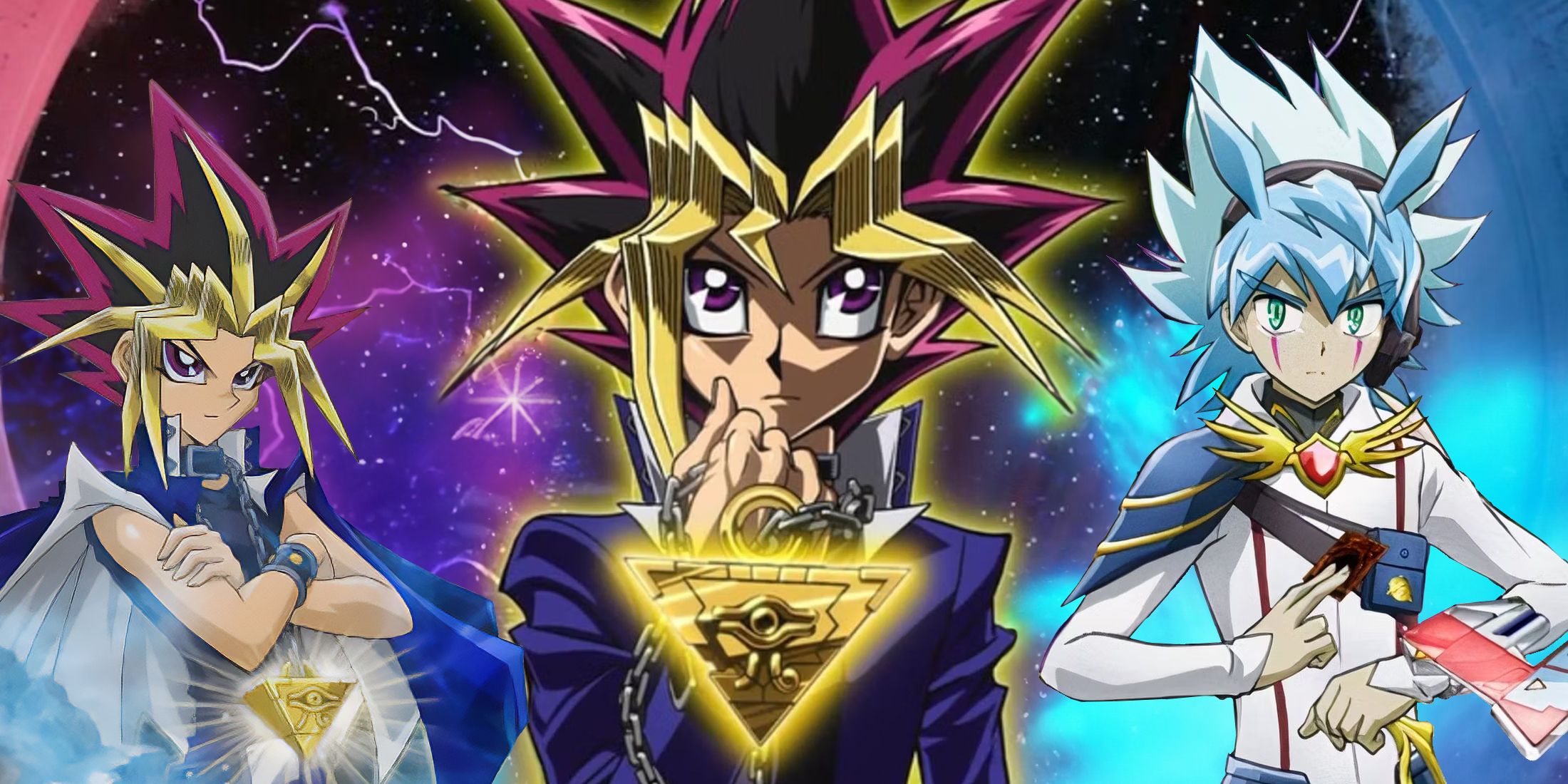
Look, trying to figure out the Yu-Gi-Oh! seasons in order is a total headache. It’s not just one show. It’s a massive, multi-generational sprawl of card games, ancient Egyptian magic, and increasingly wild hairstyles. If you grew up in the early 2000s, you probably remember Yugi Muto and his glowing puzzle, but the franchise has mutated into something much bigger since then.
Honestly, the "order" depends entirely on whether you’re a purist who wants the original manga experience or a casual fan who just wants to see someone get sent to the Shadow Realm. We’ve got spinoffs, prequels that aren't really prequels, and localized versions that changed the plot entirely.
The "Season 0" Mystery and the Duel Monsters Era
Before the card game became a global phenomenon, there was a darker, weirder version of Yu-Gi-Oh! produced by Toei Animation in 1998. Most fans call this Season 0. It never officially made it to the West because it was pretty violent. Yugi didn't just play cards; he set people on fire and played lethal games of chance. It’s a trip. If you want the full Yu-Gi-Oh! seasons in order experience, you technically start here, even though it’s not canon to the later shows.
Then comes the big one. Yu-Gi-Oh! Duel Monsters. This is the 2000 series we all know.
The Duelist Kingdom arc is where it starts. It’s messy. The rules make zero sense. Floating castles? Destroying the moon? Kazuki Takahashi, the creator, was basically figuring out the game as he went along. After that, we hit the Battle City saga, which is arguably the peak of the franchise. This is where the Egyptian God Cards—Slifer, Obelisk, and Ra—come into play. It’s long, spanning multiple seasons and several filler arcs like the Virtual World and Waking the Dragons.
A lot of people skip the filler. Don’t. While the "Noah’s Virtual World" arc interrupts the Battle City finals in a way that feels jarring, it actually adds some decent backstory to Kaiba’s dysfunctional family. The final piece of the original puzzle is the Dawn of the Duel (Season 5), which takes us back to Ancient Egypt to finally learn the Pharaoh’s name: Atem.
The GX and 5D’s Shift
Once Yugi’s story wrapped, the franchise took a gamble. They went to school.
Yu-Gi-Oh! GX follows Jaden Yuki (Judai Yuki in the sub) at Duel Academy. The first two seasons are lighthearted, almost "monster of the week" style. But by the time you hit Season 3 and 4, the show gets incredibly dark. We’re talking existential dread and soul-crushing loss. The fourth season was never even dubbed into English, which is a crime because it’s the most important part of Jaden’s character arc.
Then things got fast. Literally.
Yu-Gi-Oh! 5D’s introduced "Card Games on Motorcycles." Everyone laughed at the concept until they actually watched it. It’s a gritty, dystopian story about class warfare and ancient cults. Set in Neo Domino City, it follows Yusei Fudo. It’s widely considered the best written of the spinoffs, especially the Dark Signer arc. If you're watching the Yu-Gi-Oh! seasons in order, 5D's is where the game mechanics get complicated with Synchro Summons.
The ZEXAL, Arc-V, and VRAINS Experiment
After 5D’s, the art style changed. It got "kinda" bright.
Yu-Gi-Oh! ZEXAL is polarizing. Yuma, the protagonist, starts off as a terrible duelist. He’s annoying. He screams "Kattobingu" (Feeling the Flow) constantly. But if you stick with it through ZEXAL II, the stakes get cosmic. It’s a slow burn that pays off with some of the most emotional duels in the franchise.
Then came Yu-Gi-Oh! ARC-V. This was supposed to be the "Greatest Hits" series. It introduced the multiverse. We saw alternate versions of characters from GX, 5D’s, and ZEXAL. It brought in Pendulum Summoning, which basically broke the physical card game for a while. The first half is brilliant. The second half? Honestly, it’s a bit of a train wreck due to production issues, but it’s essential for understanding the lore.
Yu-Gi-Oh! VRAINS took us into VR. It’s a more serious, tech-heavy show. Yusaku Fujiki is a hacker-protagonist who isn't interested in friendship; he wants revenge. It’s shorter than the others and focuses heavily on Link Summoning. It feels very different from the "magic" roots of the original show.
The Modern Era: SEVENS and Go Rush!!
The most recent shift has been the most drastic.
Yu-Gi-Oh! SEVENS and Yu-Gi-Oh! Go Rush!! introduced "Rush Dueling." The art style is much more "cartoony," and the target audience is younger. The rules are simplified—you can summon as many monsters as you want in one turn. Some old-school fans hate it. Others find it refreshing because it doesn't take itself so seriously. These series exist in their own bubble, largely separate from the "Duel Monsters" through "VRAINS" continuity.
The Actual Watch List
- Yu-Gi-Oh! (Toei "Season 0"): Optional, but cool for history buffs.
- Yu-Gi-Oh! Duel Monsters: 224 episodes. The core experience.
- Yu-Gi-Oh! GX: 180 episodes. Watch the sub if you want the ending.
- Yu-Gi-Oh! 5D's: 154 episodes. Peak storytelling.
- Yu-Gi-Oh! ZEXAL: 146 episodes. Divided into ZEXAL and ZEXAL II.
- Yu-Gi-Oh! ARC-V: 148 episodes. The multiverse era.
- Yu-Gi-Oh! VRAINS: 120 episodes. The cyber-revenge plot.
- Yu-Gi-Oh! SEVENS: 92 episodes. The Rush Duel reboot.
- Yu-Gi-Oh! Go Rush!!: 100+ episodes. Aliens and cards.
There are movies too. The Pyramid of Light happens somewhere in the middle of the original show (it’s non-canon but fun). Bonds Beyond Time is a must-watch because it brings Yugi, Jaden, and Yusei together. Then there is The Dark Side of Dimensions, which is a direct sequel to the original manga (not the anime) and features some of the best animation in the series.
Watching Yu-Gi-Oh! seasons in order is a commitment. You're looking at over 1,000 episodes of content. If you're feeling overwhelmed, start with the Battle City arc of the original series and then jump to 5D's. Those represent the soul of what makes the franchise great.
The biggest mistake people make is assuming it’s all one timeline. It isn't. The first three shows (Duel Monsters, GX, 5D's) have a loose connection. After that, the shows mostly become standalone universes or alternate dimensions.
If you want to dive in, start with the 2000 series but keep a filler guide handy. Arcs like the "Capsule Monsters" or "Grand Championship" are fun but don't move the plot forward. Focus on the core tournament arcs. Also, if you can, try the Japanese version with subtitles. The 4Kids dub is nostalgic, but it removes a lot of the actual stakes, replacing death with the "Shadow Realm" and guns with... pointing fingers. It changes the tone completely.
The next logical step is to pick a "summoning mechanic" you think looks cool—whether it's Synchro, Xyz, or Link—and start that specific series. You don't necessarily have to watch everything in a straight line to enjoy the individual stories. Focus on the Duel Monsters era first to understand the foundations of the game and the lore of the Millennium Items, then move into 5D's for a more mature narrative.



