Honestly, trying to track the continuity of Yu-Gi-Oh movies is like trying to win a duel against a stacked Exodia deck. It’s messy. You've got different animation studios, weird time-traveling paradoxes, and films that literally ignore the ending of the show they’re based on. Most fans grew up watching the 4Kids version on Saturday morning TV, which makes the confusion even worse because the Western movies often feel like they exist in their own little bubble.
If you're looking for a straight line, forget it. There isn't one. Instead, we have a handful of cinematic experiments that range from "weird 90s relic" to "high-budget fanservice."
The 1999 Movie That Basically Doesn't Exist
Most people think Pyramid of Light was the first big screen outing for Yugi. It wasn't. Back in 1999, Toei Animation—the studio that did the "Season 0" anime—released a 30-minute short film simply titled Yu-Gi-Oh!.
It’s a strange beast.
The plot centers on a kid named Shōgo who finds a Red-Eyes Black Dragon card. He's too scared to duel because he thinks if he never plays it, he can never lose. Seto Kaiba, being the obsessed billionaire he is, finds out and tries to hunt him down. It’s remarkably grounded compared to what came later. No world-ending ancient gods here, just a kid who’s afraid of losing a card game.
This movie is purely for the completionists. It uses the old-school character designs where Yugi has green eyes and Kaiba has green hair. If you haven't seen "Season 0," the vibe will feel totally alien. It’s darker, slower, and the card game rules are... well, they’re barely rules.
Why Pyramid of Light Was a Weird Western Experiment
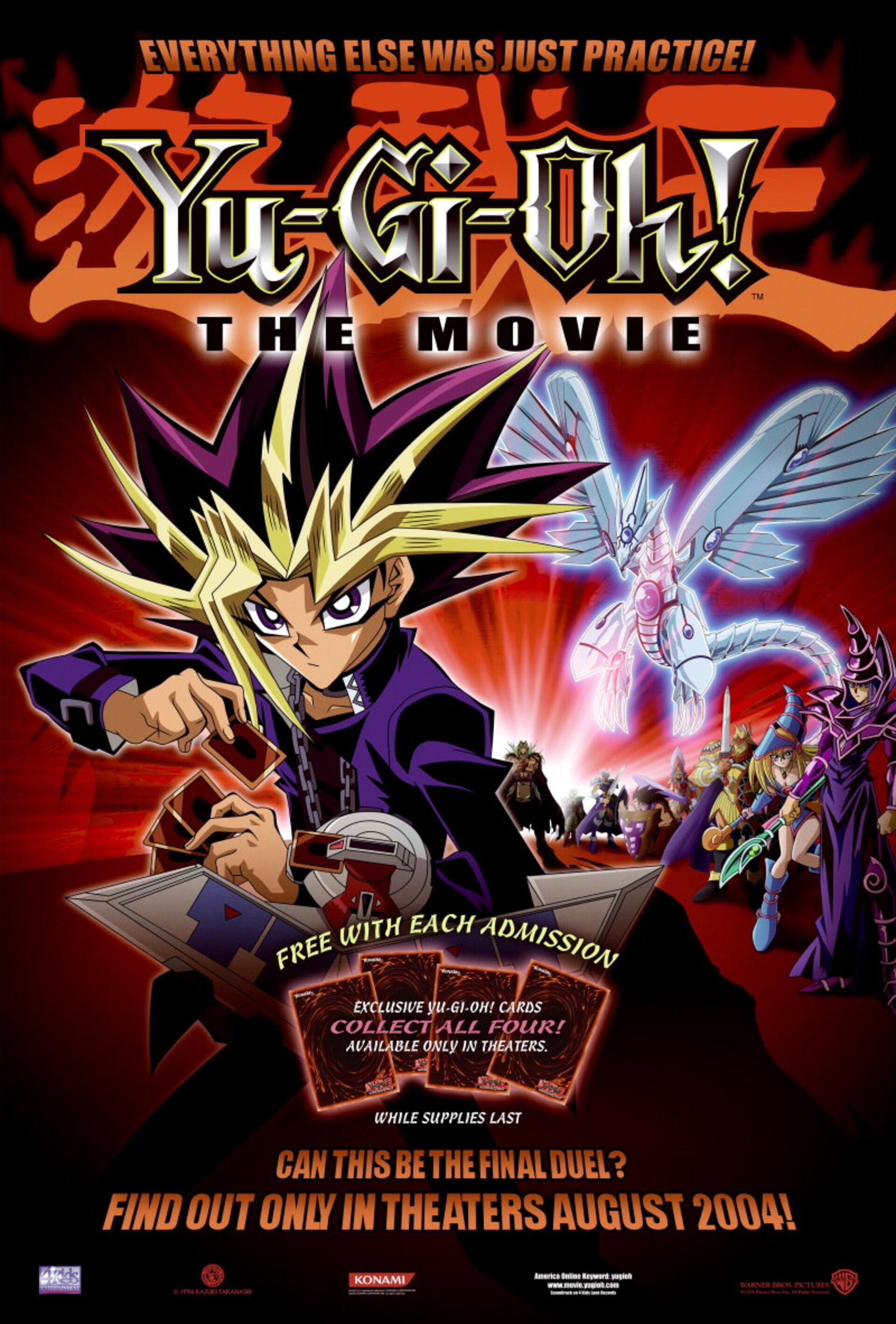
When Yu-Gi-Oh! The Movie: Pyramid of Light hit U.S. theaters in 2004, it was a massive deal. I remember the hype. Kids were literally only going to the theater to get the exclusive promo cards (Watapon, anyone?). But here is the thing: this movie was essentially commissioned by 4Kids Entertainment for a Western audience.
It was a Japanese-American co-production, which is why it feels so much like an extended episode of the dub.
The Continuity Headache
The film takes place right after the Battle City arc. Yugi has the three Egyptian God cards, and Kaiba is still salty about losing. But the villain, Anubis, feels like he was pulled out of a hat. The movie tries to retcon Egyptian lore to fit him in, but he’s never mentioned again in the series.
Fun fact: The Japanese cut of this movie is actually 12 minutes longer than the version we saw in the West. It has more dialogue, slightly more violence, and better pacing. Also, the cards in this movie look like real-life TCG cards, which was a huge departure from the simplified designs used in the TV show.
Bonds Beyond Time and the 3D Gimmick
In 2010, the franchise celebrated its 10th anniversary with Yu-Gi-Oh! 3D: Bonds Beyond Time. This is peak fanservice. It brings together Yugi Mutou, Jaden Yuki (GX), and Yusei Fudo (5D's) to stop a time-traveler named Paradox.
It’s short. Really short.
At only about 45 to 50 minutes, it’s basically a long OVA that got a theatrical release. The plot is paper-thin. Paradox wants to destroy Pegasus (the creator of Duel Monsters) to prevent the card game from ever ruining the future. It’s a classic "prevent the apocalypse" trope.
The highlight is obviously the three-way duel. Seeing Yusei’s Stardust Dragon and Jaden’s Elemental HERO Neos on the field alongside Yugi’s Dark Magician is cool, but the movie suffers from "too many protagonists" syndrome. Yusei does most of the heavy lifting, Jaden provides the jokes, and Yugi... well, Yugi is just there to be the legend.
The Dark Side of Dimensions: The Real Finale
If you want to see a movie that actually matters, it’s Yu-Gi-Oh!: The Dark Side of Dimensions (2016). This isn't just another side story. It was written by the original creator, Kazuki Takahashi, as a direct sequel to the manga.
This is where things get confusing for anime-only fans.
In the manga, the ending is slightly different. Kaiba doesn't actually witness the final duel between Yugi and Atem. Because of that, he never gets the closure he needs. The Dark Side of Dimensions is basically a character study of a man who cannot let go of his rival.
Why It Stands Out
- The Animation: It looks incredible. The budget was clearly higher than anything they’d ever done.
- The Stakes: It deals with "Plana," a collective consciousness that can rewrite reality.
- Kaiba's Ego: Seto Kaiba literally builds a space station and invents a new form of dueling just to try and find a ghost. It’s Peak Kaiba.
The movie is a love letter to the original series, but it’s definitely geared toward older fans who followed the manga. It’s long, it’s complex, and the ending is surprisingly philosophical.
How to Actually Watch the Yu-Gi-Oh Movies
If you're planning a marathon, don't just go by release date. It’ll give you whiplash. Instead, try this order to keep some semblance of sanity:
- Yu-Gi-Oh! (1999): Watch this if you want to see the Toei/Season 0 era. It’s a standalone curiosity.
- Pyramid of Light (2004): Watch this after the Battle City arc of the original anime. It fits best there, even if it's not strictly canon.
- Bonds Beyond Time (2010): This is best watched after you’ve finished Yu-Gi-Oh! 5D’s, or at least after the Crash Town arc, so you understand who the characters are.
- The Dark Side of Dimensions (2016): Save this for last. It is the definitive "goodbye" to the original cast.
Actionable Takeaway for Fans
If you only have time for one, watch The Dark Side of Dimensions. It’s the only one that feels like a "film" rather than a marketing stunt. For the best experience, try to find the Japanese version with subtitles; the English dub is nostalgic, but the original script for DSoD has a weight to it that the 4Kids-style dialogue sometimes undercuts.
Before you dive in, make sure you've refreshed yourself on the ending of the original manga. The movie starts exactly where the books left off, ignoring the "filler" arcs of the anime like the Waking the Dragons or KC Grand Prix seasons. Knowing that the Pharoah is truly gone is essential to feeling the impact of Kaiba's desperation.


