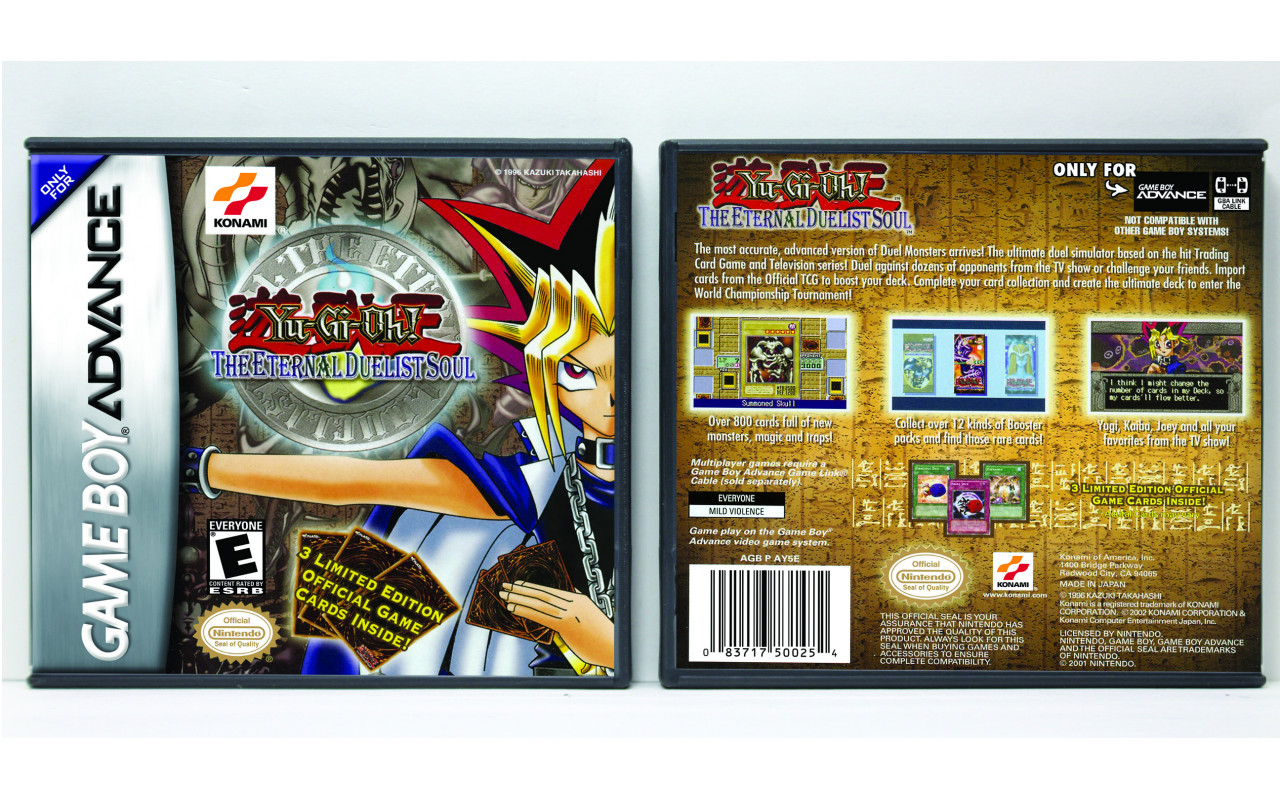
If you grew up with a Game Boy Advance in the early 2000s, you probably remember the clicking sound of a plastic cartridge sliding into the slot and that iconic Konami jingle. For most of us, Yu-Gi-Oh! Eternal Duelist Soul was the gateway drug to the competitive card game. It wasn't the first Yu-Gi-Oh! game, and it certainly wasn't the last, but it holds this weird, permanent residence in the brains of fans who preferred the grind of the Duel Monsters circuit over the RPG-lite mechanics of something like Sacred Cards.
Honestly, it’s a bit of a time capsule. Released in 2002, right when the TCG was exploding in the West, this game was the first time we got a "proper" simulator on a handheld. No weird elemental weaknesses. No "summoning points" that limited your deck building based on some arbitrary level. It was just the rules. Well, mostly the rules.
The Brutal Reality of the 2002 Meta
The game’s card pool stops somewhere around the Labyrinth of Nightmare set. This means you are playing in an era dominated by what players now call "GOAT Format" or even earlier. We are talking about a world where Raigeki, Harpie's Feather Duster, and Pot of Greed were all legal. It was chaotic. It was fast. It was, quite frankly, a little bit broken.
You start with a basic deck that is, to put it lightly, hot garbage. You've got 1200 ATK monsters trying to go up against Tea Gardner’s surprisingly annoying stall tactics. The progression loop is simple but addicting: win duels, get points, buy packs, hope you pull a Summoned Skull.
The AI in Yu-Gi-Oh! Eternal Duelist Soul isn't exactly a tactical genius by modern standards. It makes mistakes. It will sometimes use a Change of Heart on a monster it has no business taking. But man, when the AI gets a good hand, it feels like the game is personally offended by your existence. Yugi and Kaiba don't play fair. They start with the best cards in the game while you're still trying to figure out if 7 Colored Fish is your best beatstick.
Decoding the Calendar System
One thing most people forget—or maybe just blocked out because it was frustrating—is the internal clock. The game progresses through a weekly calendar. On certain days, you get magazines that give you tips or announce tournaments. It made the world feel lived-in, even if the "world" was just a series of static menus.
If you played on a real GBA, the internal battery eventually died, which messed with the clock. But back in the day? Waiting for that specific day of the week to hit a tournament felt like an actual event. It wasn't just a menu grind; it was a schedule.
Why "Eternal Duelist Soul" Beats the Modern Sequels
Look, Master Duel is great. It’s polished. It has thousands of cards. But it’s also overwhelming. Yu-Gi-Oh! Eternal Duelist Soul offers something the modern game lacks: a finite boundary.
You can actually "finish" this game. You can collect every card. There are about 800 cards in total. In a world where there are now over 12,000 unique cards in the TCG, there is something deeply therapeutic about a card pool you can actually memorize. You know every out. You know exactly what’s in your opponent's deck because you've played them fifty times.
The Tier System and the Grind
The duelists are divided into tiers. You can't just jump straight to Pegasus or Ishizu Ishtar. You have to earn your stripes against the low-level characters like Joey (who is surprisingly easy to beat) and Tristan.
- Tier 1: The basics. Tea, Joey, Tristan, Bakura, and Grandpa. Honestly, if you lose to Tristan, you might need to rethink your life choices.
- Tier 2: This is where the difficulty spikes. Mai Valentine and Mako Tsunami actually start using semi-competent strategies.
- The Rare Hunters: This was the coolest part. Occasionally, the game tells you a Rare Hunter is in town. These guys use "illegal" decks. We’re talking three copies of Exodia pieces or decks built entirely around Graceful Charity.
Winning against a Rare Hunter felt like a genuine achievement because the odds were so heavily stacked against you. It captured that "Battle City" vibe perfectly.
The Secret Sauce: Passwords and Promos
We have to talk about the passwords. Every physical Yu-Gi-Oh! card has an eight-digit code in the bottom left corner. In Yu-Gi-Oh! Eternal Duelist Soul, you could enter these codes to unlock cards in-game.
It was a brilliant marketing move. It bridged the gap between the physical hobby and the digital game. I remember scouring my collection, typing in codes for Jinzo or Imperial Order, praying I had enough Duel Points to actually "rent" or unlock them.
Then there were the physical promos. The game came with three cards: Exchange, Graceful Charity, and Archfiend of Gilfer. In 2002, Graceful Charity was a staple. Buying the game wasn't just about the software; it was about upgrading your real-life deck. That synergy is something Konami hasn't quite replicated with the same magic since the GBA era.
Technical Quirks and Annoyances
It wasn't all sunshine and Dark Magicians. The game has some weird quirks. For one, the music is an absolute earworm, but it's also incredibly repetitive. You will hear that same three-minute loop for forty hours.
The deck-building interface is also a bit clunky. Scrolling through 800 cards one by one on a D-pad? It’s a test of patience. There’s no search bar. No "filter by archetype" because archetypes barely existed back then. You just had to know that Sangan was a Fiend and scroll until you found it.
Also, let's talk about the banlist. The game uses a specific Forbidden/Limited list that was current for 2002. If you're coming from modern Yu-Gi-Oh!, seeing Monster Reborn at one and Raigeki at one feels like the Wild West. Matches end in three turns because someone drew the "power three" and cleared the board. It’s fast, mean, and totally unbalanced. And honestly? That's why it's fun.
A Quick Word on "Cheating" the System
If you really want to break the game, you just hunt for the Rare Hunters. Their cards are insane. Once you beat them enough, you can start incorporating those "forbidden" cards into your own builds for certain modes. The game actually encourages you to be as degenerate as possible once you've proven you can handle the standard tiers.
How to Play It Today (The Right Way)
If you're looking to revisit Yu-Gi-Oh! Eternal Duelist Soul, you have a few options. Finding an original cartridge is still relatively easy on the second-hand market, though prices have ticked up lately because of the "retro gaming" boom.
If you're using an emulator, do yourself a favor: turn on the fast-forward button. The animations for drawing cards and lifepoint deductions are charming, but they take forever.
Actionable Tips for a 2026 Playthrough
If you’re diving back in, here is how you actually win without losing your mind:
- Prioritize Beatdown: In the early game, don't try to be fancy. High ATK Level 4 monsters like 7 Colored Fish (1800 ATK) and La Jinn the Mystical Genie of the Lamp (1800 ATK) are your best friends. The AI struggles with simple math.
- Abuse the Stakes: You can "ante" cards in this game. If you're confident, bet your best cards to win even better ones from the AI. Just don't cry when Kaiba takes your Blue-Eyes.
- The Password Trick: Don't waste your Duel Points on random packs early on. Look up the password for Witch of the Black Forest or Sangan. These are searchers that make any deck infinitely more consistent.
- Watch the Calendar: Don't skip days. Check the magazines every Tuesday. They unlock specific packs that you can't get otherwise.
Yu-Gi-Oh! Eternal Duelist Soul remains a high-water mark for the franchise. It didn't try to be a sweeping RPG or a 3D spectacle. It just wanted to be a card game in your pocket. It succeeded so well that, even twenty-four years later, it’s still the most "pure" way to experience the original Duel Monsters era. It’s a reminder that sometimes, the simplest version of a game is the one that stays with you the longest.
The next step is simple. Dig that GBA out of the closet, or find a reliable emulator, and start grinding for that Mirror Force. Just watch out for Joey—he’s luckier than he looks.