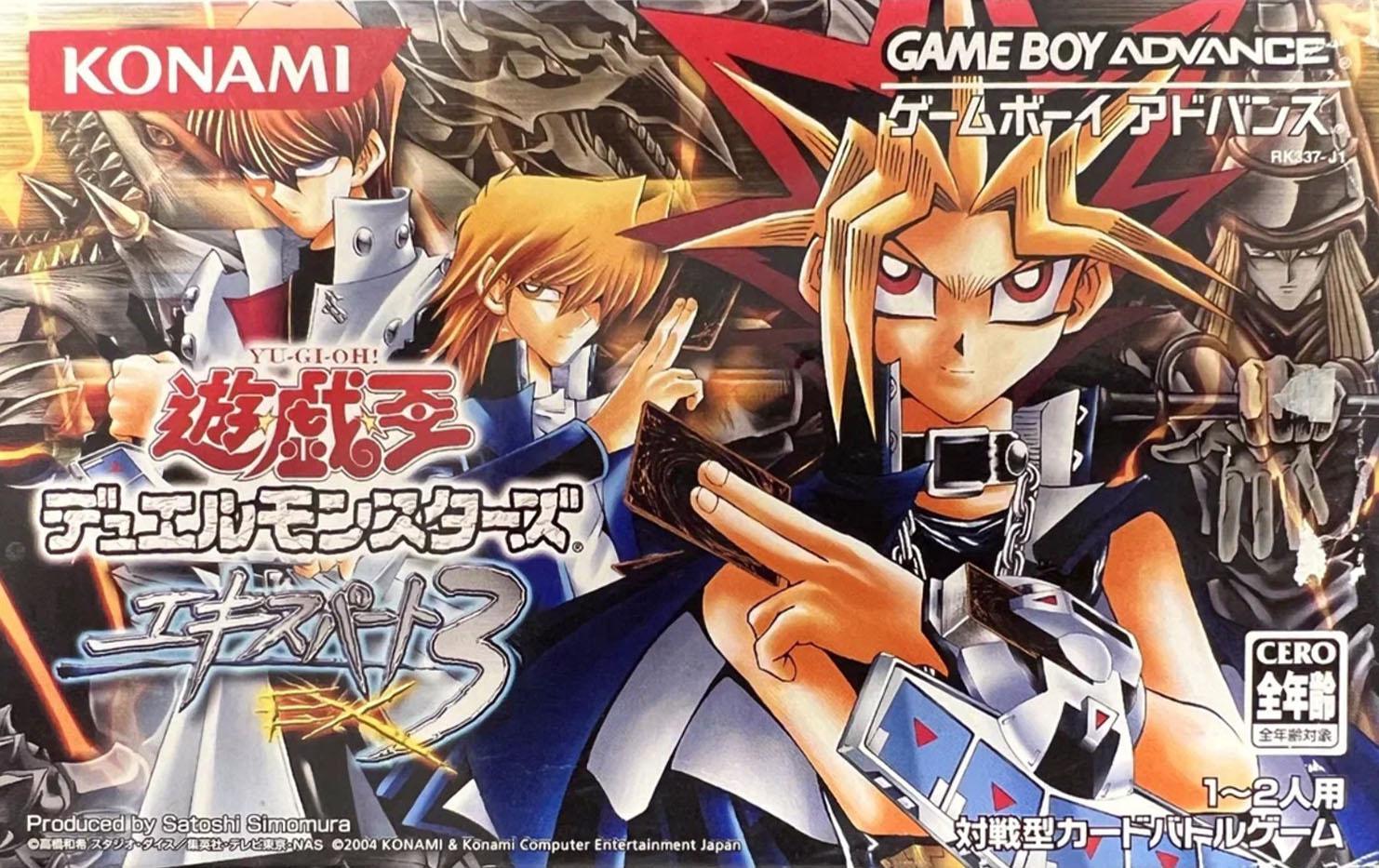
It was 1998. If you were a kid in Japan with a original brick Game Boy, you probably didn't know that the small grey cartridge labeled Yu-Gi-Oh! Duel Monsters was about to spark a global obsession. Honestly, looking back at that first Konami release, it’s a miracle the franchise survived at all. The game didn't follow the rules we know today. There were no Tribute Summons. No complex chain links. Basically, it was a glorified version of Rock-Paper-Scissors with monster art that looked like it crawled out of a fever dream.
But it worked.
The original Yu-Gi-Oh! Duel Monsters Game Boy experience is a fascinating relic. It’s a snapshot of a time before the Trading Card Game (TCG) actually existed in the real world. Kazuki Takahashi’s manga was still in its "Shadow Games" phase, where the cards were just one of many ways Yugi Muto would psychologically torture his opponents. When Konami sat down to code this thing, they were working with a moving target. They had to invent a game system out of thin air based on a comic book that was playing fast and loose with its own internal logic.
The Rules That Weren't Really Rules
If you pick up a fan-translated ROM of this game today, you're going to be confused. Very confused. You’ll try to play Blue-Eyes White Dragon and realize you don't need to sacrifice anything. You just drop it on the field. Then, your opponent drops a 400-ATK monster and somehow destroys your legendary dragon because of a "hidden" elemental weakness.
The game relied heavily on an elemental alignment system. Every card had an attribute like Forest, Wasteland, or Mountain. It wasn't just flavor text. If your monster's type was weak against the opponent's type, you lost the battle instantly, regardless of Attack points. It felt unfair. It was unfair. You've basically got to memorize a secret chart just to survive the first five duels against Joey (Jonouchi) or Tea (Anzu).
The deck building was equally restrictive. You had a "Deck Capacity" limit. Even if you managed to grind for a powerful card, you couldn't use it if your total capacity was too low. It forced a weird kind of strategy where you filled your deck with absolute garbage just so you could afford to pack one single Summoned Skull. It's a grind. A heavy, monochrome grind. Yet, there is something strangely satisfying about finally beating Seto Kaiba after he’s cheesed you with high-level monsters for three hours straight.
Why This Specific Version Matters for Collectors
There’s a reason this specific 1998 release is a holy grail for some collectors. It wasn't just the game; it was what came inside the box. Konami included three random promotional cards with every copy. This was the debut of cards like Salamandra, Acid Trap Hole, and the legendary Kunai with Chain.
If you find a "CIB" (Complete in Box) copy today, you’re looking at a significant piece of history. Most kids ripped those packs open and shoved the cards into rubber bands. Finding the original Game Boy version with the cards still sealed is like finding a fossil that’s still breathing. The game sold over 1.6 million copies in Japan alone. That's a massive number for a niche title based on a manga that hadn't even peaked yet. It proved to Shueisha and Konami that "Magic & Wizards" (as it was called in the manga) was the golden goose.
The Technical Limitations of the DMG-01
The Game Boy hardware was screaming for mercy. Managing a library of over 350 monsters on a screen with the resolution of a postage stamp meant the sprites were... creative. Some monsters look like blobs of ink. Others are surprisingly detailed. The music, composed by the Konami Kukeiha Club, is iconic in its own lo-fi way. It’s that high-pitched, driving 8-bit techno that makes you feel like the world is ending if you don't draw an Equip spell in the next ten seconds.
Unlike the later Dark Duel Stories on the Game Boy Color, which introduced the color palette we’re used to, the original is all about four shades of pea-soup green. It creates an atmosphere that feels darker and more occult, which honestly fits the early Yu-Gi-Oh! vibe better than the bright, polished anime style that came later.
Grinding for the "God" Cards
In the late 90s, "God Cards" weren't Slifer or Obelisk. They were just the cards that didn't suck. To get the best stuff, you had to use the communication cable. Remember those? Sitting two inches away from a friend, praying the cable didn't jiggle and delete your save data.
The game had a "Duelist Level" system. If you wanted to use better cards, you had to win duels to raise your level. But here’s the kicker: the AI in this game is notoriously psychic. The computer knows what you’ve set. It knows your hand. It will wait to play a specific counter until the exact moment it ruins your life. This isn't modern AI with neural networks; it’s just old-school "cheating" code that makes the victory feel that much sweeter when you finally exploit a glitch in its logic.
One of the most famous (or infamous) mechanics was the "Password" system. You could enter an 8-digit code found on real-life cards to get them in-game. Except, most of the time, the game would tell you the card didn't exist yet or required a ridiculous amount of "Star Chips" to unlock. It was a brilliant marketing move. It bridged the gap between the physical and digital worlds before most people even had an email address.
The Evolution to Duel Monsters II and III
By the time Duel Monsters II: Dark Duel Stories hit the scene, the "official" rules were starting to take shape. But the first Game Boy title remains the pure, unadulterated chaos of the early series. It represents the "Wild West" of card games.
People often ask if it’s worth playing today. Honestly? Only if you’re a masochist or a historian. If you want a balanced card game, go play Master Duel. If you want to see how a multi-billion dollar empire started—flaws and all—then you need to see the Yu-Gi-Oh! Duel Monsters Game Boy era. It’s short. It’s brutal. It’s frequently unfair. But it has a soul that many modern, microtransaction-filled mobile games lack.
You can really feel the influence of the manga here. Every duel feels like a life-or-death struggle in a dark alley in Domino City. There's no "heart of the cards" to save you; there’s only your ability to manipulate the elemental system and hope the AI doesn't decide to end your career with a turn-one Blue-Eyes.
Actionable Steps for Retrogaming Fans
If you're looking to dive into this specific piece of gaming history, don't just jump in blindly. You'll get frustrated and quit within ten minutes.
- Find a Translation Patch: The game was never officially released in English. Look for the fan translation by "MottZilla." It’s the gold standard and makes the elemental system actually readable.
- Study the Type Chart: Don't try to power through with high ATK. Learn which types beat which. For example, Dream beats Fiend, and Fiend beats Dreams. It makes no sense until you realize it’s basically a circle of rock-paper-scissors.
- Prioritize Leveling: Don't worry about winning every duel early on. Just focus on increasing your Duelist Level so you can actually use the cards you win.
- Check the Card List: Many cards in this game have completely different stats than their real-world counterparts. Check a database like the Yu-Gi-Oh! Fandom Wiki specifically for the "DM1" stats.
- Embrace the Save State: If you’re playing on an emulator, don’t feel guilty. The AI is a cheater. You’re just evening the playing field when the computer "happens" to have the perfect counter three times in a row.
This game is a time capsule. It’s the foundation of a cultural phenomenon. While it might be clunky by 2026 standards, its DNA is still visible in every pack of cards sold today. Understanding where the game came from—the weird, elemental, green-tinted mess of 1998—makes you appreciate just how far the Duel Monsters have come.