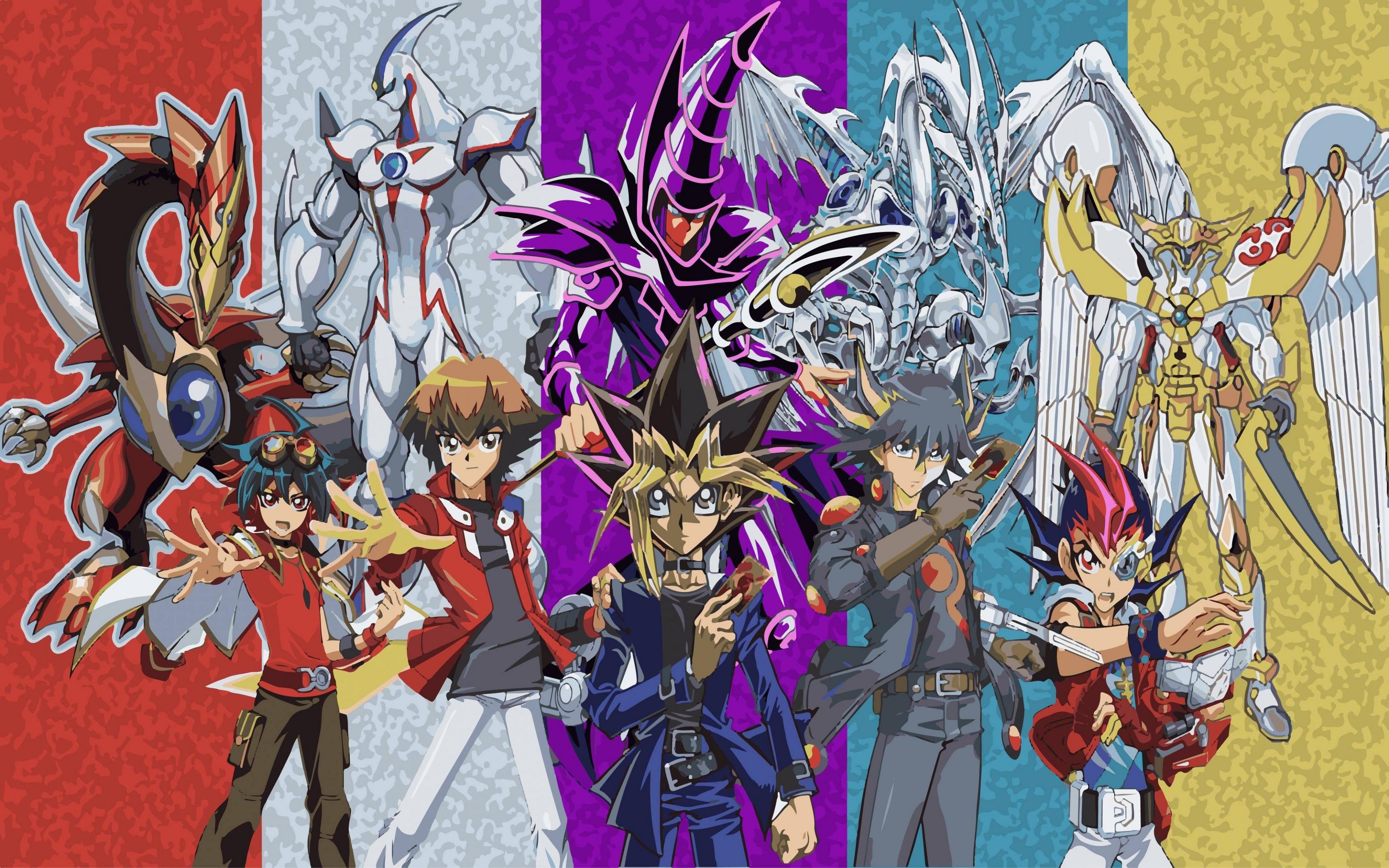
Everyone remembers the hair. It’s the first thing that hits you. You see Yugi Mutou and you aren't thinking about card game mechanics or Egyptian lore; you’re wondering how much gel it takes to keep those purple-and-black spikes from collapsing. Honestly, that’s the genius of Kazuki Takahashi’s original vision. He didn't just draw people playing a game. He drew icons.
Yu-Gi-Oh characters have this weird, magnetic staying power that defies most anime trends. Think about it. We are decades into this franchise, yet the mere silhouette of Seto Kaiba is enough to sell out a stadium or move thousands of dollars in plastic merchandise. It isn't just nostalgia. It’s how these characters were built to represent specific ideologies through their decks.
The King of Games and the Burden of the Puzzle
Yugi Mutou is a bit of a contradiction. He starts as this tiny, bullied kid who just wants friends. Then he solves the Millennium Puzzle and basically gains a second, much taller, much more confident soul. This dual-identity thing wasn't just a plot device; it was a way to explore the idea of "true strength."
Yami Yugi (or Atem) represents the ideal version of what a gamer wants to be—cool, collected, and always holding the right card. But the most interesting part of his character arc happens during the "Ceremonial Battle." That’s where we finally see that Yugi, the small one, has actually surpassed the ancient Pharaoh. It’s a gut punch. Most people forget that the entire 224-episode run was essentially a long goodbye.
The relationship between the two Yugis is what grounded the series. Without that emotional weight, the show would have just been a glorified commercial for trading cards. Instead, it became a story about growth. Yugi learned confidence, and Atem learned that he didn't have to carry the weight of his forgotten past forever.
Why Seto Kaiba Is the Greatest Antagonist Ever Written
Kaiba is a jerk. Let's just say it. He’s an ego-driven billionaire who built a theme park based on his own obsession and literally sent cards into space to teach aliens how to duel.
But he’s also right. Sort of.
In a world where everyone is screaming about "Heart of the Cards" and "Ancient Destiny," Kaiba is the only one standing there saying, "No, it's just a game and I have better technology than you." He’s the ultimate skeptic. Even when he’s literally staring at an Egyptian god or being transported to a shadow realm, he insists it’s just a high-end hologram or a trick of the mind. That level of stubbornness is legendary.
His design reflects this perfectly. The long white coat that defies gravity, the piercing blue eyes, and the Blue-Eyes White Dragon obsession. Kaiba isn't just a rival; he’s the personification of the competitive spirit taken to its most toxic, yet strangely admirable, extreme. He doesn't want to rule the world. He just wants to beat Yugi. That’s it. That’s his whole life.
The Joey Wheeler Factor
You can't talk about Yu-Gi-Oh characters without mentioning Katsuya Jonouchi, or Joey Wheeler in the dub. If Yugi is the talent and Kaiba is the money, Joey is the heart. He’s the guy who shouldn't be there. He uses a deck based almost entirely on luck—dice rolls, coin flips, and "Time Wizard."
He’s the most relatable character because he loses. A lot. But when he wins, it feels earned. His duel against Marik Ishtar in the Battle City finals is arguably the best moment in the entire original series. He technically lost, but he won the respect of everyone watching because he survived a literal "Shadow Game" that should have killed him, just through sheer willpower.
Joey proves that you don't need a Millennium Item or a billion dollars to be relevant. You just need to be a good friend and have a really lucky right hand.
The Evolution of the Archetype: GX through VRAINS
After the original series ended, the franchise had a problem. How do you replace Yugi? The answer was Jaden Yuki (Judai Yuki) in Yu-Gi-Oh! GX. Jaden was the polar opposite of Yugi. He was energetic, hated school, and actually enjoyed dueling for the sake of it.
The shift was jarring for some. But Jaden’s character arc is surprisingly dark. By the end of GX, he’s not the happy-go-lucky kid anymore. He’s fused with a cosmic entity (Yubel) and has a much more cynical view of the world. This set the stage for how the franchise would handle its leads moving forward.
- Yusei Fudo (5D's): The "serious" protagonist. He lives in a literal junkyard and builds his own motorcycle. He’s the first lead who feels like an adult from the start.
- Yuma Tsukumo (ZEXAL): A return to the "rookie" trope, but with a much higher learning curve. He was divisive, but his growth was tangible.
- Yuya Sakaki (ARC-V): The entertainer. His struggle with his "inner darkness" (Z-ARC) was a massive plot point that leaned heavily into the multiverse theory.
- Yusaku Fujiki (VRAINS): A stoic hacker with social anxiety. He was a complete departure from the "shonen hero" mold.
Each of these Yu-Gi-Oh characters brought a different flavor to the game. While Yugi focused on the mystical, Yusei focused on the social divide between the rich and the poor, and Yusaku focused on the trauma of the past.
The Villains Nobody Saw Coming
A good card game anime is only as good as its villain. Maximillion Pegasus (Pegasus J. Crawford) set the bar high. He was flamboyant, used a "Toon" deck that felt like a fever dream, and had a genuine, tragic motivation: he just wanted to see his dead wife again.
Then came Marik Ishtar. Marik changed the stakes. Suddenly, it wasn't just about losing a soul; it was about physical pain. His "Shadow Games" were brutal. The Egyptian God cards—Slifer, Obelisk, and Ra—became characters in their own right. They weren't just monsters; they were forces of nature that the human characters had to try and control.
Bakura is the one that really creeps people out, though. The "Thief King" persona from the final arc showed us a version of the world where the game wasn't a game at all, but a literal war. The fact that the "nice" Bakura was just a puppet for an ancient evil for most of the series makes his character one of the most tragic in the show's history.
What Most People Get Wrong About These Characters
The biggest misconception is that Yu-Gi-Oh characters are just there to sell cards. While the marketing is obviously a huge part of it, the character writing—especially in the original manga by Kazuki Takahashi—is deeply rooted in horror and psychological drama.
In the early chapters of the manga (often called "Season 0" by fans), Yugi was much more ruthless. He would literally set people on fire or drive them insane through "Penalty Games" if they lost his challenges. The card game wasn't even the focus yet. It was about a spirit of vengeance punishing bad people.
When the series shifted to Duel Monsters, that edge remained. The characters aren't just playing for fun; they are often playing for their lives, their family's safety, or the fate of the world. That high-stakes environment is why we care when someone draws a "Pot of Greed." It’s not about the +1 card advantage; it’s about whether or not they survive the next five minutes.
The Design Philosophy: Silhouettes and Color
If you look at the character designs across the different eras, there is a very specific logic at play. Every main character has a "look" that translates to their deck.
- Yugi: Red, black, and gold. His deck is a mix of dark magic (Dark Magician) and ancient warriors (Black Luster Soldier).
- Kaiba: Blue and white. Clean, sharp lines. His deck is about high ATK power and technological superiority.
- Yusei: Blue and yellow. His "Stardust Dragon" reflects the "shooting star" theme of his world.
- Jack Atlas: Purple and white. He’s the "King," and his "Red Dragon Archfiend" is a direct contrast to Yusei’s elegance—it’s pure, raw aggression.
This visual storytelling is why kids could recognize these characters from across a room. It’s also why the memes have lasted so long. The "Kaiba Corp" logo is as recognizable to a certain generation as the Nike swoosh.
How to Appreciate Yu-Gi-Oh Characters in 2026
If you’re coming back to the series or looking at these characters for the first time, don't just look at the cards they play. Look at why they play them.
- Check out the original manga: It’s much darker than the anime and gives a lot more context to why Yugi and Kaiba are the way they are.
- Watch the Japanese version (Subbed): The English dub is iconic for its voices (Dan Green and Eric Stuart are legends), but the original Japanese script often carries a much more serious tone and different musical cues that change the vibe of the characters.
- Look at the "Deck Profiles" through a character lens: See how a character’s deck evolves with their personality. Jaden’s shift from "Elemental HEROs" to "Evil HEROs" is a perfect example of storytelling through gameplay mechanics.
The legacy of these characters isn't just in the billion-dollar card game. It’s in the way they taught a generation about strategy, friendship, and the fact that sometimes, even if you have the best cards in the world, you can still lose to a guy with a fuzzy brown ball named Kuriboh.
To really understand the impact, you have to look at the community. Even now, fans are still debating whether Kaiba actually loved his brother or if he just saw him as an extension of his own power. They’re still arguing over which protagonist would win in a "fair" fight. That level of engagement only happens when characters are built with actual depth.
Yu-Gi-Oh characters are more than just avatars for a game. They are the reason the game matters. Without the drama of the Duelist Kingdom or the tragedy of the Pharaoh’s past, the cards would just be pieces of cardboard. Because of them, those cards are "the heart."
To deepen your understanding of these dynamics, your next step should be to compare the Battle City character arcs with the Pharaoh's Memories arc. You'll notice a massive shift in how the millennium items dictate character motivations versus how the card game does. For a practical exercise, try building a "Character Accurate" deck in any modern Yu-Gi-Oh simulator—you'll quickly realize how much their personalities actually hindered their winning percentages, which makes their victories even more impressive.