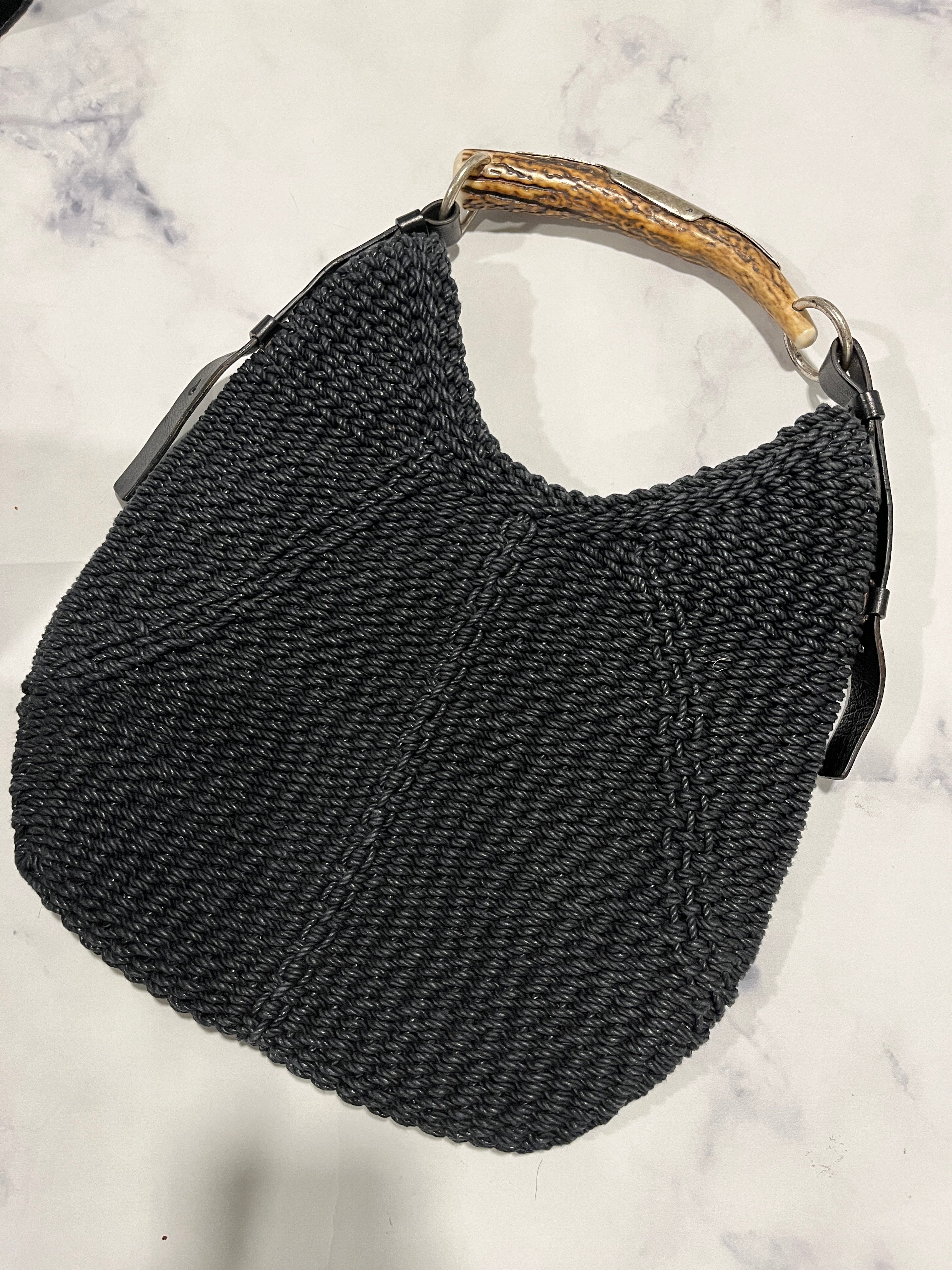
You’ve seen it. That slouchy, defiant hunk of leather topped with a curved, dangerous-looking handle that looks like it belongs in a museum or a weapon rack. The YSL Mombasa horn bag is one of those rare fashion objects that people either obsess over or find completely baffling. Honestly? That’s exactly how Tom Ford wanted it.
When it debuted on the Spring/Summer 2002 runway, it didn't just walk; it charged. At the time, Yves Saint Laurent was in a weird spot. The Gucci Group had just bought the house, and Tom Ford was trying to figure out how to make "old-school" French couture feel relevant to a generation obsessed with low-rise jeans and the Matrix. He decided the answer was a bag named after a Kenyan seaport.
The Handle That Broke the Internet (Before the Internet Was Ready)
The defining feature—the one everyone talks about—is the handle. It wasn't just a "horn-style" handle. It was actual, honest-to-god horn. Specifically, Ford sourced naturally shed deer and Ankole cattle horn to create a grip that felt prehistoric. Every single original bag was technically a "one-of-one" because no two horns grow the same way.
This wasn't just an aesthetic choice. Ford famously told the press that what the bamboo handle was to Gucci, the horn would be to Saint Laurent. It was a power move. Carrying a Mombasa felt like holding a scepter. It was heavy. It was cool to the touch. It was, as some critics noted at the time, a "formidable weapon" if you ever found yourself in a tight spot in a dark alley.
The strategy worked. Bergdorf Goodman originally ordered 60 bags, panicked about the 2001 economy, and then immediately begged for 500 more because they couldn't keep them on the shelves. By the end of its first year, the Mombasa and its variations had generated a staggering $90 million in revenue. That was 26% of the brand’s total earnings. Not bad for a bag with no logos.
Why the YSL Mombasa Horn Bag Still Matters in 2026
Fashion is a circle, and right now, we are looping back hard. In early 2026, Anthony Vaccarello (the current creative lead at Saint Laurent) officially brought the Mombasa back. But there’s a catch. If you’re looking for the 2026 version, you’ll notice the horn is... gone.
The new revival features a leather-wrapped handle. It’s sleeker, sure. It’s arguably more "ethical" and definitely more "quiet luxury." But for the purists? The original horn-handled version from the early 2000s remains the ultimate grail.
How to Spot a Real Vintage Mombasa
Since these are currently flooding the resale market (and being faked like crazy), you have to be careful. Real YSL Mombasa bags from the Tom Ford era have very specific "tells."
- The Serial Number: Look inside for a rectangular leather tab. On a real vintage piece, the serial number is usually 12 digits, split into two rows of six. If you see "Saint Laurent Paris" in a modern font on a "vintage" horn bag, run. That branding didn't exist back then; it would say "Yves Saint Laurent Rive Gauche."
- The Horn Texture: Acrylic fakes look too perfect. Real horn has "growth rings," subtle ridges, and color variations. If the handle feels like lightweight plastic, it probably is.
- The Weight: These bags are surprisingly heavy. The leather used in the early 2000s was a thick, "chevre" (goatskin) or a dense calfskin. It shouldn't feel flimsy or paper-thin.
- Hardware Inscriptions: The metal caps holding the horn in place are often engraved with "YSL" or subtle tribal-inspired patterns. The engraving should be deep and crisp, not blurry.
The "Bella Hadid" Effect and the 2026 Revival
Just this month, in January 2026, Bella Hadid was spotted in New York carrying the medium-sized Mombasa revival in "Rouge Cabernet" leather. She’s the face of the new campaign shot by Glen Luchford, and the "Hadid effect" has already caused a 400% spike in searches for the vintage horn versions on sites like Vestiaire Collective and 1stdibs.
It's a weird moment for the bag. We have the new version—which costs about $4,300 for a medium and $5,600 for a large—competing with the vintage horn versions that you can still occasionally find for under $1,200 if the seller doesn't know what they have.
Pro tip: If you want the "vibe" without the price tag, look for the "St. Tropez" version of the Mombasa. It features the same horn handle but with a ruffled, tiered leather body. It’s a bit more "boho," but the craftsmanship is just as high.
Variations You Should Know About
The Mombasa wasn't just one bag; it was a whole ecosystem.
- The Classic Hobo: The most common shape. Flat-bottomed, crescent-topped.
- The Men's Version: Yes, Tom Ford made a larger, rugged version for men. It’s basically a massive weekender with a giant horn.
- The Exotic Skins: If you find a Mombasa in lizard or ostrich, you’ve hit the jackpot. These were produced in extremely limited quantities for the "Rive Gauche" VIPs.
- The Metal Handle: Some later versions from the Stefano Pilati era (mid-2000s) swapped the horn for a heavy silver or gold-tone metal handle.
The Practical Reality of Owning One
Let's be real for a second. This bag is a pain to carry if you’re used to lightweight nylon totes. The horn doesn't "give." It sits on your shoulder like a solid piece of timber. If you wear a thin silk blouse, the horn might leave a mark.
But that’s kind of the point.
The YSL Mombasa horn bag wasn't designed for "comfort." It was designed to make you look like you just returned from a very expensive, very chic safari. It’s a "look." It’s a statement that says you value texture and history over practicality.
Your Next Steps
If you're ready to hunt one down, start by searching for "YSL Rive Gauche Horn Bag" rather than just the modern keyword. Many older collectors don't even use the word "Mombasa."
Check the "sold" listings on eBay to get a real sense of the current market value—don't just trust the $3,000 asking prices on boutique sites. Most importantly, if you find one with a cracked handle, skip it. Horn is notoriously difficult to repair once it splits, and a "glued" handle will never have the same structural integrity or value. Look for handles that have been kept in climate-controlled environments; extreme dryness is the enemy of natural horn.
The Mombasa is officially back, but the original horn version is the only one that truly captures that chaotic, sexy, dangerous energy of the early 2000s.