If you ask a hardcore Falcom fan about the "perfect" entry point for the Ys series, they won't point you to the big, open-world sprawl of Ys VIII: Lacrimosa of Dana. They probably won't mention the flashy party mechanics of Ys IX or Ys X: Nordics, either. No. They’ll look you dead in the eye and talk about a 2005 remake of a 1989 black sheep. Ys: The Oath in Felghana is that game. It's lean. It's mean. It’s essentially a shot of digital adrenaline that refuses to let go of your throat until the credits roll.
Honestly, it’s kind of a miracle this game even exists in its current form. Back in the late 80s, Ys III: Wanderers from Ys was a weird side-scroller. People hated it. Or, well, they didn't hate it, but it felt like a massive step backward from the "bump combat" charm of the first two games. Then, Nihon Falcom decided to take that basic story—Adol Christin and his beefy best friend Dogi returning to Dogi's hometown—and rebuild it using the engine from Ys VI: The Ark of Napishtim. The result? A masterpiece of tight design and brutal difficulty.
Why the Combat in Ys: The Oath in Felghana Ruins Other Games
Most modern ARPGs are bloated. You spend forty minutes looking at gear stats and another twenty fiddling with skill trees. Ys: The Oath in Felghana doesn't care about your spreadsheets. You have a sword. You have three elemental bracelets—Wind, Fire, and Earth. That is it.
The brilliance lies in the execution. Adol moves like he’s wearing rocket-propelled boots. You aren't just mashing buttons; you’re managing a literal combo meter that dictates your experience gain and drop rates. If you stop hitting things, your bonuses dry up. It forces this frantic, aggressive playstyle where you’re constantly diving into the middle of a pack of monsters just to keep the momentum alive.
It’s fast. Like, really fast. You jump, you double jump, you whirl through the air with the Wind bracelet, and you bash through shields with the Earth bracelet. There’s a purity here that’s vanished from the genre. You won't find fetch quests that ask you to collect ten wolf pelts. If a character tells you to go to the Tigray Quarry, you go there, you kill everything that moves, and you fight a boss that will likely make you scream.
The "Wall" and Why We Love It
Let's talk about the bosses. In many games, bosses are just "sponges" with high HP. In The Oath in Felghana, they are puzzles.
Take Chester Stoddart, for example. He’s the rival archetype, the "Vergil" of this game. The first time you fight him, you'll probably die in thirty seconds. He’s faster than you. His reach is better. He punishes every single mistimed jump. But the game isn't being unfair. It’s teaching you. You start to recognize the frame data. You realize that you can’t just tank hits because healing items don’t exist in combat. You either dodge perfectly, or you die.
This creates a flow state. When you finally beat a boss like Galbalan, your hands are actually shaking. It’s a dopamine hit that modern, "hand-holding" RPGs rarely provide.
The Sound of Felghana: More Than Just Background Noise
You cannot talk about this game without mentioning the Falcom Sound Team JDK. If you’ve never heard "The Boy Who Had Wings" or "Illburns Ruins," stop reading and go look them up on YouTube. Right now.
Most game soundtracks are meant to blend into the background. Falcom does the opposite. They use searing electric guitars, driving synth beats, and melodic violin leads that make every screen feel like a heavy metal concert. It’s high-energy power metal that perfectly matches the speed of the combat.
- The Atmosphere: Even though the graphics are dated (it's a 2005 PC game ported to PSP and later refined for "Memoire" versions), the art direction holds up.
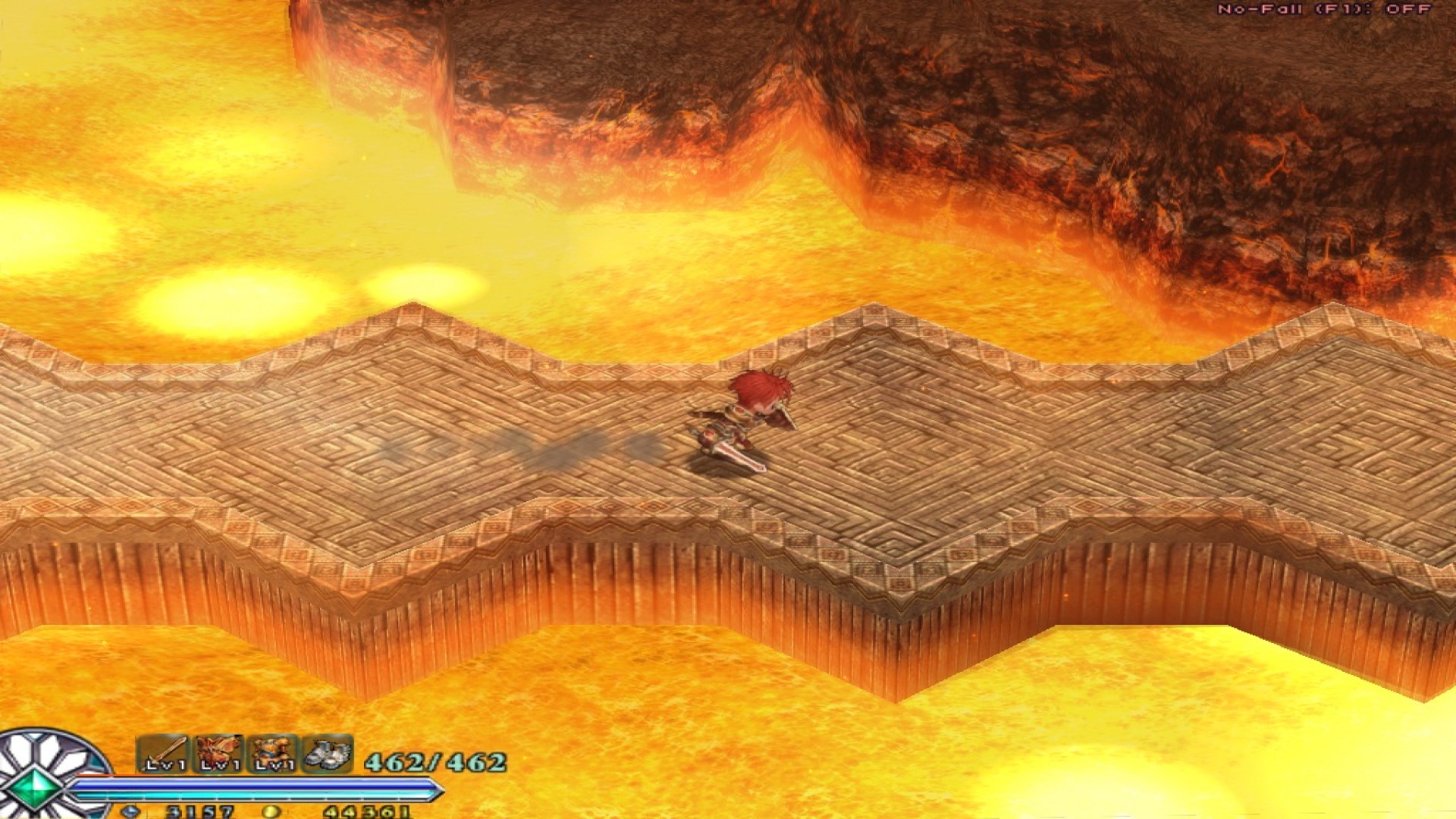
- The Scale: From the snowy peaks of the Elderm Mountains to the lava-soaked depths of the fire dungeon, the locations feel distinct despite the small map size.
- The Narrative: It’s a simple story about a corrupt Count and an ancient evil, but the pacing is airtight. No filler.
What People Get Wrong About the Difficulty
There’s a misconception that Ys: The Oath in Felghana is just for masochists. "It’s the Dark Souls of 2005," people say. That's a lazy comparison.
The game is actually very fair. If you're struggling, five minutes of grinding for one extra level makes a massive difference because of how the damage formulas work. It’s one of the few games where a single level-up feels like you’ve suddenly become a god. Plus, the "No Fall Damage" and "Retry" mechanics mean you’re never losing more than a minute of progress. It respects your time, even while it's kicking your teeth in.
The Different Versions: Which One Should You Play?
If you're looking to dive in today, you have choices.
- The Steam Version: This is based on the original PC release. It’s rock solid, supports high resolutions, and has the best modding potential.
- The PSP Version: Introduced voice acting and the "Double Boost" mechanic. A bit lower resolution, obviously.
- Ys: The Oath in Felghana Memoire: This is the newest HD remaster for Nintendo Switch and PlayStation. It features "Refined" character art (though you can toggle to the classic art), full voice acting for Adol, and a "High-Speed Mode."
Most purists suggest the PC version for the snappiest controls, but the Memoire edition is incredibly convenient for handheld play. The fact that Adol—traditionally a silent protagonist—has a voice in the new version is a bit controversial, but honestly, it adds a nice layer to the drama.
The Legacy of Adol Christin in Redmont
The town of Redmont serves as your only hub. Unlike the massive cities in Final Fantasy, Redmont feels like a real place because you return to it after every major beat. You get to know the shopkeepers. You see the NPCs' lives change as the political tension with Count McGuire ramps up.
It’s a compact experience. You can beat the game in about 10 to 12 hours. In an era where every game wants to be a 100-hour live-service commitment, there's something deeply refreshing about a game that says what it needs to say and then gets out of the way.
Technical Nuances You Might Have Missed
The game runs on a 2.5D perspective. The environments are 3D, but the camera is fixed, and the characters are often high-quality sprites or low-poly models that prioritize animation over realism. This is why the game feels so "snappy." There’s no input lag. There’s no heavy physics engine slowing down your jumps.
If you play on "Inferno" difficulty, the game changes entirely. Bosses gain new attack patterns. The timing windows for your elemental charges become razor-thin. It’s basically a different game at that point, reserved for people who have memorized every pixel of the boss arenas.
How to Get Started with Felghana Today
If you're ready to jump in, don't just mash the attack button. Here’s the real strategy:
First, learn the "pogo" jump. You can strike downward in mid-air to bounce off enemies. This isn't just for style; it keeps you out of reach of ground-based hitboxes. Second, pay attention to your crystals. Upgrading your weapons at the blacksmith is mandatory. If you try to take on the Abandoned Mine with a base-level sword, you're going to have a bad time.
Also, don't hoard your Boost meter. In The Oath in Felghana, the Boost gauge refills quickly. Use it to tank through a tough set of frames or to burst down a boss during a stagger window.
Final Practical Steps for the New Player
- Check the Settings: If playing on PC, ensure your refresh rate is capped at 60Hz. The engine's physics are sometimes tied to the framerate, and running at 144Hz can make certain jumps nearly impossible.
- Switch the OST: If you’re playing a version that allows it, try the "Genesis" or "PC-88" soundtracks for a different vibe, though the "Original" (2005) arrangements are generally considered the gold standard.
- Map Your Controls: If you're on a controller, put the "Wind" magic on a button you can reach easily while jumping. You'll be using it for platforming as much as combat.
Ys: The Oath in Felghana represents a specific peak in Japanese game design. It’s from an era before "open world" was a requirement and before tutorials lasted three hours. It trusts the player. It assumes you are smart enough to learn its patterns and fast enough to react to them. Whether you're a long-time Falcom fan or someone who just wants a pure, unadulterated action experience, this is the one. Grab a controller, turn the volume up to eleven, and prepare to die at least a dozen times to a giant bird. It’s worth it.