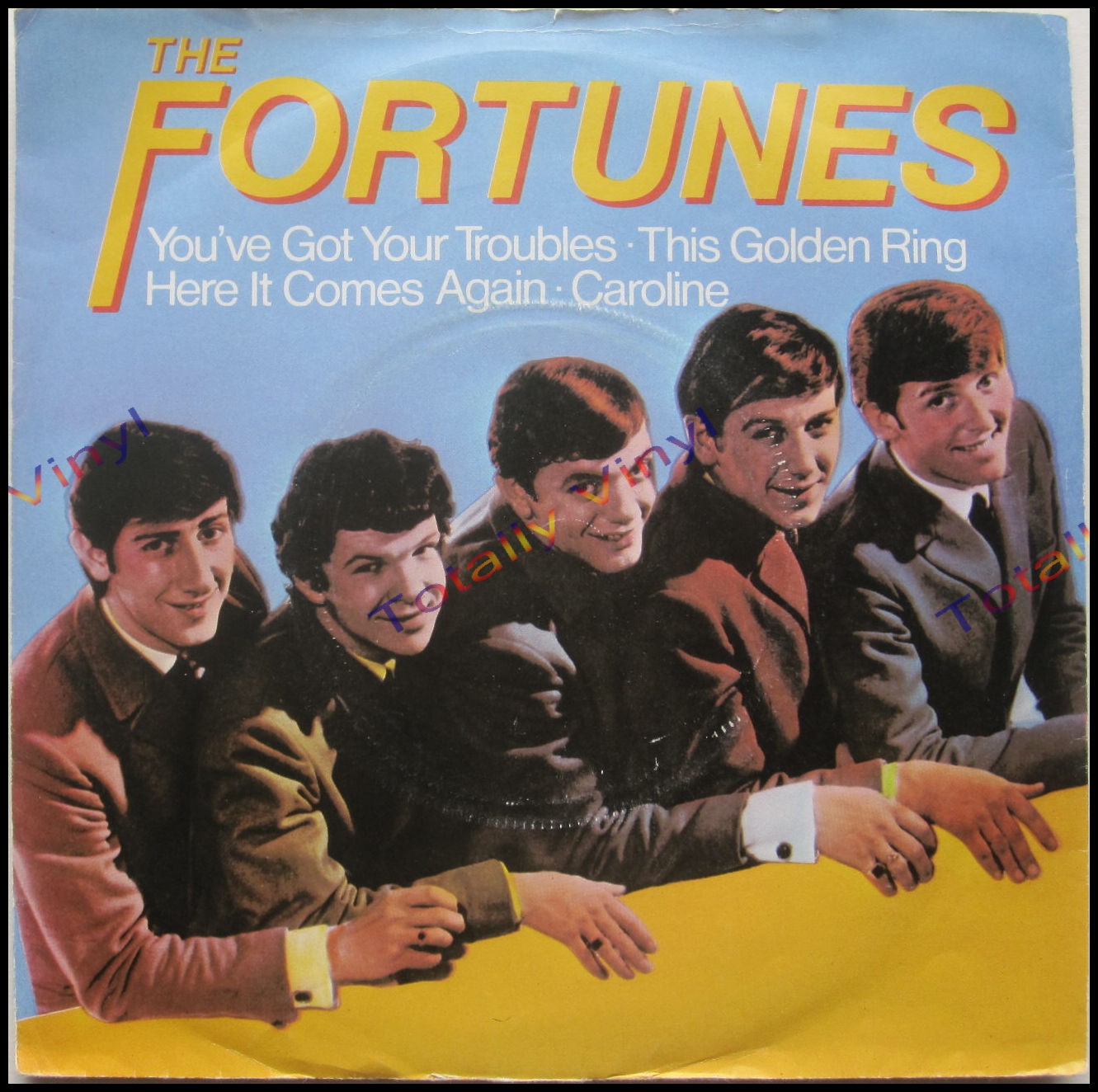
If you’ve ever sat in a dimly lit room nursing a broken heart while the radio played something a little too upbeat for your mood, you’ve probably felt the exact tension that made You've Got Your Troubles a global smash. It’s a weird song. Seriously. On one hand, you have these bright, soaring trumpet blasts and a melody that feels like a summer stroll through London. On the other, the lyrics are basically a competition of who is more miserable. It’s peak 1960s British Pop—polite, polished, but secretly devastated.
The Fortunes released this track in 1965. It didn't just climb the charts; it defined a specific moment when the "British Invasion" was moving away from raw Chuck Berry riffs and toward something more orchestral and sophisticated. Most people recognize the "I've got mine" refrain instantly, even if they can't name the band. That’s the mark of a true earworm. But there is a lot more to this song than just a catchy hook and some brass. It’s a masterclass in songwriting, session musician history, and the brutal reality of the music business in the mid-sixties.
The Roger Cook and Roger Greenaway Magic
You can't talk about You've Got Your Troubles without talking about "The Two Rogers." Roger Cook and Roger Greenaway were the powerhouse songwriting duo behind this track. This was actually their first big hit. Before they were writing for The Fortunes, they were just two guys trying to figure out how to bridge the gap between folk and pop.
The story goes that they wrote the song with a much slower, almost country-western vibe in mind. Imagine that for a second. Without that driving beat, it’s a very different animal. But when it got into the hands of producer Noel Walker, everything changed. He saw the potential for something bigger. He wanted drama. He wanted the kind of wall-of-sound depth that was starting to dominate the airwaves.
Honestly, the lyrics are kinda mean if you think about it. The narrator is talking to someone who is complaining about their own romantic woes, and his response is basically: "Shut up, I have it way worse."
"You've got your troubles, I've got mine... I've lost my lady, so I've got more than you."
It’s the 1965 version of "suffering is not a competition," except the song argues that it absolutely is a competition, and the singer is winning the gold medal in sadness. This bluntness is part of why it sticks. It feels human. We’ve all been that person who, in a moment of grief, lacks the empathy to care about someone else’s minor inconveniences.
Why the Arrangement Changed Everything
If this song had been recorded with just a guitar and a drum kit, it likely would have faded into the background of the 1965 charts. What makes You've Got Your Troubles stand out—even today—is the brass. Those trumpets aren't just background noise; they are the emotional engine of the track.
The arrangement was handled by Les Reed. If that name sounds familiar, it should. He’s the guy who co-wrote "It's Not Unusual" for Tom Jones. Reed had this uncanny ability to make a pop song feel like a cinematic event. By layering the vocal harmonies of The Fortunes (who were exceptionally tight singers) over a sophisticated orchestral backing, he created a sound that felt expensive.
The Session Musician Secret
Here is a fun bit of trivia that music nerds love to debate: who actually played on the record? While The Fortunes were a real band who played their own instruments live, the London session scene in the 60s was a closed shop of elite players.
It is widely documented that Jimmy Page—yes, that Jimmy Page from Led Zeppelin—was one of the busiest session guitarists in London at the time. While there is some back-and-forth among historians, many credit him with the acoustic guitar work on this track. This wasn't unusual. Big Jim Sullivan and Jimmy Page played on almost everything coming out of Decca or EMI at the time. It ensured the take was perfect the first time, saving the label money. This "pro" sheen is exactly why the song sounds so much "thicker" than the garage-band style records of the same era.
The Fortunes: More Than a One-Hit Wonder?
The Fortunes are often unfairly labeled as one-hit wonders in the States, which is a bit of a tragedy. While You've Got Your Troubles was their massive breakthrough, reaching Number 7 on the US Billboard Hot 100 and Number 2 in the UK, they had a decent run of hits.
"Here It Comes Again" followed shortly after, and years later, they had another massive resurgence with "Here Comes That Rainy Day Feeling Again" in 1971. They had this specific niche: mid-tempo, harmony-heavy songs about being slightly depressed. They were the masters of the "Sad Bop."
The lead singer, Rod Allen, had a voice that was pure silk. He stayed with the band for decades, essentially until his death in 2008. That kind of longevity is rare. Most bands from the 60s imploded within three years due to ego or bad management. The Fortunes just kept working. They became a staple of the cabaret and "oldies" circuit, largely because You've Got Your Troubles never stopped being played on the radio.
The Song’s Cultural DNA and Cover Versions
You know a song has legs when everyone from country stars to reggae artists tries to take a crack at it. You've Got Your Troubles has been covered by an exhausting list of people.
- The Beatles Connection: While they never officially released a version, the song was a staple of the era they dominated, and its harmonic structure is very much in line with what McCartney was doing with tracks like "Yesterday" (also released in '65).
- Jack Blanchard & Misty Morgan: They took it to the country charts in the 70s, proving the songwriters' original "country" instinct wasn't wrong.
- Reggae Cuts: There are several rocksteady and reggae versions of this song. The rhythmic "chug" of the chorus actually fits the reggae "skank" perfectly.
Why does it work in so many genres? Because the structure is mathematically perfect. The verse builds tension, the bridge releases it slightly, and the chorus provides a massive, soaring payoff. It’s "Songwriting 101" executed at a PhD level.
The 1965 Landscape: A Brutal Year for Competition
To understand how impressive the success of You've Got Your Troubles was, you have to look at what it was up against in the summer of 1965.
The Beatles were releasing Help!. The Rolling Stones had "(I Can't Get No) Satisfaction." Bob Dylan was reinventing music with "Like a Rolling Stone." This was arguably the greatest year in the history of modern music. For a vocal harmony group from Birmingham to carve out a top-five spot in that environment is nothing short of a miracle.
It succeeded because it offered something the others didn't. It wasn't as aggressive as the Stones or as intellectual as Dylan. It was a song for the "rest of us"—the people who were just a bit sad and wanted a pretty melody to help them feel better. It was pop music as a comfort blanket.
Common Misconceptions
A lot of people think the song is about a breakup. Well, it is, but it’s actually about two breakups. The narrator is listening to a friend talk about their girl leaving, only to reveal that his own girl left too. It’s a "misery loves company" anthem.
Another misconception is that the band was just a "manufactured" studio creation. While session players were used in the studio for efficiency, The Fortunes were a touring powerhouse. They could actually hit those four-part harmonies live, which is way harder than it looks, especially with 1960s stage monitors (which were basically non-existent).
Technical Breakdown: Why It Sounds "Correct"
There’s a technical reason your brain likes this song. The use of the "major to minor" shift in the melody creates an immediate sense of longing.
- The Key: It’s primarily in G Major, but it borrows heavily from the minor scale to give it that "blue" feeling.
- The Tempo: It sits right at about 116 BPM. That’s the "walking pace" tempo. It feels natural to the human heart rate.
- The Vocals: The lead is double-tracked. This was a common trick used by George Martin with the Beatles to make a voice sound thicker and more authoritative.
When you combine these elements with the bright, percussive "clack" of the snare drum, you get a record that cuts through the static of a small AM radio speaker. In 1965, that was the only thing that mattered. If it didn't sound good on a 2-inch transistor radio, it wasn't a hit.
How to Listen to It Today
If you’re going to revisit this track, don't just pull up a low-quality YouTube rip. Find a high-fidelity mono mix. Stereo was an afterthought in 1965, and the mono mix is where the "punch" lives. You want to hear those trumpets hitting you right in the center of your forehead.
Listen for the way the bass guitar follows the vocal melody during the verses. It’s a subtle bit of arrangement that makes the song feel incredibly cohesive. Also, pay attention to the fade-out. The harmonies continue to layer on top of each other until the very end, showing off the band's range.
Actionable Takeaways for Music Fans
If you're a fan of the "Mid-Sixties British Sound" or a songwriter looking to learn from the greats, here’s how to apply the lessons of You've Got Your Troubles:
- Study the "Counter-Melody": Look at how the brass section plays a different melody than the singer. This is how you create "depth" in a song without making it messy.
- Embrace the Contrast: If your lyrics are sad, try making the music upbeat. This creates "cognitive dissonance," which is often much more interesting than a slow, sad song about being sad.
- Check out the "Two Rogers" catalog: If you like this, look up Roger Cook and Roger Greenaway. They wrote "I'd Like to Teach the World to Sing" (the Coca-Cola song) and "Long Cool Woman in a Black Dress." They are the unsung heroes of pop.
- Acknowledge the Session Greats: Next time you hear a 60s hit, look up who played on it. You’ll be shocked how often the same five guys in London or Los Angeles (The Wrecking Crew) were responsible for your favorite riffs.
You've Got Your Troubles remains a perfect snapshot of a time when pop music was becoming an art form. It’s catchy enough for a commercial, but sad enough for a rainy Tuesday night. That balance is why we’re still talking about it sixty years later.



