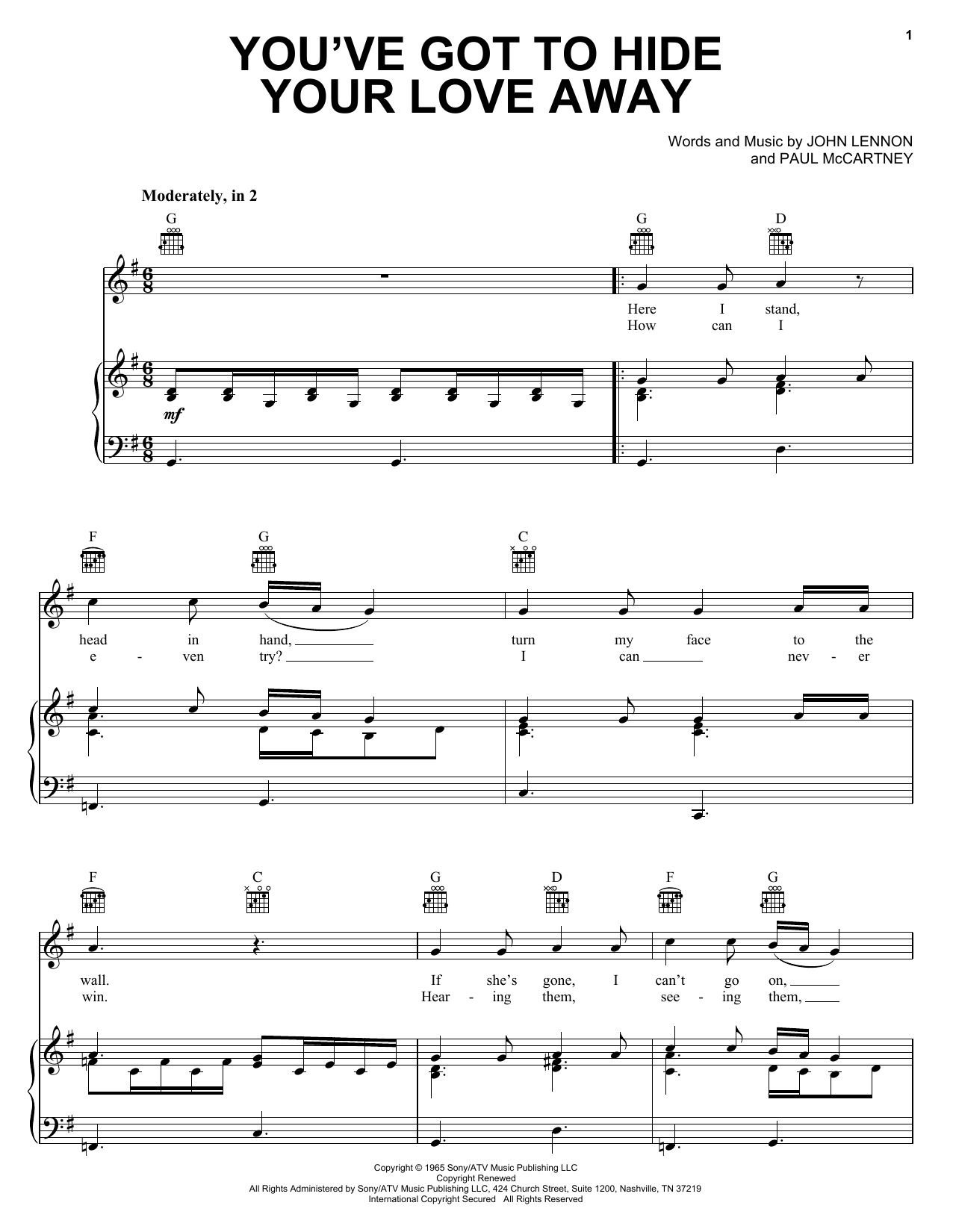
John Lennon was terrified. It’s 1965. The Beatles are the biggest thing on the planet, but Lennon is feeling trapped in his "fat Elvis" period, eating his heart out and writing songs that sounded like what he thought people wanted to hear. Then he wrote You've Got to Hide Your Love Away. Everything changed. It wasn't just another catchy tune for the Help! soundtrack. It was a pivot point. If you listen closely to the acoustic strumming and that mournful flute, you're hearing the exact moment a boy band leader decided to become an artist.
Most people think of this track as just "the Bob Dylan one." Sure, the influence is there—the 12/8 time signature, the acoustic focus, the raspy delivery. But it’s deeper than imitation. Lennon was hiding things. He was hiding his misery in a "mending" marriage to Cynthia, and some suggest he was reflecting the forced secrecy of the band's manager, Brian Epstein, who was a gay man in an era where that was literally a criminal offense in the UK.
Why You've Got to Hide Your Love Away Was a Massive Risk
In the mid-sixties, the formula was simple: electric guitars, "yeah yeah yeah," and upbeat tempos. When The Beatles stepped into Abbey Road’s Studio Two on February 18, 1965, they didn't bring the Rickenbackers. They brought an ethos of vulnerability.
Lennon’s vocals are raw. He’s not hitting the high notes with that polished mop-top sheen. Instead, he’s gravelly. He sounds tired. Honestly, he sounds defeated. The song breaks the "Beatles Rule" of the time by ditching the background harmonies. It’s just John. Paul, George, and Ringo are there, but they are subservient to the mood. It was the first time they used an outside session musician—Johnnie Scott on the flutes—marking a departure from the "four guys in a garage" aesthetic they’d leaned on since Hamburg.
The Dylan Connection: More Than Just a Hat Tip
You can’t talk about this song without mentioning Bob Dylan. The two camps had met in August 1964 at the Delmonico Hotel in New York. That meeting is legendary for various reasons (mostly involving herbal substances), but the creative fallout was the real story. Dylan told John his lyrics were "pointless" or at least lacked substance. Lennon took it to heart.
Before this, Beatles lyrics were mostly "I love you," "She loves you," "Please love me." With You've Got to Hide Your Love Away, Lennon moved inward. "Hey, you've got to hide your love away." It’s a command to himself. It’s paranoid. It’s brilliant.
Breaking Down the "Hey!"
There is a specific moment in the song that defines Lennon’s transition. The "Hey!" before the chorus. It isn't a joyful shout. It’s a warning. In the film Help!, they perform this in a stylized apartment, and you can see the shift in Lennon's eyes. He wasn't playing the part of the "witty Beatle" anymore. He was playing himself.
The recording process was unusually brisk. Two takes. That’s it. They didn’t overthink it because the feeling was already there. Paul McCartney later noted that John didn't have a bridge for the song, which was unusual for their songwriting style. They just let it breathe as a folk ballad. It proved that The Beatles didn't need the wall of sound to be powerful. They just needed a story.
The Brian Epstein Theory
For years, critics and biographers like Philip Norman have speculated that the lyrics were a direct nod to Brian Epstein. Brian was the man who made them, but he lived a double life. As a gay man in 1965 London, "hiding your love away" wasn't a metaphor; it was a survival tactic. Lennon was notoriously cruel to Epstein at times, but he was also deeply observant.
Whether the song is about Lennon's own feeling of being trapped in a "professional" persona or a sympathetic nod to Brian’s private struggle, the result is the same: universal isolation.
The Technical Shift: From Pop to Folk-Rock
Musically, the song is a masterclass in simplicity. It uses a basic G-D-F-C progression that feels circular, almost like someone pacing in a small room.
- The Flutes: Bringing in Johnnie Scott to play both alto and tenor flutes was a radical move. It replaced the standard guitar solo and added a baroque, slightly chilly atmosphere.
- The Percussion: Ringo isn't driving the beat here. He’s barely touching the skins, using brushes and a tambourine to keep a heartbeat, not a stomp.
- The Acoustic Soul: This was the precursor to Rubber Soul. Without this track, we don't get "Norwegian Wood." We don't get "In My Life."
Basically, this song was the "proof of concept" for the next three years of their career. It showed the world—and the band—that they could grow up.
What Most People Get Wrong About the Recording
There’s a common myth that Lennon was trying to be Dylan. He wasn't. He was trying to use Dylan's tools to build a Lennon house. If you listen to Dylan’s "I Don’t Believe You (She Acts Like We Never Have Met)," the DNA is there, but Lennon brings a melodic sensibility that Dylan often eschewed for narrative complexity.
Also, look at the "mistake" in the lyrics. Lennon sang "two foot small" instead of "two feet tall." He liked the mistake. He kept it. That’s the "new" Lennon—the one who valued the "feel" over the "perfect." It was a middle finger to the polished production of the early sixties.
The Legacy of a Two-Minute Masterpiece
At only 2 minutes and 9 seconds, the song is incredibly short. Yet, it covers more emotional ground than most five-minute epics. It’s been covered by everyone from Pearl Jam to The Beach Boys, but nobody quite captures the specific brand of "Beatle-paranoia" that John nailed in 1965.
It remains a staple of classic rock radio because it feels modern. It doesn't have the dated "teeny-bopper" energy of "I Want to Hold Your Hand." It feels like a late-night conversation in a dimly lit bar. It’s the sound of the 1960s losing its innocence.
How to Listen to It Now
If you want to really "get" the song, don't just stream it on crappy earbuds. Find a mono mix if you can. The mono version has a punchier, more claustrophobic feel that serves the lyrics better than the wide stereo separation where the flutes feel like they're in a different room.
Pay attention to the way Lennon says the word "feeling." "If she's gone I can't go on, feeling two foot small." The way his voice cracks slightly? That’s not a mistake. That’s the beginning of the end for "The Mop Tops" and the birth of John Winston Lennon, the icon.
Actionable Insights for Music Lovers and Songwriters
To truly appreciate or learn from the craft of You've Got to Hide Your Love Away, consider these steps:
- Analyze the 12/8 Time Signature: If you're a musician, try playing a standard 4/4 pop song in this "waltz-like" 12/8 feel. It instantly adds a sense of longing and weight to the lyrics.
- Study the "Less is More" Production: Notice how the absence of a bridge and the absence of vocal harmonies actually makes the song stronger. Sometimes, subtracting elements increases the emotional impact.
- Explore the Help! Album Deeply: Don't just stick to the hits. Listen to this track alongside "It's Only Love" to see how Lennon was struggling with—and mastering—the art of the sincere ballad.
- Contextualize with Dylan: Listen to Bob Dylan’s Another Side of Bob Dylan (1964) immediately before this track. You will hear the exact sonic bridge The Beatles crossed to reach their mature period.



