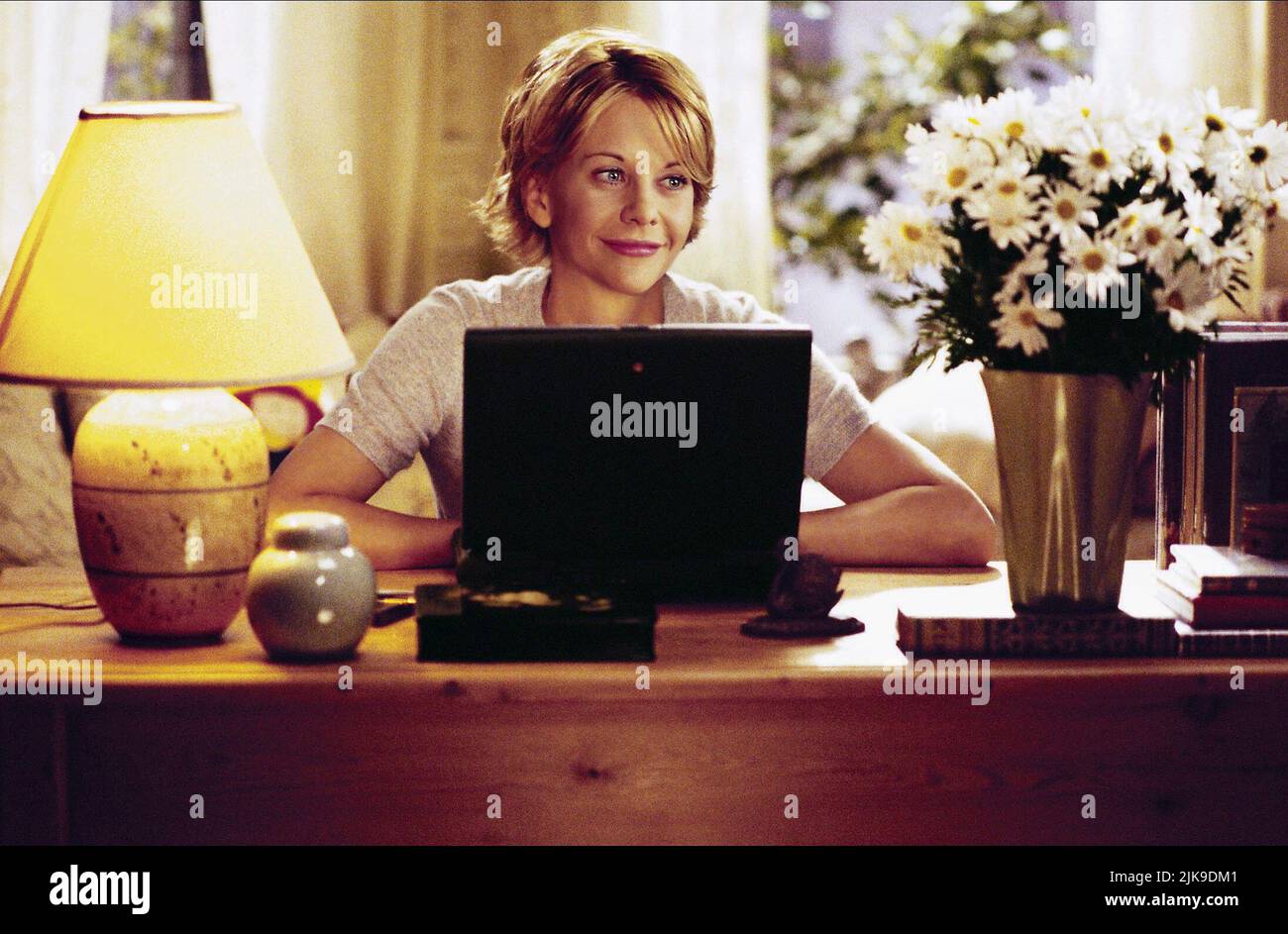
Honestly, if you haven't spent a rainy Sunday afternoon watching Meg Ryan pace around a fictional Upper West Side apartment in a pair of wool tights and a charcoal cardigan, have you even lived? We’re talking about the 1998 classic that basically defined an era. You've Got Mail Meg Ryan isn’t just a movie performance; it’s a whole mood, a seasonal transition, and a very specific type of New York longing that doesn't actually exist in the real world.
It's been decades. Yet, here we are, still obsessed with Kathleen Kelly’s bedside lamp and her impeccably organized children’s bookstore.
The Shopgirl vs. The Robber Baron
The plot is basically "enemies-to-lovers" before that was a tired TikTok trope. Kathleen Kelly (Ryan) owns The Shop Around the Corner, a boutique children’s bookstore left to her by her mother. Joe Fox (Tom Hanks) is the heir to Fox Books, a massive, corporate bookstore chain that moves in down the block, offering steep discounts and—god forbid—lattes.
They hate each other in person. Like, real, stinging, "I hope your store goes bankrupt" kind of hate.
But online? They’re "Shopgirl" and "NY152." They exchange these long, rambling, pseudo-intellectual emails about the smell of New York in the fall and the mystery of butterflies on the subway. They are soulmates in the inbox and bitter rivals on the sidewalk. It’s peak Nora Ephron.
Why the chemistry actually worked
Most people don't realize that this was the third time Ryan and Hanks shared the screen. They had this shorthand. You can see it in the way they bicker.
- Joe Versus the Volcano (1990): The weird, experimental one where she plays three different roles.
- Sleepless in Seattle (1993): The one where they don't even meet until the last scene.
- You've Got Mail (1998): The one where they finally get to just... talk.
Meg Ryan was at the absolute zenith of her career here. She had this way of being "America’s Sweetheart" without being annoying. She was vulnerable but sharp. She’d trip over a chair, and you’d think, "Yeah, I’d do that too."
Fun facts that make the movie even better
Most of the "magic" wasn't just movie sets. Nora Ephron was obsessive about the details. To prepare for the role, Meg Ryan and Heather Burns (who played Christina) actually worked for a week at Books of Wonder, a real-life children's bookstore in Manhattan. They weren't just pretending; they were learning how to shelve and talk to actual picky Upper West Side parents.
Also, can we talk about the tech? Meg Ryan didn't even own a computer before this movie. The production had to give her one so she could practice.
The "Shop Around the Corner" wasn't even a bookstore. In real life, it was a cheese and antique shop called Maya Schaper’s. They cleared everything out, filled it with thousands of real children’s books, and made it look so inviting that people used to walk off the street trying to buy things while they were filming.
The Michael Palin mystery
Here's a weird one: Michael Palin (from Monty Python) was supposed to be in this movie. He played a reclusive, Thomas Pynchon-esque author. He filmed a bunch of scenes, but in the end, they cut him out entirely because the movie was running too long. Imagine being a legend like Palin and getting left on the cutting room floor because Tom and Meg were too busy talking about daisies.
Is the ending actually problematic?
If you go on Twitter today, people have opinions. The big debate: should Kathleen have ended up with the man who literally destroyed her livelihood and put her out of business?
Joe Fox is kind of a jerk for the first two-thirds of the movie. He lies to her. He manipulates the situation once he realizes she’s "Shopgirl." He lets her sit in Cafe Lalo waiting for a stranger while he watches from across the street.
But the movie argues that the store was going to close anyway. The world was changing. Joe didn't just kill her business; he helped her find the next version of herself—a writer. It’s a bit of a "corporate gaslighting" vibe if you look too closely, but within the cozy confines of a 90s rom-com, we usually give it a pass.
Why we still watch it in 2026
It's the nostalgia. It’s the sound of the 56k modem. It’s the way Meg Ryan says "daisies are the friendliest flower."
We live in a world of instant DMs and "seen" receipts. There was something patient about You've Got Mail Meg Ryan and the way they communicated. They wrote paragraphs. They waited all day for a "ding."
The New York that never was
The movie makes the Upper West Side look like a small village in Europe. Everything is gold-toned. Every sidewalk is clean. It’s a fantasy of urban life where you can afford a massive apartment while running a failing indie shop.
If you're looking for a piece of that feeling, here are the real spots you can still visit:
- Zabar’s: The scene where Joe helps Kathleen in the cash-only line. It’s still there and still iconic.
- Cafe Lalo: The "meeting" spot. (Note: It has gone through some closures and reopenings recently, so check before you go).
- The 91st Street Garden: Where the final scene happens. It’s inside Riverside Park and looks exactly like the movie in the spring.
Actionable Next Steps
If you want to relive the magic, don't just put the movie on. Try a "Kathleen Kelly Day":
- Go to an independent bookstore and buy a hardcover book you don't need.
- Get a tall Starbucks (even though it's the "enemy").
- Walk through Riverside Park around 89th Street.
- Actually write a long-form email to someone you haven't talked to in a while. No emojis allowed.
There’s something deeply human about wanting to be known for your mind before your face. That’s the real legacy of Kathleen Kelly. She was just a girl in a cardigan, looking for a "Dear Friend" in a world that was becoming increasingly "business."



