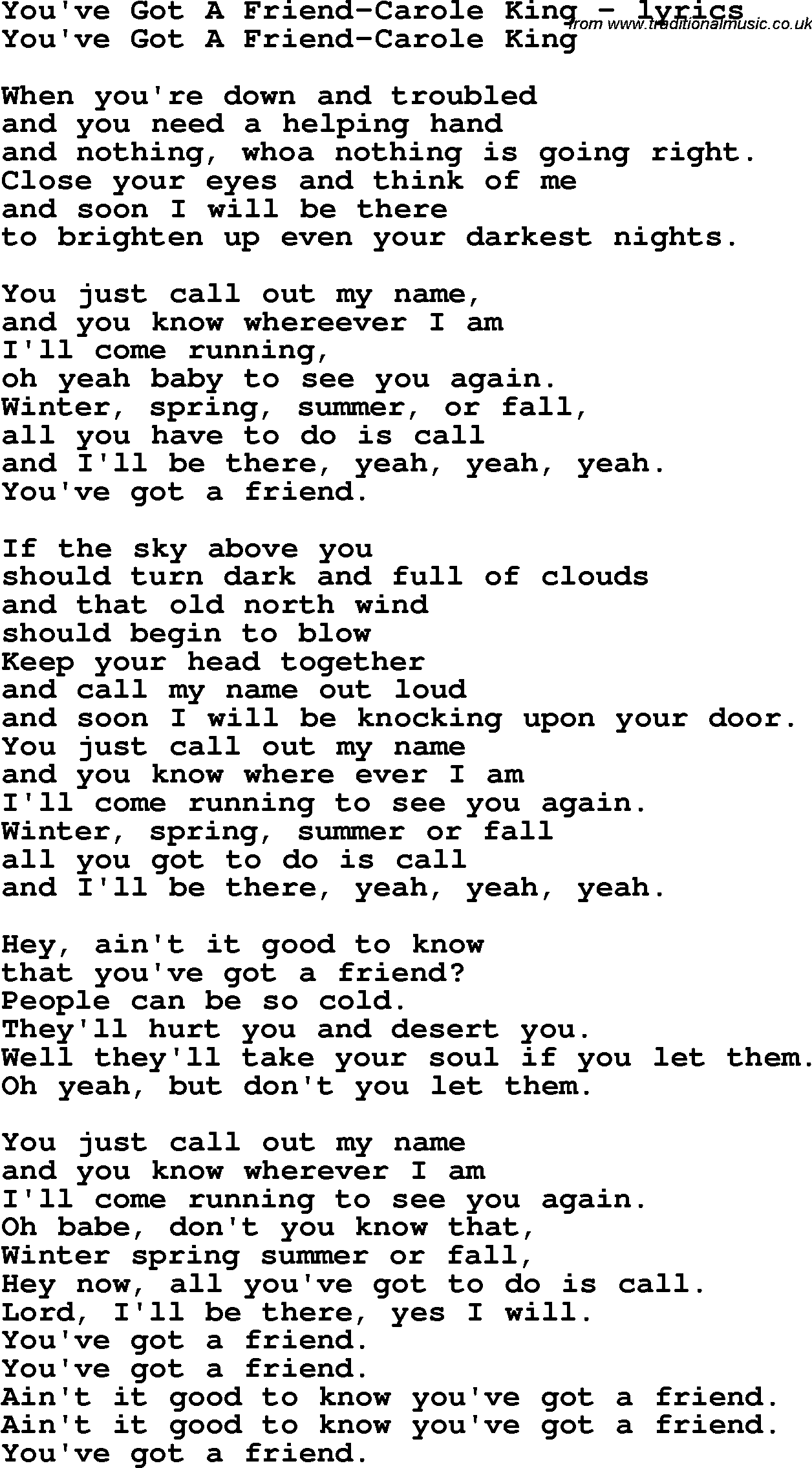
It was 1971. James Taylor was struggling with his own demons, and Carole King sat down at a piano and wrote a song that would basically become the universal blueprint for loyalty. Most people think they know the You've Got a Friend lyrics because they’ve heard them at every third wedding or graduation ceremony since the Nixon administration. But there is a weird, almost spiritual weight to those words that goes way beyond a catchy chorus. It’s a song about a specific kind of radical availability. When King wrote it, she wasn't trying to create a massive radio hit; she was actually responding to a line in Taylor’s "Fire and Rain" where he mentions he's seen lonely times when he couldn't find a friend. She basically decided to provide the answer.
Music doesn't do this anymore. We live in an era of "ghosting" and "boundaries," which are fine, but King’s lyrics are the opposite. They are a terrifyingly open invitation. If you need me, call me. I’ll be there. I’ll even come running, even if it’s winter, spring, summer, or fall. That is a heavy promise to make to someone.
The Acoustic Psychology of Carole King’s Writing
Look at the opening lines. You just call out my name, and you know, wherever I am, I'll come running. It’s conversational. It’s not poetic in a flowery, Shakespearean sense. It’s prose set to a melody. When King recorded it for her album Tapestry, she kept the arrangement sparse. She wanted the listener to feel like she was sitting right there on the piano bench next to them.
The brilliance of the You've Got a Friend lyrics lies in their lack of conditionality. Most pop songs about love or friendship have a "if you love me back" or "if we stay together" clause. Not this one. It’s a one-way declaration of support. James Taylor, who famously covered the song and took it to number one on the Billboard Hot 100, actually helped King realize how powerful the sentiment was. He heard it while they were recording at A&M Studios and told her it was one of the best things he’d ever heard.
Honestly, it’s kind of wild that a song this simple survived the psychedelic era and the rise of disco. It’s because the lyrics tap into a primal human fear: the fear of being truly alone when "dark sky clouds" gather. We all want that one person who doesn't check their calendar before saying they'll show up.
Why James Taylor’s Version Changed the Meaning
While Carole wrote it, James Taylor owns a piece of its soul. His version is slightly more melancholy. When he sings the part about people being so cold and how they’ll hurt you and desert you, you believe him because of his history with addiction and mental health struggles. In his voice, the lyrics aren't just a nice thought; they’re a survival tactic.
- King’s version: A motherly, earthy reassurance.
- Taylor’s version: A brotherly, weary promise from someone who knows what it’s like to lose everything.
These two perspectives created a dual legacy for the song. It’s why it works at both a funeral and a baby shower. The lyrics are flexible enough to hold all that weight without breaking.
Breaking Down the Verse: When Your Soul Needs a Room
The second verse is where the imagery gets a bit more intense. "If the sky above you grows dark and full of clouds..." It’s classic pathetic fallacy, using the weather to mirror an internal state. But then she hits that line: "And that old north wind begins to blow." It’s cold. It’s lonely. The lyrics suggest that friendship isn't just about hanging out when things are good. It’s about being a literal shelter.
People often misquote the song. They forget the "old" in "old north wind" or they swap "keep your head together" for something more generic. But "keep your head together" is a very 1970s sentiment. It’s about sanity. It’s about not losing your mind when the world turns hostile. King wasn't just talking about a bad day at work; she was talking about the kind of existential dread that makes you want to crawl under the covers and stay there.
The "Close Your Eyes" Technique
"Close your eyes and think of me, and soon I will be there." This is almost meditative. It’s the idea that friendship is a mental state. Even if the person isn't physically present, the knowledge of their existence—the fact that they would come running—is enough to brighten even the darkest night.
I think we’ve lost a bit of that today. We have 500 "friends" on social media, but how many of them would actually come running if you called out their name? The You've Got a Friend lyrics act as a mirror. They ask the listener: who is this person for you? And more importantly, are you this person for anyone else?
The Recording Session That Almost Didn't Happen
There’s a bit of music history that people miss. King wrote the song in about 20 minutes. Just 20 minutes to write a song that has been covered by everyone from Aretha Franklin to Michael Jackson to Donny Hathaway. It poured out of her. She later said she felt like she didn't even write it—like it was already there, and she just wrote it down.
When they were tracking it for Tapestry, Lou Adler (the producer) kept the lights low. He wanted that intimacy. If you listen closely to the original recording, you can hear the creak of the piano stool and the way King’s voice slightly breaks on the high notes. That imperfection is what makes the lyrics feel real. If it were auto-tuned or polished to death like modern pop, the message would fall flat. It would sound like a Hallmark card. Instead, it sounds like a confession.
Legal and Legacy Struggles
Believe it or not, there was a tiny bit of tension regarding James Taylor’s version. Because both King and Taylor recorded the song around the same time, there was a risk they’d compete on the charts. But King, being the person she is, actually encouraged Taylor to release his as a single. She didn't care about the chart battle; she just wanted the song to be heard.
That lack of ego is baked into the You've Got a Friend lyrics. It’s a selfless song.
Actionable Takeaways for Real-Life Friendship
If you really sit with these lyrics, they offer a pretty solid framework for how to be a better human being. It’s not just about the music. It’s about the philosophy of presence.
- Stop "Checking In" and Start Showing Up. The lyrics don't say "text me when you're free." They say "call out my name." There’s a directness there that we often avoid because we don't want to be a "burden."
- Be the "North Wind" Shelter. When someone is going through it, they don't need advice. They need to know that the sky won't fall on them alone. Just being there—the "running to see you again" part—is usually enough.
- Acknowledge the Cold. The song admits that people can be "cold." They will "take your soul if you let them." True friendship is recognizing the harshness of the world and deciding to be the exception to the rule.
- Listen to the 1971 Tapestry Recording. Seriously. If you’ve only heard the radio edits, go back to the original Carole King version. Listen to the way she plays the piano. The way she hits the keys is just as much a part of the "lyrics" as the words themselves. It’s firm. It’s steady. It’s reliable.
The Final Chord
The song ends with a repetition of "You've got a friend." It’s a mantra. By the time the track fades out, you’re supposed to believe it. Whether it's the 1971 classic or a modern cover, the You've Got a Friend lyrics remain a standard because they don't ask for anything in return. They just offer a hand. In a world that’s increasingly transactional, a song that offers everything for free is always going to be relevant.
If you're feeling isolated, or if you've realized you haven't been that "running" friend lately, the best next step is to actually reach out. Don't send a meme. Don't like a post. Call someone. Use their name. Let them know that if the old north wind starts blowing, you’ve already got your coat on. That is the real power behind the song. It’s not just a piece of music; it’s a standing order for how to treat the people you love. Go ahead and put the record on, then make the call.



