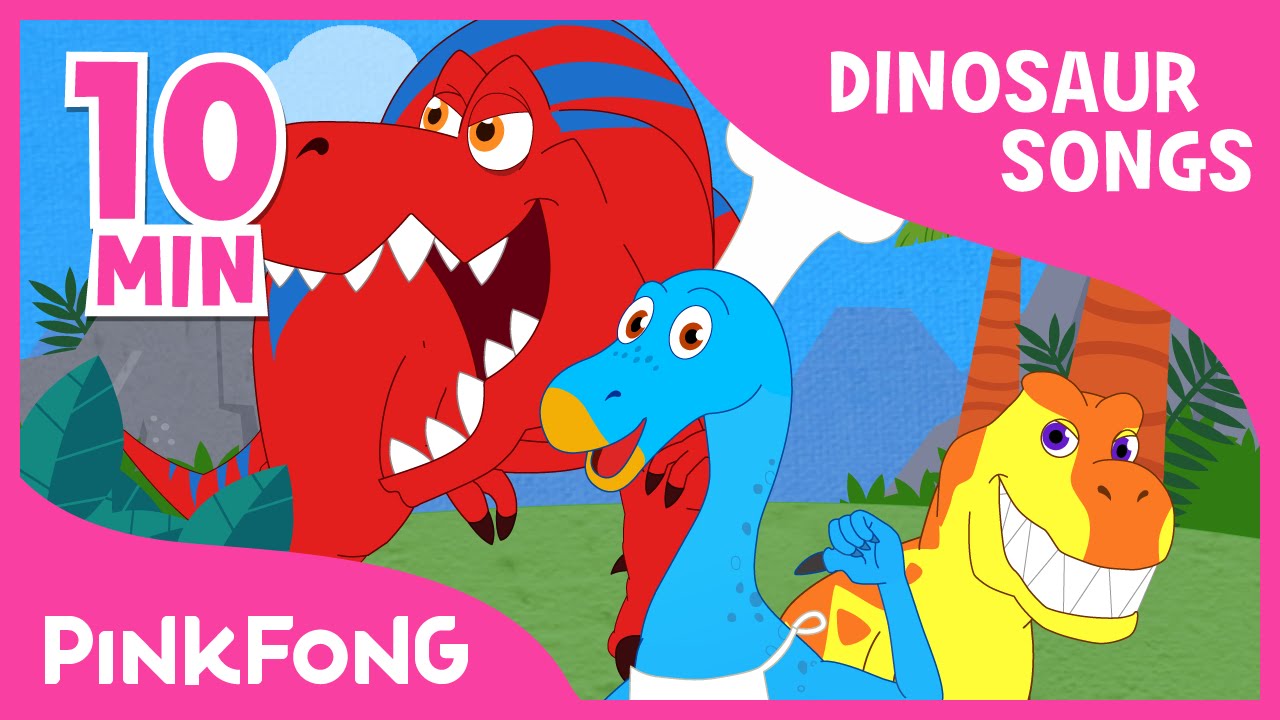
If you’ve spent more than five minutes around a three-year-old lately, you already know the "Baby Shark" era has a massive, scaly rival. It’s the age of the T-Rex. Specifically, YouTube dinosaur songs have carved out a gargantuan niche in digital media, racking up billions of views from families across the globe. Some of these tunes are genuine earworms that’ll have you humming about herbivores while you’re trying to do your taxes. Others? They’re basically sonic torture designed by an algorithm.
Kids love them. Parents tolerate them. But there is a massive difference between a video that’s just loud colors and one that actually teaches a kid the difference between the Cretaceous and Jurassic periods.
Honestly, the sheer volume of content is overwhelming. You search for a quick song to distract a toddler during a diaper change, and suddenly you’re down a rabbit hole of CGI raptors and synth-pop beats. It’s a wild west of educational content and pure "brain rot" fluff. Sorting through the mess requires a bit of an expert eye—or at least the ears of someone who has heard the "Dinosaur ABCs" four thousand times in a single week.
Why YouTube Dinosaur Songs Rule the Playroom
Dinosaurs are basically monsters that actually existed. That’s the magic. For a child, they represent the ultimate fantasy: huge, powerful creatures that aren't around to actually eat you. YouTube creators figured this out early. By mixing high-energy music with prehistoric facts, channels like Pinkfong, Cocomelon, and StoryBots have created a feedback loop of engagement that Google’s algorithm absolutely loves.
It’s not just about the visuals. It’s the rhythm. Most successful YouTube dinosaur songs follow a very specific tempo—usually between 120 and 140 beats per minute. This is the "sweet spot" for toddler movement. It encourages jumping, stomping, and "rawring," which provides a much-needed physical outlet for cooped-up kids.
But there's a psychological layer here, too. Developmental psychologists often point to "extreme interests" in children, and dinosaurs are the number one category for this. When a kid watches a video about a Spinosaurus, they aren't just being entertained; they’re categorizing the world. They’re learning taxonomy before they can even tie their shoes.
The Heavy Hitters: Who is Actually Making This Stuff?
You can’t talk about this without mentioning Pinkfong. While they are the masters of the shark world, their dinosaur catalog is surprisingly deep. They don't just stick to the T-Rex. They go into the Pachycephalosaurus and the Ankylosaurus. The "Dig It Up" series is particularly effective because it frames paleontology as a mystery game.
Then you have The StoryBots. If you want quality, this is the gold standard. Their "Tyrannosaurus Rex" song features a rap-battle vibe that is genuinely funny for adults. It’s smart. The lyrics actually rhyme "Cretaceous" with "predaceous." That’s high-level writing for a kids' show.
On the flip side, you have the "Johnny Johnny Yes Papa" style channels. These are the ones to avoid. They often use recycled, low-quality 3D assets and songs that don't even make sense. If the lyrics are just "Dinosaur, dinosaur, where are you?" on repeat for ten minutes, your kid isn't learning anything. They’re just staring at a screen.
The Science (Sorta) of Why These Songs Stick
Ever wonder why you can’t get a specific chorus out of your head? It’s called an earworm, or more technically, "involuntary musical imagery."
Most YouTube dinosaur songs use a simple I-IV-V chord progression. This is the backbone of blues, rock, and almost every nursery rhyme in history. It feels familiar. When a kid hears a song about a Triceratops using the same structure as "Twinkle Twinkle Little Star," their brain latches onto it instantly.
Complexity is the enemy of a viral kids' song.
Does it actually help with learning?
There is some debate among educators about whether these videos are "educational" or just "passive." A study published in Journal of Applied Developmental Psychology suggests that while digital media can introduce new vocabulary, the real learning happens when parents watch with the child.
If the song mentions that a Brachiosaurus eats plants, and you point to a tree outside, that’s a win. If the video just plays in the background while the kid zones out, the educational value drops to near zero.
- Pros: Vocabulary expansion, rhythm development, interest in science.
- Cons: Overstimulation, blue light exposure, questionable factual accuracy in lower-end channels.
Spotting the "Fakes": When Accuracy Goes Out the Window
The "Dino-Media" industry is huge, and not everyone cares about the difference between a pterosaur and a dinosaur (FYI: Pterosaurs are flying reptiles, not dinosaurs).
I’ve seen dozens of YouTube dinosaur songs that show humans riding a Stegosaurus. Look, I get it’s for kids. But there's a 60-million-year gap there. If a channel shows a T-Rex and a Stegosaurus hanging out as best friends, they’re lying to your toddler. They lived in different time periods. The T-Rex is closer in time to an iPhone than it is to a Stegosaurus.
Why does this matter? Because kids are sponges. If they learn the wrong "facts" now, they’ll be the ones arguing with their first-grade teacher later.
Look for channels that cite their "dino-facts." PBS Kids and Danny Go! tend to be much better at keeping the science relatively straight while keeping the energy high. Danny Go! is a particularly interesting case—he’s a real guy, not a cartoon, which helps kids connect the "dinosaur dance" to actual human movement.
The Evolution of the "Dino Dance" Trend
It started with simple animations. Now, we have 4K rendered monsters that look like they stepped out of Jurassic Park.
The trend has shifted toward "interactive" songs. These are videos that tell the kid to "Stomp like a Rex" or "Chomp like a Raptor." This is a massive improvement over the older, static videos. It turns screen time into "active time."
Interestingly, the music has evolved too. We’re seeing more synth-wave, hip-hop, and even heavy metal influences in these tracks. It’s a far cry from the "Barney" era of the 90s. Today’s YouTube dinosaur songs are produced with the same software used to make Top 40 hits.
How to manage the screen time madness
You can't just turn it off. That leads to a meltdown of prehistoric proportions.
Instead, use these songs as a bridge. If your kid is obsessed with a song about fossils, get some kinetic sand and hide some toy bones in it. Use the music as a soundtrack for sensory play. This moves the experience from a flat screen into the physical world.
Also, check the "Auto-play" settings. YouTube’s algorithm is designed to keep you watching, and it will eventually pivot from a high-quality educational song to a weird, 20-minute loop of unboxing videos if you aren't careful.
The Weird World of "Dinosaur Parody" Songs
There is a sub-genre of YouTube dinosaur songs that are basically parodies of popular pop songs. You’ll find dino-themed versions of Taylor Swift or Imagine Dragons tracks.
These are hit or miss. Some are clever. Some feel like a desperate grab for clicks. Usually, the ones that focus on specific traits—like the "small arms" of the T-Rex—tend to be the most entertaining. It’s a bit of self-aware humor that makes the tenth viewing of the day slightly more bearable for the adults in the room.
Real-world paleontology vs. YouTube
One thing the videos often miss is what we’re actually learning right now in the field. Feathers are a big one.
Most YouTube dinosaur songs still show the scaly, "lizard-like" versions of these animals. But we know now that many of them, especially the raptor family, were covered in feathers. If you find a channel that actually shows a feathered T-Rex, subscribe immediately. They’re actually paying attention to modern science.
Making the Most of the Prehistoric Playlist
Don't just let the algorithm decide what your child consumes. There's a lot of junk out there. But there's also a lot of brilliance.
If you want to find the best YouTube dinosaur songs, look for these specific markers:
- Clear Pronunciation: Can you actually hear the names of the dinosaurs?
- Physical Cues: Does the song encourage the kid to move?
- Visual Variety: Does it show different environments, or is it just the same loop?
- Scientific "Nods": Does it mention time periods or specific diets?
You’ve got the power here. By being selective, you turn a mindless distraction into a legitimate educational tool.
To take this a step further, start a "Dino Journal" with your kid. Every time they hear a new song about a specific dinosaur, help them draw it or find a picture of it in a book. It reinforces the vocabulary and turns the catchy tune into a lasting memory.
Check the "About" section of the YouTube channels you frequent. The best ones are usually run by educators or parents who actually care about the content, rather than massive content farms designed solely to farm ad revenue. Stop the video occasionally and ask, "What was that one called?" or "What does he eat?" It breaks the trance and keeps the brain engaged.
Lastly, don't be afraid to branch out. If they love the music, look for museum live streams or "dino-cam" videos that show the actual fossils. The music is the "hook," but the real world of science is where the long-term value lives.



