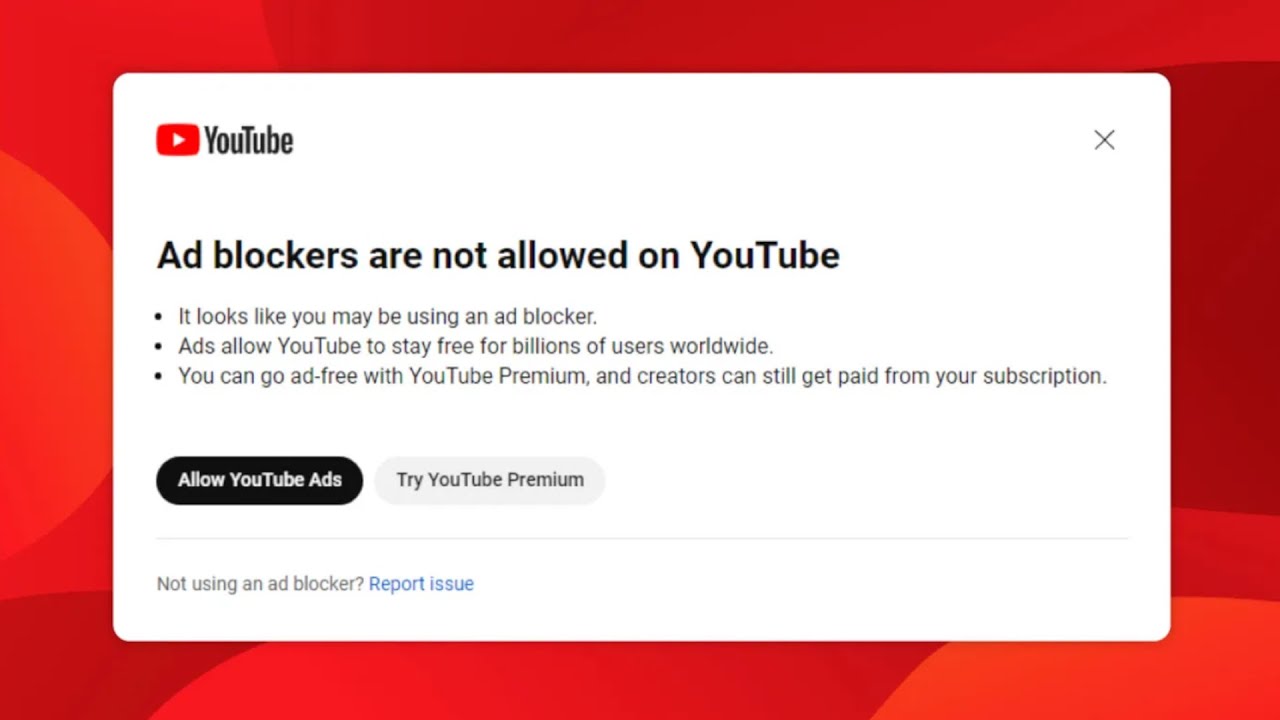
You’re settled in, snacks ready, clicking on that video you’ve been waiting for all day. Then, the screen goes black. Instead of the creator’s face, you get a stern pop-up telling you that "Ad blockers violate YouTube’s Terms of Service." It feels like a betrayal. For over a decade, the dance between users and the platform was simple: they show ads, we block them, and life goes on. Not anymore. YouTube blocking ad blocker tech isn't just a temporary glitch; it's a massive, coordinated shift in how the internet's biggest video site operates. It's a game of cat and mouse where the cat just got a lot faster.
Google, the behemoth behind YouTube, has finally decided that the billions lost in potential revenue are no longer acceptable. This isn't just about corporate greed, though that’s the easiest villain to point at. It’s about the fundamental economics of hosting petabytes of data for free. Honestly, the free ride was always going to have a toll booth eventually.
The Global Crackdown: More Than Just a Pop-up
If you think this is just a localized test, you're mistaken. What started as a "small global experiment" in mid-2023 has evolved into a full-scale offensive. YouTube is now using "server-side ad insertion" (SSAI). This is a technical nightmare for developers. Basically, instead of the ad being a separate piece of code that your browser can identify and snip out, the ad is being stitched directly into the video stream itself. Your ad blocker looks at the data and thinks it's just part of the video you're trying to watch. It can't tell where the commercial ends and the content begins.
It’s clever. It’s also incredibly frustrating.
Users have reported different levels of enforcement. Some get a "three strikes" warning. You watch three videos with an blocker, and then the player is disabled entirely. Others just see an endless loading circle. Christopher Lawton, a YouTube communications manager, has been clear in public statements: ads support a global ecosystem of creators. But for the average person who just wants to see a 10-minute recipe without three unskippable 30-second clips for insurance companies, that explanation feels thin.
The reality is that YouTube’s ad revenue hit nearly $31.5 billion in 2023. Even a small percentage of users blocking ads represents hundreds of millions of dollars in "leakage." By tightening the screws, they aren't just trying to annoy you; they are trying to force a conversion to YouTube Premium.
Why Your Favorite Extensions Are Breaking
Remember when uBlock Origin was invincible? Those days are getting complicated. The arms race is moving at light speed. One hour, a new filter list works; the next, YouTube updates its script and you're back to the "Ad blockers are not allowed" screen.
The technical reason is a shift toward Manifest V3. This is a change in the Chrome browser engine (Chromium) that limits the power of extensions to modify web pages in real-time. Since Google owns Chrome and YouTube, they have the home-field advantage. They are literally changing the rules of the stadium while the game is being played.
- Privacy concerns: Some users argue that YouTube’s methods for detecting ad blockers are actually a violation of privacy laws in regions like the EU. The argument is that the site is "spying" on your browser's local extensions without consent.
- The performance hit: Have you noticed your PC fans spinning louder when YouTube is open? Some users have accused YouTube of intentionally slowing down site performance—essentially a "lag tax"—for those detected using ad-blocking software. YouTube denied this, attributing lag to the ad blockers' own code struggling to fight the site's new scripts, but the user experience remains miserable regardless of who's at fault.
It's a mess. Truly. You've got developers on Reddit and GitHub working 24/7 to push updates, while Google’s engineers deploy automated countermeasures. It’s the most intense tech battle of the 2020s that doesn't involve AI.
The Impact on Creators (The Side Nobody Discusses)
We love to hate the corporation, but the creators are caught in the middle. Most YouTubers make a pittance from AdSense. When you block an ad, that creator gets zero cents for your view. Zero. For a channel with millions of views, that adds up to a mortgage payment or a salary for an editor.
However, many creators also hate the way YouTube is handling this. Intrusive, mid-roll ads that break the flow of a carefully edited documentary hurt the art. It’s a catch-22. If everyone blocks ads, the creators can’t afford to make the videos. If YouTube makes the ads unbearable, the audience leaves. This tension is why we've seen a massive surge in "Sponsorships" inside the videos themselves. You know the ones—"This video is sponsored by..."—those are unblockable because they are part of the file. In a weird way, YouTube blocking ad blocker software has actually made videos more cluttered with marketing, not less.
What Actually Works in 2026?
The landscape is shifting, but people are stubborn. If you're looking for a way around the blockade, the old "install and forget" method is dead. Here is the current state of workarounds, though none are guaranteed for long:
- Open-source browsers: Moving away from Chrome is the first step many take. Browsers like Firefox or Brave still offer more flexibility because they aren't tied to Google’s Manifest V3 restrictions as tightly.
- DNS-level blocking: Some people use Pi-hole or specialized DNS settings. The problem? As mentioned, server-side insertion makes this less effective because the ad and the video come from the same domain.
- The "Gray" Apps: On mobile, third-party apps have long been a refuge. But Google has been aggressive in sending "cease and desist" letters to these developers, leading to the shut down of several major players.
- The VPN trick: Users sometimes set their VPN to countries where YouTube hasn't fully rolled out the most aggressive blocking or where Premium is significantly cheaper. It’s a hassle, but for some, it’s a point of pride.
Honestly, the most reliable "hack" right now is just staying incredibly active in the community. If you aren't checking for filter updates every single day, you're going to see that "blocked" screen.
The Future: A Two-Tiered Internet
We are moving toward a web where "free" means "unusable." YouTube is the canary in the coal mine. If they succeed in totally neutralizing ad blockers, every other major platform will follow suit. Netflix already has an ad tier. Disney+ has an ad tier. The "Golden Age" of an open, ad-free-ish internet is closing.
YouTube Premium is the goal. They want that $13.99 a month. It’s predictable revenue. For them, a user who blocks ads is a net loss because of the bandwidth costs. In their eyes, if you won't pay with your time (ads) or your money (Premium), they'd rather you just didn't use the site at all. It sounds harsh, but the math doesn't lie.
Actionable Steps for the Frustrated User
If you are tired of the constant battle, you have three real paths forward. Pick the one that fits your technical comfort level and your wallet.
- Audit your extensions: Get rid of multiple, clashing ad blockers. If you're running three different ones, they are likely tripping YouTube’s detection scripts faster. Stick to one highly-rated, open-source option and learn how to manually clear your cache and update "force-update" filter lists.
- Try the "Enhancer" approach: There are browser extensions specifically designed to "clean up" the YouTube UI without necessarily triggering the "blocker detected" flag by skipping frames instead of blocking the request. It’s a subtle difference, but it works better for some.
- Consider the "Family Plan" hack: If you really can't stand ads but don't want to pay full price, splitting a family plan with five friends or family members brings the cost down to a couple of dollars a month. It’s the only way to get peace of mind and support creators without the headache of the constant cat-and-mouse game.
- Use NewPipe or Libretube (Android): If you are on mobile, look into privacy-frontends that don't use the official YouTube API. They are harder to set up but provide a much cleaner experience.
The era of YouTube blocking ad blocker tech is here to stay. It’s not a phase; it’s the new architecture of the platform. You can either spend your time updating scripts and clearing caches, or you can change how you consume the content. Either way, the "free" internet just got a lot more expensive.
Next Steps: Check your current browser version to ensure it hasn't automatically updated to a restricted Manifest V3 build, and consider switching to a non-Chromium browser like Firefox if you want to maintain more control over your extensions. Keep an eye on the official uBlock Origin Reddit threads for the most up-to-date filter codes to bypass the latest January 2026 detection scripts.