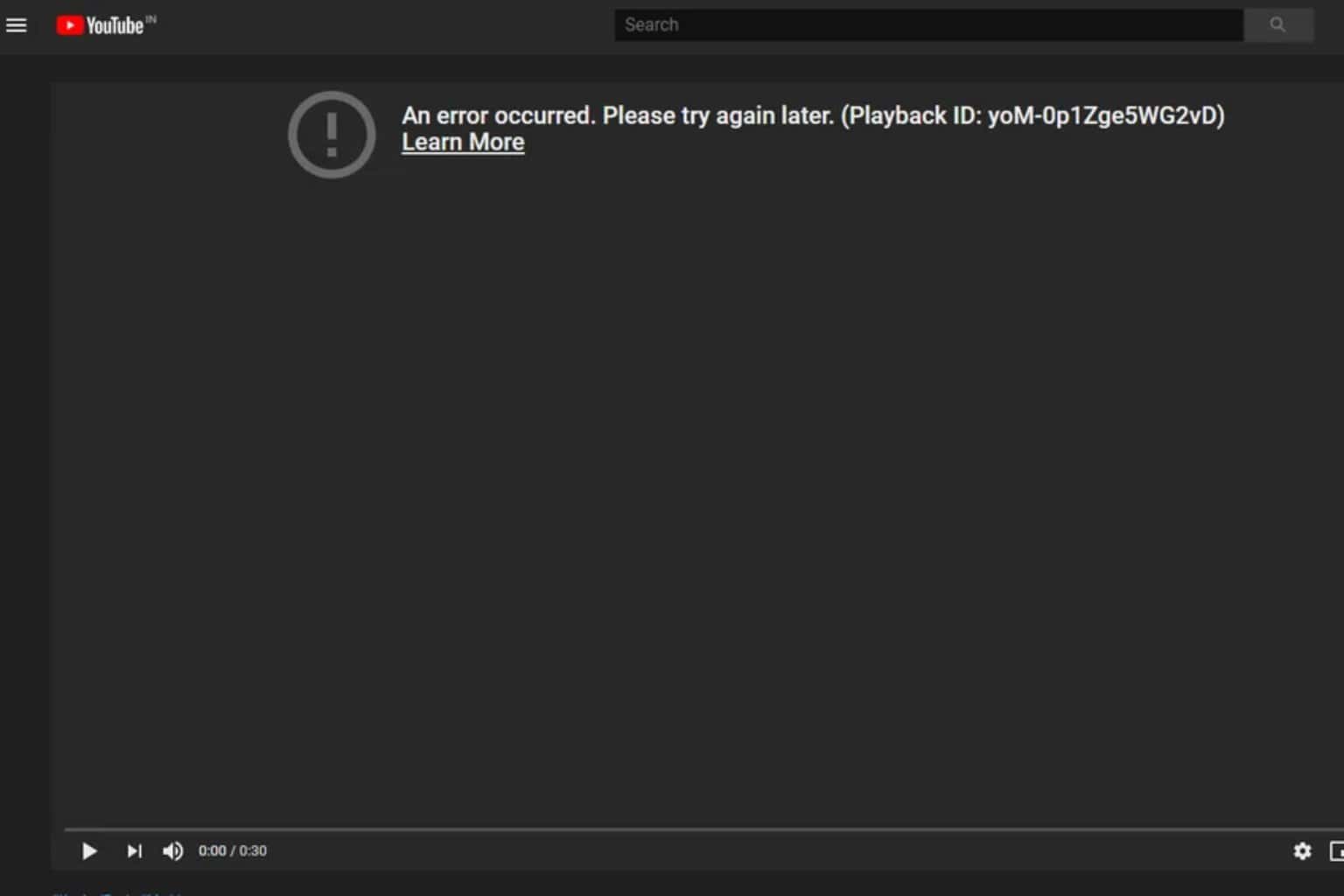
You're halfway through a video. Maybe it’s a recipe, a gaming walkthrough, or a high-stakes live stream. Then, the screen goes black. A jagged circle spins for a second before that dreaded white text appears: "An error has occurred. Please try again later. (Playback ID: [Random String of Characters])". It's incredibly annoying. Most people just refresh the page and hope for the best, but when that doesn't work, you're left staring at a string of gibberish that looks like your cat walked across the keyboard.
Honestly, that Playback ID isn't for you. It’s a unique fingerprint for that specific session, meant for YouTube’s engineers to track down server-side bugs. But you aren't an engineer, and you just want to watch your video.
Why YouTube an error has occurred playback id happens in the first place
Google is usually pretty quiet about the specifics of these errors. However, community experts on the YouTube Help Forum and developers who work with the YouTube API generally agree that this error is a catch-all. It’s like a "Check Engine" light on a car. It could be a loose gas cap, or your entire transmission could be lying on the highway.
Usually, it's a handshake issue. Your browser and the YouTube server have a disagreement about how the data is being sent. This can happen because of outdated cache files, a glitchy browser extension, or even a momentary hiccup in your DNS settings. Sometimes, it’s just YouTube having a bad day. In 2020, YouTube suffered a massive global outage that left millions of people seeing various playback ID errors for hours. If it's a server-side problem, no amount of clicking on your end will fix it. You just have to wait.
But most of the time? It’s something local. Your computer is holding onto a "ghost" of a previous session that's no longer valid.
The "Quick Fix" that actually works 60% of the time
Before you start digging into your system settings, try the "Power User" refresh. Don't just hit the refresh button. On Windows, hold Ctrl and press F5. On a Mac, it's Command + Shift + R. This performs a hard reload, forcing the browser to ignore its cached files and redownload everything from the server.
If that fails, check your extensions. Ad-blockers are the most common culprits here. YouTube has been aggressively fighting ad-blockers lately, and sometimes their "anti-adblock" scripts clash with your "anti-anti-adblock" scripts, resulting in a total playback failure. Turn off your ad-blocker for just a second. Refresh. If the video plays, you've found your villain.
Digging into the browser cache
Browsers are hoarders. They save bits of websites to make them load faster next time. Eventually, this hoard gets dusty. When the YouTube an error has occurred playback id pops up repeatedly across different videos, your cache is likely corrupted.
Go into your browser settings. Look for "Clear Browsing Data." You don't need to delete your entire history—nobody wants to lose their saved passwords or that one tab from three weeks ago. Just select "Cookies and other site data" and "Cached images and files." Set the time range to "All time." It feels like a chore, but clearing this junk out solves the majority of playback errors because it forces a fresh connection between you and the content delivery network (CDN).
Dealing with DNS and Connection Glitches
Sometimes the problem isn't the browser. It's the "map" your computer uses to find YouTube. This is called DNS (Domain Name System). If your ISP's DNS is lagging, the video player might time out before it can even start.
Try flushing your DNS. It sounds technical, but it’s just a command. Open your Command Prompt (type cmd in the Windows search bar) and type: ipconfig /flushdns. Hit enter. You’ll get a little message saying it was successful. This clears out the old "map" and forces your computer to look for the fastest route to YouTube again.
If you want to be really thorough, you can switch to Google’s Public DNS. Many tech experts, including those at The Verge and PCMag, suggest using 8.8.8.8 and 8.8.4.4. It’s often more reliable than whatever your local cable company is providing.
The Router Reset: Not Just a Cliche
We’ve all heard it. "Have you tried turning it off and back on again?" It's a meme for a reason—it works. Routers accumulate "noise" over time. A simple power cycle can clear the internal memory and reset the connection to your internet service provider. Unplug it. Count to thirty. Plug it back in. While you're waiting for those lights to blink back to green, check if your phone can play the video on cellular data. If your phone plays it on 5G but not on Wi-Fi, the problem is definitely your home network or the router itself.
Browser Specifics and Updates
Are you still using an old version of Chrome or Firefox? YouTube updates its player constantly. If your browser version is lagging behind, it might lack the necessary "instructions" to decode the video stream correctly.
- Click the three dots in the top right of Chrome.
- Go to "Help."
- Select "About Google Chrome."
- It will automatically check for updates.
For Safari users, this usually means updating macOS itself. It’s annoying to restart your whole computer for a video, but if the YouTube an error has occurred playback id is haunting your Mac, a system update is often the only permanent cure.
Incognito Mode: The Secret Diagnostic Tool
Want to know if it's your settings or your browser without deleting everything? Open an Incognito or Private window. This opens a "clean" version of the browser with no extensions and no saved cookies. If the video plays perfectly in Incognito, then you know for a fact that one of your extensions or a specific cookie is the problem. You can then go through your extensions one by one to see which one is the traitor. Usually, it's something like a VPN extension or a "Dark Mode" enforcer that's messing with the video overlay.
What if it's the video itself?
It’s rare, but sometimes the video file is literally broken on YouTube’s end. This usually happens right after a video is uploaded or a live stream ends. The server is still processing the different resolutions (360p, 720p, 1080p, 4K). If you try to watch a 4K video while it’s still "baking," you might trigger a playback ID error. Try dropping the quality to 720p manually using the gear icon. If it plays at a lower resolution, just wait an hour for the high-def version to finish processing.
Actionable Steps to Fix Your Stream Right Now
Stop clicking the refresh button like a maniac. It won't help. Instead, follow this sequence to get back to your video:
- Perform a Hard Refresh: Use
Ctrl + F5to bypass the cache. - Test in Incognito: If it works there, disable your extensions one by one, starting with ad-blockers.
- Clear Site Data: Delete cookies specifically for YouTube.com rather than your whole browser history.
- Flush your DNS: Open your command terminal and use the
ipconfig /flushdnscommand to reset your network pathing. - Check for Browser Updates: Ensure you are running the latest build of your web browser to maintain compatibility with YouTube’s latest player scripts.
- Lower the Video Quality: Switch from "Auto" to "720p" or "480p" to see if a specific server-side resolution is the bottleneck.
If none of these work and the error persists across multiple devices (phone, laptop, TV), the issue is almost certainly on Google's side or with your Internet Service Provider. In that case, the best move is to check a site like DownDetector to see if thousands of other people are screaming about the same thing. If they are, go grab a coffee. You've done all you can do.