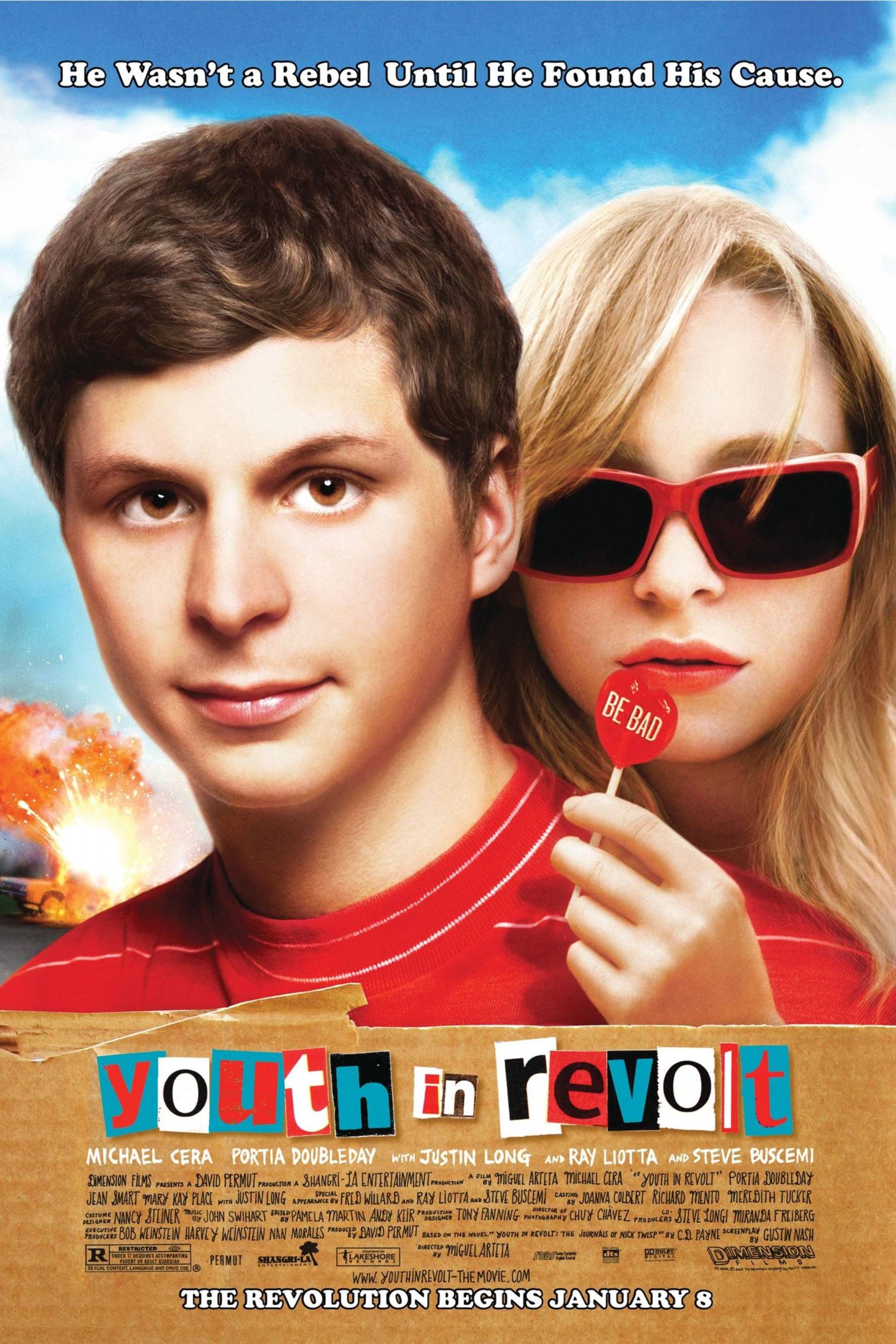
If you were a teenager in the late 2000s, you probably remember the specific brand of awkward that Michael Cera patented. It was everywhere. But Youth in Revolt was different. It wasn't just another Superbad clone. It had this weird, stylized, almost European cinematic flair mixed with a dirty American indie vibe. Honestly, it's one of those movies that people either forgot or obsessed over, and if you're looking to watch Youth in Revolt today, you're likely chasing a very specific kind of nostalgia for a time when "indie" felt like a personality trait.
The movie is based on C.D. Payne’s epistolary novel, which—if you haven't read it—is way more chaotic than the film. The story follows Nick Twisp. He’s a geeky kid living in a trailer park with his mom and her revolving door of questionable boyfriends. Then he meets Sheeni Saunders. She’s sophisticated, listens to French pop, and basically ruins his life in the best way possible. To win her over, Nick has to create a "bad boy" alter ego named Francois Dillinger. Recently making waves recently: The Silence in the Spotlight and the Joke That Went Too Far.
The Dual Performance of Michael Cera
Most actors would've played this as a simple Dr. Jekyll and Mr. Hyde trope. Not Cera. As Nick, he’s the classic stuttering, vinyl-collecting pacifist. But as Francois? He’s got a mustache, a cigarette constantly dangling from his lip, and a sociopathic disregard for authority. It’s hilarious because Francois is exactly what a sheltered nerd thinks a rebel looks like.
Miguel Arteta, the director, did something smart here. He didn't use CGI to make them look different. It was all posture, eye contact, and that thin, creepy mustache. It works because it reflects the internal fractures of being sixteen. You want to be the cool guy, but you're actually the guy who knows too much about Frank Sinatra. More insights regarding the matter are detailed by GQ.
When you watch Youth in Revolt, you’re seeing a snapshot of a very specific era in comedy. This was the peak of the "Michael Cera Cinematic Universe." It’s fascinating to see how the movie leans into the absurdity of the source material. Payne’s book was written as a series of diary entries, which is hard to translate to screen. The film uses animation and quick cuts to bridge that gap. It feels frantic. It feels like a teenager’s brain on too much caffeine and unrequited love.
A Supporting Cast That Actually Carries Weight
Look at this lineup. You’ve got Jean Smart, Steve Buscemi, Zach Galifianakis, and Ray Liotta. Usually, in teen comedies, the parents are just cardboard cutouts. Here, they are absolute disasters. Ray Liotta playing a high-strung cop who is dating Nick’s mom is peak casting.
- Steve Buscemi plays the deadbeat dad living in a garage.
- Justin Long shows up as a drug-tripping brother who thinks he’s an intellectual.
- Portia Doubleday (Sheeni) had the impossible task of being a "dream girl" who is actually just as pretentious and weird as the protagonist.
The chemistry isn't "romantic" in the traditional sense. It’s transactional. Sheeni wants excitement; Nick wants her. Francois is the bridge.
Why We Still Talk About Youth in Revolt
A lot of movies from 2009 haven't aged well. The humor can feel dated or mean-spirited. But Youth in Revolt survives because it’s fundamentally about the performance of identity. Every kid has a "Francois" inside them—that version of themselves they wish they could pilot when things get tough.
There's also the soundtrack. It’s a mix of Kinks tracks and French Yé-yé girls like Jacqueline Taïeb. It gave the movie a timeless feel. It didn't rely on the Top 40 hits of 2009, which means it doesn't feel stuck in a time capsule of autotune and skinny jeans.
"I’m not a bad person. I just have a bad person inside me." — This basically sums up the entire plot.
The film didn't explode at the box office. It made about $19 million against an $18 million budget. That’s "cult classic" territory. It’s the kind of movie you find on a streaming service at 2 AM and realize you’ve been sleeping on a gem.
Critical Reception vs. Fan Reality
Critics were mostly kind but confused. Rotten Tomatoes has it sitting in the high 60s. Roger Ebert actually liked it, giving it three stars and noting that Cera "finds a way to play two characters who are both essentially himself." That’s high praise from a guy who didn't suffer fools.
The common complaint was that it felt "toss-off." People thought it was just another Michael Cera movie. But if you look closer at the cinematography and the script by Gustin Nash, there's a lot of craft. The dialogue is snappy. It’s rhythmic. It’s the kind of writing that assumes the audience is smart enough to keep up with references to French cinema and obscure literature.
Finding the Movie in 2026
If you’re trying to watch Youth in Revolt right now, you’ve got options, but they shift constantly. Licensing for these mid-budget indie films is a nightmare. One month it’s on Netflix, the next it’s hidden in the "available to rent" section of Amazon or Apple TV.
Physical media collectors actually value this one because the Blu-ray contains some great deleted scenes and an alternate ending. The alternate ending is much darker. It changes the whole vibe of the film. In the theatrical cut, things are wrapped up with a bit of a wink. The deleted stuff? It shows just how dangerous Francois actually was.
How to Get the Most Out of Your Rewatch
Don't just put it on in the background while you're scrolling on your phone. You'll miss the visual gags. There are little bits of animation scattered throughout that represent Nick's internal state.
- Pay attention to the colors. Nick’s world is beige and muted. Francois’s world is high contrast and sharp.
- Listen to the lyrics of the French songs. They often mirror exactly what's happening on screen, providing a meta-commentary that most people ignore.
- Watch Steve Buscemi’s face. He doesn't have many lines, but his reactions to Michael Cera’s nonsense are masterclasses in understated comedy.
The movie deals with heavy stuff—arson, statutory issues, parental neglect—but it does it with a shrug. That’s the "revolt" part. It’s not a political revolt. It’s a revolt against the boredom of suburban life. Nick Twisp isn't trying to change the world; he’s just trying to lose his virginity and maybe not get arrested in the process.
Final Verdict on the Twisp Legacy
Is it the best teen movie ever? No. Is it the most unique one from its decade? Probably. It captures a moment in time when "quirky" hadn't yet become a dirty word. It’s sincere in its weirdness.
When you finally sit down to watch Youth in Revolt, you’re seeing a transition point for Michael Cera. Shortly after this, he started taking more experimental roles. This was his "last hurrah" as the teen lead before he moved into the stranger territory of Crystal Fairy & the Magical Cactus.
If you're looking for a double feature, pair this with Submarine (2010). They share a DNA of hyper-literate teens and visual flair.
Next Steps for the Viewer:
Check your local digital library apps like Libby or Hoopla; often, these cult hits are available for free with a library card. If you're a fan of the film's tone, track down the original novel by C.D. Payne. There are actually over a dozen sequels in the "Twisp" saga that explore Nick’s life well into adulthood, most of which are even more chaotic than the first installment. Keep an eye on the "Leaving Soon" sections of major streamers, as the distribution rights for Dimension Films titles are notoriously flighty.



