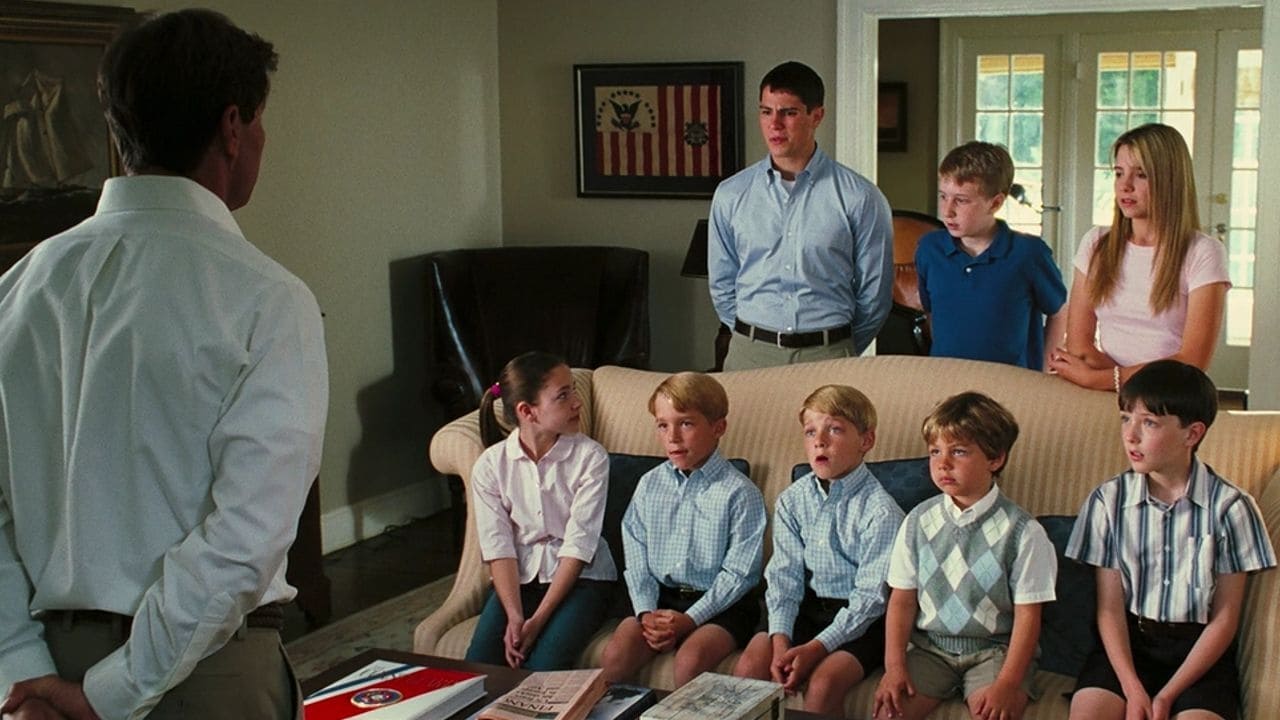
So, here’s the thing about the Yours Mine and Ours movie—it’s actually a ghost story. Not the kind with chains and rattling floorboards, but the kind where a 1960s true story keeps haunting Hollywood every few decades because we can’t stop obsessing over the idea of a "mega-family." You probably remember the 2005 version. Dennis Quaid looking stressed in a Coast Guard uniform. Rene Russo trying to manage a literal army of children. It’s loud. It's messy. It’s peak mid-2000s slapstick.
But most people don’t realize that the 2005 flick is just one layer of a very real, very complicated history.
The original 1968 film starred Lucille Ball and Henry Fonda. It was a massive hit. Why? Because it was based on the life of Helen Beardsley, a woman who actually lived through the logistical nightmare of merging two giant families. When you watch these movies, you’re seeing a Hollywood-tinted version of a survival manual.
The Real Beardsley Story vs. Hollywood Magic
If you look at the Yours Mine and Ours movie through a historical lens, the 2005 remake feels like a fever dream compared to the 1968 original. The 1968 version was based on Helen Beardsley's book, Who Gets the Drumstick? It wasn't just a gag about kids spilling paint on a general's head. It was about the Great Depression-era mentality of "making do" and the legitimate struggle of 18 children trying to find their identity under one roof.
Honestly, the 2005 version stripped a lot of that soul away.
Director Raja Gosnell, who also gave us the live-action Scooby-Doo, leaned hard into the "kids vs. parents" trope. In the remake, Frank Beardsley (Quaid) is a high-ranking Coast Guard officer, and Helen North (Russo) is a free-spirited handbag designer. It’s the classic "order vs. chaos" setup. The movie implies that if you just have enough chore charts and a whistle, you can manage nearly twenty human beings.
Real life is never that clean.
The Beardsleys weren't just a punchline. In the actual history, Frank and Helen married in 1961. Frank had ten children; Helen had eight. They eventually had two more together. That's twenty kids. Imagine the laundry. No, really—stop and actually think about twenty people's worth of socks. The movie shows the kids sabotaging their parents' marriage because they want their old lives back. While that makes for great cinema, the real-world challenge was much more about the sheer, crushing weight of domestic logistics.
Why the 2005 Remake Still Pulls Numbers
You’d think a movie with a 6% rating on Rotten Tomatoes would be forgotten. It isn't.
Despite critics absolutely hating the Yours Mine and Ours movie from 2005, it remains a staple of cable TV and streaming platforms. It’s a "comfort watch." There is something deeply satisfying about watching a house get destroyed by a bunch of kids when it isn't your house. It taps into the same energy as Cheaper by the Dozen.
The cast of kids was actually a breeding ground for future talent, too. You’ve got a young Miranda Cosgrove right before iCarly exploded. You’ve got Danielle Panabaker. You’ve even got Sean Faris. For a lot of Gen Z, this movie is a nostalgic touchstone not because it's "good cinema," but because it was the ultimate "what if" scenario for anyone who ever fought with a sibling over the TV remote.
The "Blended Family" Fantasy
Hollywood loves the Yours Mine and Ours movie concept because it sells a specific lie: that conflict can be solved with a montage.
In the 2005 film, the kids from both sides eventually team up to break their parents up, only to realize they actually love being a giant tribe. They build this elaborate craft project to save the marriage. It’s sweet. It’s also totally unrealistic. Experts in family psychology, like those at the Stepfamily Magazine or researchers like Dr. Patricia Papernow, often point out that "blending" a family takes years, not weeks.
The movie treats the kids like two opposing sports teams. In reality, the 1968 film handled this with a bit more nuance. Lucille Ball’s performance showed the genuine exhaustion of a mother trying to be everything to everyone. The 2005 version focuses on slapstick stunts—like Frank falling into a vat of slime or whatever happened in that lighthouse.
It’s interesting to note how the movies reflect the eras they were made in:
- The 1968 version is about the traditional American dream expanding to its breaking point.
- The 2005 version is about the clash between "Type A" career culture and "Bohemian" creative culture.
Dissecting the Chaos: Production and Reception
Let's get into the weeds of why the 2005 Yours Mine and Ours movie felt so different from its predecessor.
Production-wise, the film was a joint venture between Paramount and MGM. They wanted a family blockbuster. They got one, at least financially. It made about $72 million against a $45 million budget. Not a runaway hit, but it did its job.
But the "vibe" was off for many.
Rene Russo and Dennis Quaid have zero romantic chemistry. They feel like two people who met at a corporate retreat and decided to buy a house together on a whim. This is a common complaint in reviews from the time. Roger Ebert famously gave it one star, calling it "lifeless." He wasn't wrong, but he also wasn't the target audience. The target audience was an eight-year-old who wanted to see a lighthouse turned into a giant slip-and-slide.
The Actual Logistics of 18 Kids
If you want to understand the Yours Mine and Ours movie, you have to look at the numbers.
- Food: In the real Beardsley household, they bought milk by the crate and bread by the dozen.
- Space: The 2005 movie uses a massive, gorgeous lighthouse. Real-life large families usually live in cramped quarters where "privacy" is a word you find in a dictionary, not an actual room.
- Transport: You don't drive a minivan. You drive a bus. Literally.
The 2005 film ignores the financial stress. Frank is a Coast Guard Admiral. He's loaded. Helen is a successful designer. The stakes are lower when you can afford to replace a broken vase or a ruined floor. This is where the movie loses its "human" quality and becomes a cartoon.
How to Watch It Today
If you’re planning a marathon, start with the 1968 original. It’s funnier, the acting is superior, and Lucille Ball is a comedic genius who knows how to play "frazzled" better than anyone in history. Then, watch the 2005 Yours Mine and Ours movie as a time capsule of mid-2000s fashion and parenting tropes.
It’s fascinating to see how the "North" kids (the artistic ones) are coded versus the "Beardsley" kids (the disciplined ones). It’s a very dated way of looking at personality types.
What We Can Learn From the Beardsley Legacy
So, what’s the takeaway here?
Beyond the slapstick and the questionable 2000s CGI, the Yours Mine and Ours movie matters because it highlights our cultural obsession with the "Big Family." We are fascinated by the idea of a community built within a single home.
If you are actually in a blended family, don't look to these movies for advice. They are meant to be escapism. The "actionable insight" here is that real blending isn't about a shared craft project; it’s about acknowledging that everyone’s old life is gone and building something new from the scraps.
Moving Forward with Your Movie Night
If you want to dive deeper into the reality behind the film, I highly recommend tracking down a copy of Helen Beardsley’s original book. It’s out of print but usually available through used bookstores. It offers a much more grounded, often moving look at what happens when two grieving people decide to gamble on love and a massive grocery bill.
- Check the credits: Look for the names of the real Beardsley children in the "Special Thanks" or as consultants in the older versions.
- Compare the tone: Notice how the 1968 version treats the kids as individuals, whereas the 2005 version treats them as a "unit."
- Identify the tropes: Spot the "Military Dad" vs. "Hippie Mom" clichés that have since been used in dozens of other sitcoms and movies.
The Yours Mine and Ours movie isn't a masterpiece, but it’s a fascinating look at how Hollywood tries—and often fails—to capture the beautiful, messy reality of a truly large family. It’s loud, it’s annoying, and it’s a little bit ridiculous. Kind of like a real family, honestly.



