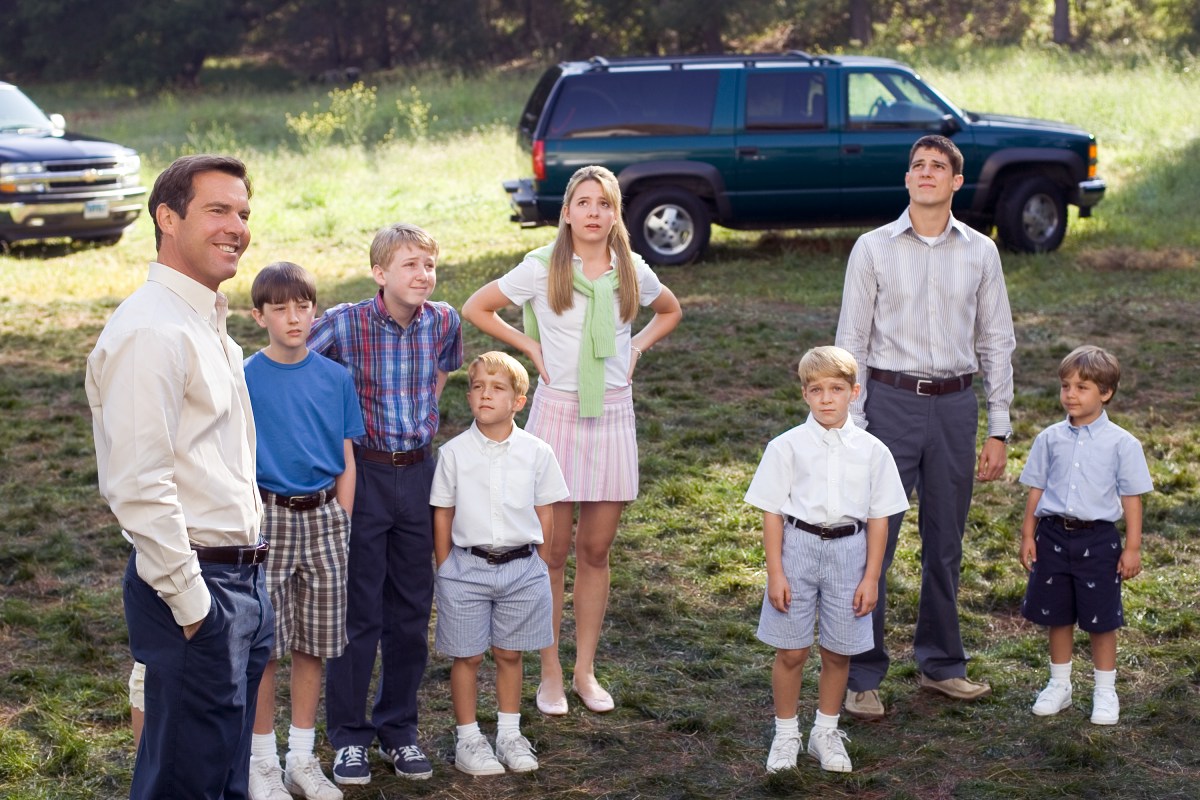
Honestly, the mid-2000s were a weirdly specific time for family comedies. Everything was about high-concept chaos, massive ensembles, and the kind of slapstick that probably resulted in some very real bruises for the stunt team. If you grew up in that era, or if you’ve spent any time scrolling through streaming services on a lazy Sunday, you’ve definitely run into Yours Mine and Ours 2005. It’s the remake of the 1968 Lucille Ball and Henry Fonda classic, but with a distinct, hyper-saturated 2000s energy that feels like a time capsule.
Critics absolutely mauled it at the time. Like, they were ruthless. But here’s the thing: it still pulls numbers. People still watch it. Why? Because there is something deeply, primally satisfying about watching eighteen children systematically dismantle a lighthouse.
The High-Stakes Math of Eighteen Kids
The premise is basically a logistics nightmare. Dennis Quaid plays Frank Beardsley, a Coast Guard Admiral who runs his life like a battleship. He’s got eight kids. On the other side, you have Rene Russo as Helen North, a free-spirited handbag designer with ten kids. They were high school sweethearts, they reconnect, they get married on a whim, and suddenly you have twenty people trying to live under one roof.
It’s a nightmare.
Most movies struggle to give three children distinct personalities. This movie has eighteen. Of course, not all of them get a character arc—some are basically living set dressing—but the movie leans into the archetypes. You’ve got the overachievers, the rebels, the twins who exist solely to cause property damage, and the youngest ones who are just there to look cute and occasionally cry.
Why Yours Mine and Ours 2005 Hits Different Than the Original
The 1968 version was a product of its time. It was a bit more grounded, focused on the "blended family" struggle when that was still a relatively fresh concept for mainstream cinema. The Yours Mine and Ours 2005 version, directed by Raja Gosnell (the guy behind the live-action Scooby-Doo and Big Momma’s House), decided to crank the volume to eleven.
Everything is faster. The messes are bigger. The "war" between the Norths and the Beardsleys is choreographed like a military campaign.
The kids don't want to be together. They hate the new living arrangement. So, they form an unholy alliance. It’s "us against them," where the kids decide to behave so poorly and create so much friction that their parents will be forced to divorce. It sounds dark when you say it out loud, but in the context of a PG-rated comedy, it’s mostly just people falling into vats of paint or getting hit with grocery items.
A Cast That Went On to Do Big Things
If you look back at the cast list now, it’s a total trip. You’ve got a very young Miranda Cosgrove right before iCarly exploded. Danielle Panabaker is in there before she became a staple of the CW’s The Flash. Sean Faris was the "teen heartthrob" of the week.
Dennis Quaid is doing his "stern but secretly loving dad" thing that he basically perfected in the 90s and 2000s. He’s got that specific grin that makes you think he’s either about to give you a lecture on discipline or take you fishing. Rene Russo, meanwhile, provides the necessary contrast. She’s the "crunchy" mom who believes in "self-expression" and "feelings," which, naturally, clashes with Quaid’s "march in a straight line" philosophy.
The Production Reality of a Mega-Family Film
Filming a movie with eighteen kids is, by all accounts, a total headache. There are labor laws. You can only shoot for certain hours. You need a small army of tutors and handlers.
The production design of the house is actually one of the best parts of the movie. They found this massive, dilapidated lighthouse property and turned it into a character of its own. It starts as a wreck, becomes a sterile military barracks, and eventually turns into a colorful, chaotic mess that represents the blending of the two families.
Actually, the "blending" is the core of the SEO-friendly "value" here. Even though it's wrapped in slapstick, the movie touches on the real-world friction of step-families. It’s never as easy as "we’re married now, so everyone get along." There’s a genuine sense of loss for the kids—loss of their old routines, loss of their parents' undivided attention, and loss of their personal space.
What the Critics Missed (and What Audiences Saw)
When you look at the Rotten Tomatoes score for Yours Mine and Ours 2005, it’s sitting at a dismal 6%.
Ouch.
Critics hated the predictability. They hated the "standard" jokes. But audiences gave it a much higher "Popcornmeter" score. Why the gap? Because movies like this aren't trying to be Citizen Kane. They are designed to be "comfort watches." They provide a safe environment where the biggest problem in the world is a pig running loose during a formal dinner or a boat race gone wrong.
It’s a "family movie" in the truest sense—something you can put on for a seven-year-old and not have to explain any complex metaphors, while the adults can at least appreciate the chemistry between Quaid and Russo.
The Logistics of the "Big Family" Genre
There was a trend back then. Cheaper by the Dozen (the Steve Martin version) came out in 2003. Yours Mine and Ours followed in 2005. Hollywood realized that there was a massive market for "large family chaos."
Maybe it’s because most people live in smaller households and the idea of eighteen siblings is like looking at an alien civilization. Or maybe it’s the wish fulfillment of never being lonely.
Whatever the reason, this movie represents the peak of that trend. After this, the genre started to pivot toward more "grounded" family dramedies or moved entirely into animation.
Key Lessons for Blended Families (Hidden in the Jokes)
If you strip away the scenes where someone gets covered in slime, there are a few actual takeaways:
- Routines matter. Frank’s military precision was too much, but Helen’s total lack of structure was also a disaster. The "win" happened when they met in the middle.
- Kids need a "say." The rebellion started because the parents made a life-altering decision without talking to the people it affected most.
- Space is sacred. The biggest fights in the movie weren't about ideology; they were about who was touching whose stuff. That’s pretty universal.
Is It Still Worth a Watch?
If you’re looking for high-brow cinema, no. Definitely not.
But if you want a nostalgia hit from 2005? If you want to see a pre-fame Miranda Cosgrove or just watch Dennis Quaid try to maintain his sanity while a house literally falls apart around him? Then yeah, Yours Mine and Ours 2005 holds up in a very specific, "early 2000s DVD" kind of way.
It reminds us of a time before smartphones took over the dinner table. In this movie, the kids have to actually talk to each other to plot their schemes. There’s something charmingly low-tech about it.
Actionable Steps for Your Next Movie Night
If you're planning to revisit this one, or introduce it to a new generation, here’s how to do it right:
- Double Feature: Watch it back-to-back with the 1968 original. It’s a fascinating look at how "family values" and filmmaking styles changed over forty years.
- Spot the Stars: Play "spot the future celebrity." Half the kids in this movie popped up in major TV shows or movies later in the decade.
- The "Blended" Discussion: If you’re a blended family, use the movie as a low-stakes way to talk about the "us vs. them" dynamic. It’s easier to talk about how the Beardsleys and Norths struggled than it is to talk about your own kitchen-table tensions.
- Check the Soundtrack: The 2005 soundtrack is a literal playlist of what was popular on Radio Disney at the time. It’s a total trip.
Ultimately, Yours Mine and Ours 2005 isn't a masterpiece, but it’s a solid piece of entertainment that understood its audience. It knew people wanted to see a big, messy, happy ending. And in a world that’s usually just messy, that’s not a bad thing to spend ninety minutes on.
Next Steps:
- Search for the movie on your preferred streaming platform (it frequently cycles through Netflix and Disney+).
- Compare the "Family Chart" from the 2005 version to the 1968 version to see which kid-archetypes were added for the modern era.
- Look up the filming locations; the lighthouse house is actually a real structure in Southern California that you can see from the outside.


