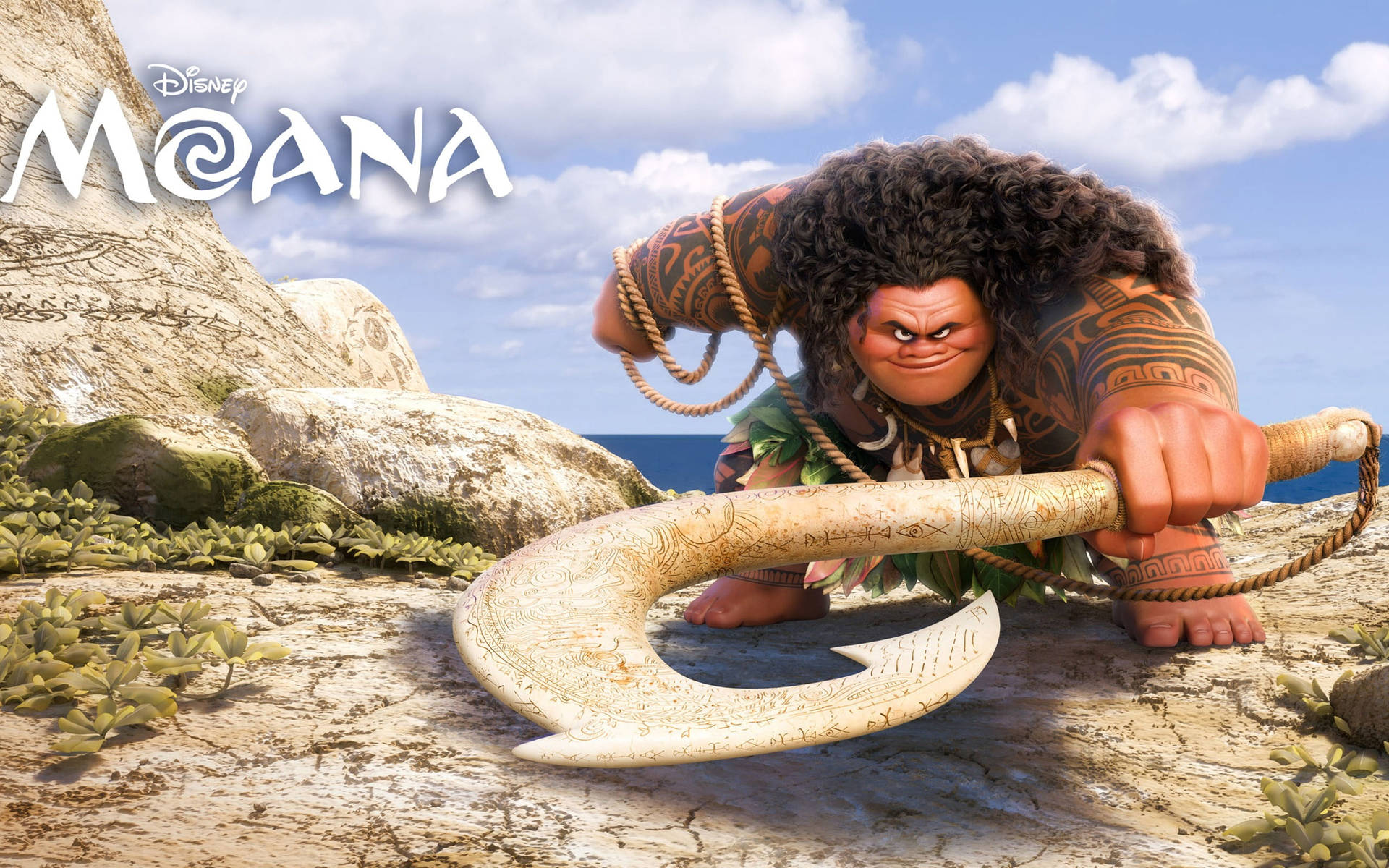
It is the earworm that simply refuses to die. You know the one. You’ve probably hummed it while doing the dishes or found yourself accidentally belt-singing it in the car because Lin-Manuel Miranda is a sorcerer of rhythm. But "You're Welcome," the definitive Maui and Moana song, isn’t just a catchy bridge between plot points. It’s a dense, bragging, fast-talking resume that manages to squeeze about three thousand years of Polynesian oral tradition into roughly two minutes and forty-three seconds. Honestly, it’s kind of a miracle it works at all.
Most people see it as a funny narcissism anthem. Maui, voiced with surprising vocal agility by Dwayne "The Rock" Johnson, spends the entire track gaslighting a teenage girl while literally drawing on his own skin. But if you look at the lyrics—and the animation of "Mini Maui"—there is a staggering amount of ethnographic detail hidden under that pop-rap beat. It isn't just Disney being cute. It’s a very specific distillation of the Māui myths found across the Pacific, from Hawai'i to Aotearoa (New Zealand).
The Actual Mythology Behind the Bragging
When Maui starts listing his achievements, he isn't making things up. He’s reciting his greatest hits. In the Maui and Moana song, he claims he "snared the sun" to give humans longer days. This is a direct reference to the legend of Maui and his brothers using a noose made of his mother’s hair to slow down the sun god, Tama-nui-te-rā. In the myth, the sun was moving too fast for people to get their chores done or for crops to grow. Maui beat the sun into submission. It’s violent, weird, and incredibly important to Pacific Islander identity.
Then there’s the bit about "pulling islands from the sea." This is perhaps the most famous Maui feat. Using his grandmother’s jawbone as a hook—which Disney swapped for a magical glowing fishhook for obvious family-friendly reasons—he fished up the North Island of New Zealand, known as Te Ika-a-Māui (The Fish of Maui). The South Island is his canoe, or waka.
Fire and the Sky
He also mentions stealing fire. In the song, he says, "I harnessed the breeze / I'm gonna lead, you're gonna follow." But the fire story is actually way more interesting and a bit darker in the original lore. Maui basically tricked the fire goddess Mahuika into giving him her fingernails, which were made of flame, until she got fed up and tried to burn him alive. The movie glosses over the "burning the world down" part, focusing instead on the benefit to humanity.
The song functions as a pepeha or a genealogy of deeds. In many Polynesian cultures, knowing your lineage and your "take" (your contributions or history) is vital. By singing this song, Maui is establishing his mana. He’s not just being a jerk; he’s stating his credentials in a world where names have power.
Why the Music Works So Well (And Why It's Still Stuck in Your Head)
Lin-Manuel Miranda is famous for his "wordiness." He loves a rapid-fire internal rhyme scheme. In "You're Welcome," he uses a technique called "patter singing." It’s an old theatrical trick where the lyrics are rhythmic and fast, designed to show off a character's wit and ego.
Think about the rhyme: "The tide, the grass, the ground / Oh, that was Maui just messing around."
It’s effortless. But there’s a deeper musical layer here. Opetaia Foa'i, the founder of the group Te Vaka, worked closely with Miranda to ensure the "pulse" of the music felt authentic to the Pacific. While "You're Welcome" is the most "Broadway" song in the film, it still maintains a rhythmic drive that feels distinct from a standard Disney ballad like "Part of Your World."
The Rock’s performance is actually central to why the song works. He isn't a Broadway singer. He's a charismatic entertainer. His slight vocal imperfections make the song feel more human and less like a polished studio product. You can hear the smirk in his voice. That's hard to fake.
The Narrative Trap: It's a Distraction
Here is something most people miss: the Maui and Moana song is a tactical maneuver.
Moana is standing there, desperate, trying to save her entire civilization. Maui is a washed-up demi-god who hasn't had an audience in a millennium. The song is a literal "song and dance" meant to distract her so he can steal her boat. It’s the ultimate "look over there!" move.
- He uses the visuals (the tattoos) to keep her eyes moving.
- He uses the rhythm to keep her feet tapping.
- He uses the "you're welcome" hook to make her feel like she owes him something.
By the time the song ends, she’s locked in a cave. It’s one of the few times in a Disney movie where a major musical number is used as a weapon of deception by a "hero" character. It’s brilliant screenwriting. It establishes Maui’s character as a trickster—which is his primary archetype in real mythology. He’s a Māui-tikitiki-a-Taranga, a figure defined by his cleverness and his tendency to push boundaries.
Cultural Accuracy vs. Disney Magic
There was actually some pushback when the song and the character design first leaked. Some Pacific Islander critics felt that making Maui a "big" guy played into stereotypes about Polynesian body types. However, others pointed out that in many legends, Maui is a powerhouse, a man of immense strength who literally moved the sky.
The song tries to bridge this gap by focusing on his agility. He’s fast. He’s light on his feet. He’s a rapper. He’s not just a "big guy"; he’s a force of nature.
The Tattoos (The Malu and Pe'a)
The animation of the tattoos in the Maui and Moana song is arguably the most culturally significant part of the sequence. These aren't just random drawings. They are based on traditional tatau. The way "Mini Maui" acts as a conscience—and a secondary narrator—reflects the idea that history is literally written on the body in many Pacific cultures. Every line has a meaning. Every achievement is earned.
Interestingly, the song helps humanize a god. We see that he needs the validation. If nobody says "thank you," does he even exist? It’s a subtle nod to the idea that gods in many traditions are kept alive by the memory and gratitude of the people.
Impact on Pop Culture and the Live-Action Future
Since 2016, "You're Welcome" has been streamed billions of times. It’s a staple of kids' parties and talent shows. But its real legacy is how it opened the door for more specific cultural storytelling in mainstream animation. Without the success of the Maui and Moana song, we might not have seen the same level of deep-dive cultural consultation in movies like Encanto or Raya and the Last Dragon.
With a live-action Moana remake currently in production (and Dwayne Johnson returning to the role of Maui), there is a lot of speculation about how this song will translate. In a live-action setting, the "Mini Maui" tattoo will likely be a CGI marvel. The challenge will be maintaining the whimsical, trickster energy of the original without it feeling too "stagey" in a realistic environment.
Misconceptions About the Song
- Maui wrote it: No, in the movie's logic, he's "improvising," but it's a testament to his ego.
- It’s an original myth: The song is a compilation. No single myth contains all these elements in exactly this order, but they are all rooted in real Polynesian stories.
- The Rock didn't sing it: He actually did. No ghost singers were used for his parts.
Actionable Insights for Fans and Researchers
If you want to go deeper than just singing along, there are a few things you can do to actually understand the context of the Maui and Moana song.
- Read the "Maui" stories from different regions: Check out the Māori versions of the Maui legends versus the Hawaiian ones. You'll see that while the "fishing up islands" story is common, the details vary wildly. It’s a great way to see how oral tradition evolves over geography.
- Listen to the soundtrack's "Outtakes": There are several versions of songs that didn't make the cut which give more context to Maui’s backstory.
- Study the art of the Tatau: Look into the history of Polynesian tattooing. You’ll find that the "moving pictures" on Maui’s skin are a stylized version of a very real, very sacred art form.
- Check out Te Vaka: If you like the rhythm of the movie, listen to the actual band that inspired the sound. It’s much more percussion-heavy and gives you a real sense of the "Moana" vibe without the Hollywood filter.
The next time you hear those opening drums and Maui starts talking about the sky, remember it’s not just a catchy tune. It’s a 3,000-year-old history lesson disguised as a chart-topping pop song. You’re welcome.



