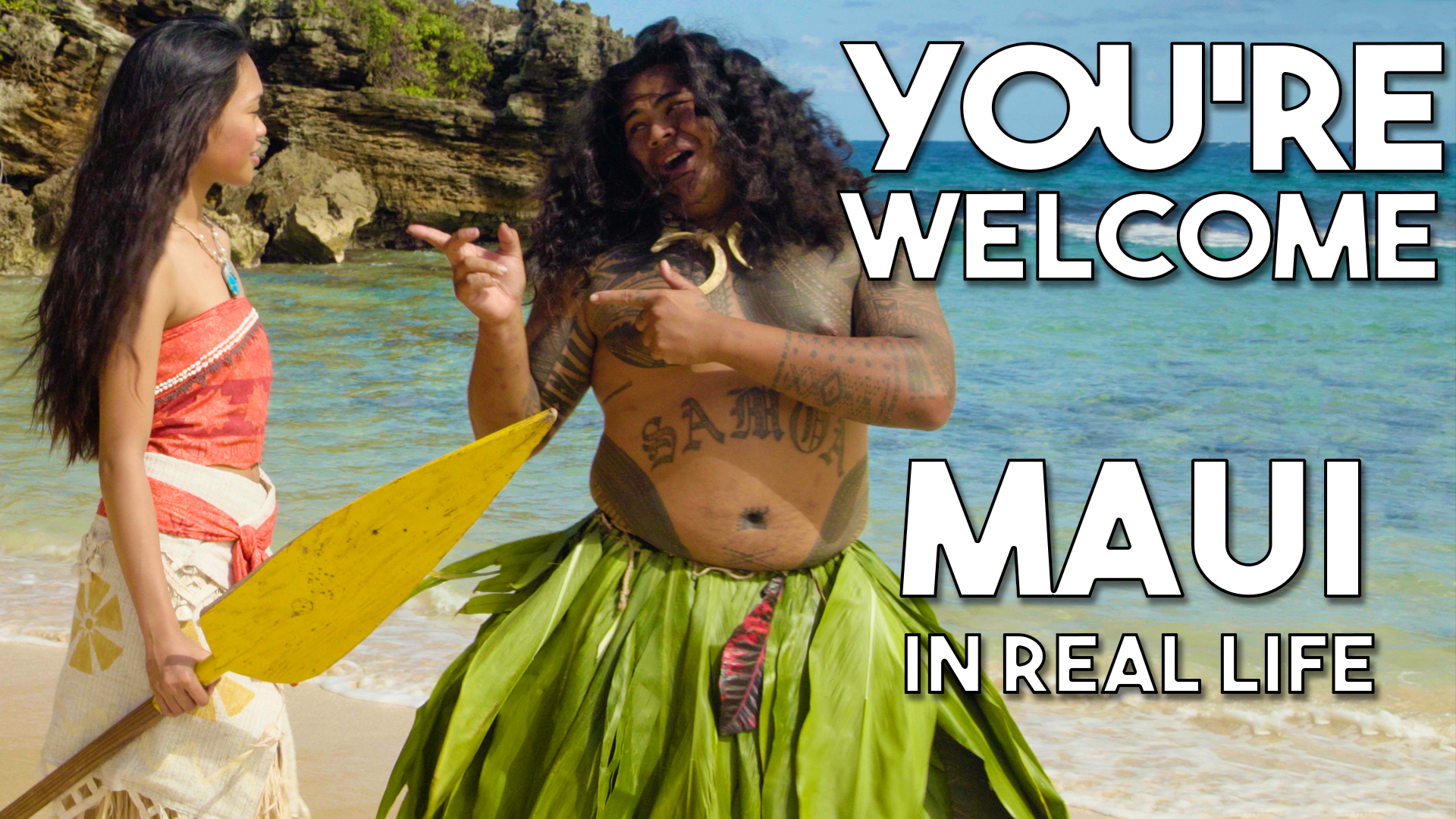
Honestly, if you've spent more than five minutes around a toddler or a Disney fan since 2016, you probably have "You're Welcome" from Moana permanently etched into your brain. It’s one of those tracks that starts with a bouncy, harmless beat and ends with you accidentally rapping about lassoing the sun while doing the dishes. But there is actually a lot more going on with this song than just Dwayne "The Rock" Johnson being incredibly charming for two minutes and forty-three seconds.
It’s kind of a weird song when you really look at it. Most Disney "hero" introductions are sweeping, emotional, or at least a bit more humble. Not Maui. He spends the entire duration of You're Welcome gaslighting a teenage girl into thinking he’s doing her a favor while he's literally stealing her boat. It is a masterclass in ego, and yet, we all love it. Why? Because Lin-Manuel Miranda is a wizard at making narcissism sound like a party.
The Secret History of the Song (It Wasn't Always Maui's)
Here is a bit of trivia that usually shocks people: "You're Welcome" was originally supposed to be Moana’s song.
Yeah, you read that right. In the early drafts of the script, Moana was the one who was supposed to sing to Maui. The directors, Ron Clements and John Musker, originally imagined Moana finding a washed-up, depressed Maui who had lost his mojo. She was going to sing a song to him to remind him of how great he used to be. Basically, she was going to be his hype man.
But as the story evolved, the team realized that making Maui an arrogant, "I’m the greatest thing to happen to the Pacific" kind of guy made for a way better dynamic. It allowed for that friction between Moana’s sincerity and Maui’s thick-headed vanity. Once they flipped the script, they gave the task to Lin-Manuel Miranda, who was basically at the peak of his Hamilton fame while writing this.
Miranda actually watched old videos of The Rock's "Rock Concerts" from his WWE days to get the vibe right. He wanted to capture that specific brand of "heel" charisma where the guy is clearly a jerk, but he’s so entertaining you can't help but cheer for him.
How The Rock Actually Pulled Off the Vocals
Let’s be real—Dwayne Johnson is not a Broadway singer. He’s the first person to admit that. But he’s got rhythm, and he’s got "The Rock" factor.
To make the song work, Miranda wrote it specifically for Johnson’s limited vocal range. If you listen closely, the melody doesn't jump around a ton. It stays in a comfortable "talk-singing" zone that allows Johnson to lean into the character’s personality rather than worrying about hitting a high C.
The rap section was the real test. Lin-Manuel Miranda is famous for those dense, internal-rhyme-heavy raps, and he didn't go easy on Johnson. The "I killed an eel, I buried its guts" verse is surprisingly fast. Johnson apparently practiced it for weeks, and the result is a track that went 4x Platinum. It’s actually kind of wild to think that the guy who started as a pro wrestler now has a quadruple-platinum music plaque on his wall because of a Disney demigod.
The Mythology Most People Miss
One of the coolest things about You're Welcome is that it isn't just random bragging. Almost every single line refers to an actual Polynesian myth.
- The Sky: The line about "holding up the sky" refers to the legend where the sky and earth were so close people couldn't stand up. Maui used his strength to push the sky high enough for trees to grow and humans to walk upright.
- The Sun: The "lassoed the sun" bit comes from the story of Maui and his brothers using a rope made from their sister's hair (in some versions) to catch the sun and beat it into moving slower so the days would be longer.
- The Fire: "Stole you fire from down below" is about Maui's trickery with Mahuika, the goddess of fire. He basically kept putting out the fire she gave him until she got mad and revealed the secret of how to make it from scratch.
- The Coconuts: This one is a bit darker. The "buried the guts" line refers to the death of Te Tuna (a giant eel). According to the myth, Maui buried the eel's head, and the first coconut palm grew from that spot. If you look at a coconut, the "three holes" are said to be the eyes and mouth of the eel.
The animation during this sequence also shifts to a 2D "tapa cloth" style for Maui’s tattoos. That character, "Mini Maui," acts as Maui’s conscience. He was hand-drawn by legendary animator Eric Goldberg, the same guy who did the Genie in Aladdin. That’s why that sequence feels so much like a classic 90s Disney movie hidden inside a modern 3D one.
Why It Still Works Today
It is 2026, and this song is still pulling massive numbers on streaming platforms. It has over 1.8 billion views on YouTube. That is an insane amount of "You're Welcome."
I think it works because it’s the ultimate "confidence" song. We live in a world where everyone is obsessed with "main character energy," and Maui is the original poster child for that. Even though he’s technically being a villain in this specific scene—remember, he literally locks Moana in a cave—his joy is infectious.
Plus, it’s short. At under three minutes, it doesn't overstay its welcome. It gets in, hits you with a catchy hook, gives you a rap you can barely keep up with, and then ends with a literal "You're welcome!"
Actionable Insights: What You Can Learn from Maui
If you’re looking for a takeaway from this song that isn't just "Disney songs are catchy," here it is:
- Know Your Audience: Maui didn't just sing; he gave a sales pitch. He knew Moana was impressed by legends, so he played into them.
- Personality Over Perfection: The song works because of Johnson’s charm, not because he’s the world’s best singer. Lean into your unique voice.
- Visual Storytelling: The tattoos telling the story while he sings is a great example of "show, don't just tell." If you're presenting an idea, find a way to make it visual.
If you want to go down a real rabbit hole, go watch the Jordan Fisher version of the song that plays during the credits. It’s a completely different vibe—more pop and R&B—and it shows just how solid the actual writing of the song is. Whether it’s a pro wrestler or a Broadway star singing it, the structure holds up.
Next time it comes on the radio or your kid’s playlist, don't fight it. Just accept that for the next three minutes, you're face-to-face with greatness and it's strange. You're welcome.



