It’s the leather. It’s the cigarette ground into the dirt by a red high heel. It’s that gravity-defying carnival ride that literally flies into the sky for no logical reason. When people talk about the end song in Grease, they aren't usually thinking about "We Go Together"—the actual finale—they’re thinking about the seismic shift of "You’re the One That I Want."
That song changed everything.
Honestly, if you look at the 1978 film, that specific musical number is the moment John Travolta and Olivia Newton-John stopped being just actors and became permanent icons. It’s weird, right? Sandy spends the whole movie being "wholesome," then puts on some tight pants, and suddenly, she’s the most powerful person in the room. Danny Zuko, the guy who spent two hours trying to look cool, is literally on his knees. The end song in Grease isn't just a catchy tune; it’s a masterclass in how to close a movie so hard that people are still talking about it nearly fifty years later.
The Transformation That Launched a Thousand Halloween Costumes
John Farrar wrote "You’re the One That I Want." He was Newton-John’s long-time producer and songwriter. Interestingly, the director of the film, Randal Kleiser, wasn't actually a fan of the song at first. He felt it didn't quite fit the 1950s vibe of the rest of the soundtrack. He was wrong. Totally wrong.
The song works because it’s a duet that actually has stakes. You’ve got Danny trying to be a track star to impress Sandy, and Sandy showing up looking like she just walked off a high-fashion biker shoot. It’s the ultimate "fake it till you make it" anthem.
The chemistry is palpable. Travolta’s "electrifying" growl was mostly improvised movement. He had this way of moving—liquid almost—that made the carnival backdrop feel like a Broadway stage. Newton-John, who was famously terrified of the transformation scene, had to be sewn into those black sharkskin trousers because the zipper broke. She couldn't even drink water for fear of needing a bathroom break that would require a seamstress. That’s the kind of dedication that goes into a legendary end song in Grease.
Why "We Go Together" is the Real Finale (But Nobody Cares)
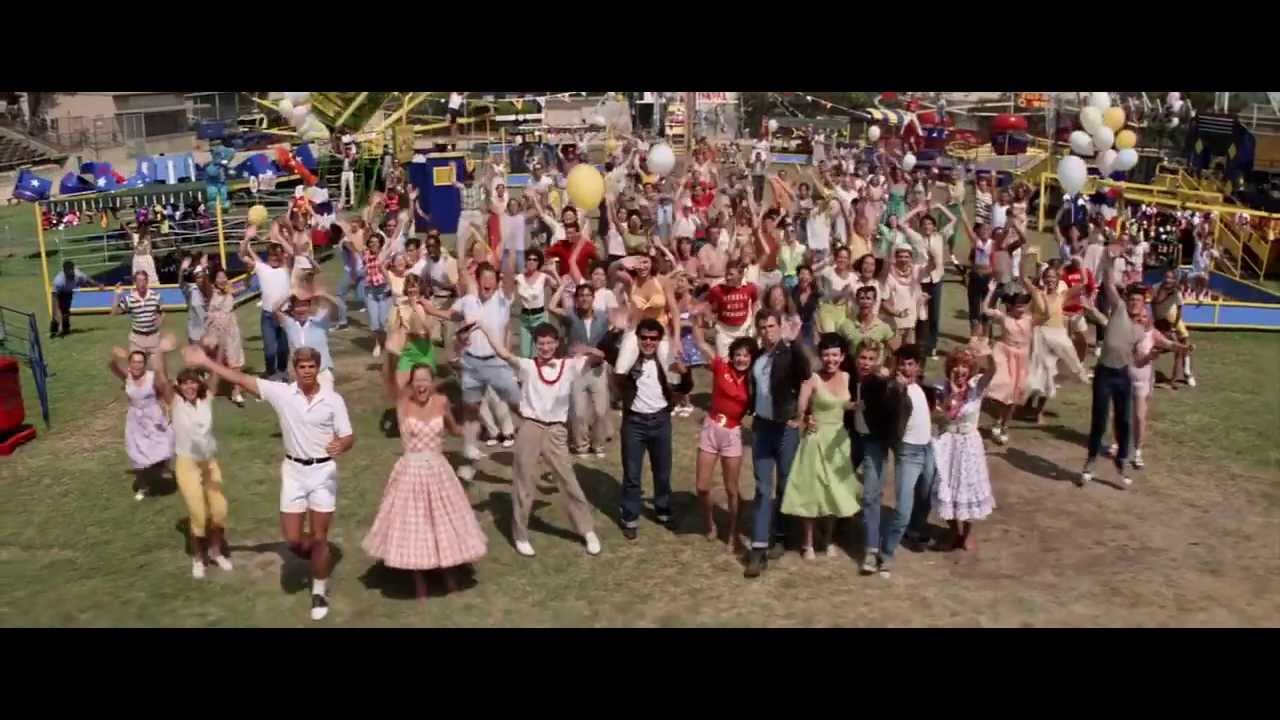
Technically, the end song in Grease—the one that rolls into the credits—is "We Go Together."
It’s full of nonsense. "Rama lama lama ka dinga da dinga dong." It’s a gibberish-filled celebration of friendship and the end of high school. While "You’re the One That I Want" is about the tension between two people, "We Go Together" is about the ensemble. It’s the T-Birds and the Pink Ladies acknowledging that they’ll "always be together," even though everyone knows high school friends almost always drift apart after graduation.
The choreography in this section is chaotic in the best way. It feels like a real party. You see the background actors actually having fun, which is rare for big-budget musicals of that era. But let’s be real: the flying car is what everyone remembers. The Greased Lightnin’ convertible taking off into the clouds is one of the most "wait, what?" moments in cinema history. It’s never explained. It doesn’t need to be. It’s the 70s.
The Chart Performance No One Expected
When the soundtrack was released, the end song in Grease didn't just do well. It decimated the charts. "You’re the One That I Want" hit number one in about a dozen countries. In the UK, it stayed at the top for nine weeks. Nine. To put that in perspective, that’s longer than most modern pop stars stay in the cultural conversation at all.
It sold over 6 million copies.
The irony? The original Broadway show didn't have this song. In the stage version, the big finale transformation song is called "All Choked Up." It’s a decent rockabilly track, but it lacks the pop sheen that Farrar brought to the movie. If the filmmakers had stuck to the original play's music, it’s highly unlikely the movie would have become the juggernaut it is today.
The Technical Brilliance of the Carnival Sequence
The "Shake Shack" was a real funhouse. The actors were actually running through it. This wasn't a sterile green-screen environment. You can see the sweat. You can see the dust.
Patricia Birch, the choreographer, had to figure out how to make two people who weren't professional dancers (well, Newton-John wasn't, Travolta definitely was) look like they were in a synchronized fever dream. She used the environment—the slides, the moving floors—to create momentum. It’s fast. It’s jagged.
- The "Step" - Danny’s weird little kick-step.
- The "Lean" - Sandy leaning back while Danny circles her.
- The "Floor Slide" - Pure Travolta bravado.
People forget that Grease was filmed in just two months on a relatively small budget. The carnival was a real traveling fair that happened to be in town. They shot the finale in a day or two. The pressure was massive, yet the end song in Grease feels effortless.
What Modern Musicals Get Wrong
If you look at La La Land or the West Side Story remake, everything is perfect. Too perfect. The end song in Grease works because it’s a bit messy. Newton-John’s hair is a little wild by the end. Travolta’s shirt is partially untucked. It feels like a memory of high school rather than a documentary of it.
The sound mix is also incredibly heavy on the bass, which was a deliberate choice to make it "pop" on 1970s radio. It was designed to be a hit single first and a movie scene second. That’s the secret sauce.
The Cultural Legacy of the Leather Jacket
That final outfit Sandy wears—the one she wears during the end song in Grease—sold at auction for $405,700 back in 2019. The buyer? He actually returned the jacket to Olivia Newton-John because he didn't feel it belonged in a private collection. It belonged to her.
That’s the level of emotional attachment people have to this specific moment. It’s not just a song; it’s a symbol of reinvention. Sandy decides she’s tired of being the "good girl" and takes control of her narrative. Danny decides he’s tired of being the "tough guy" and tries to be better for her.
Of course, critics have spent decades arguing that the message is "change yourself to get a guy." And yeah, looking at it through a 2026 lens, it’s a bit problematic. But if you watch the scene closely, Danny has also changed. He’s wearing a letterman sweater. He’s trying to be the guy he thinks she wants. They both meet in the middle, even if Sandy’s "middle" involves a lot more hairspray.
Exploring the Sound of 1958 vs. 1978
One of the most fascinating things about the end song in Grease is that it sounds absolutely nothing like the 1950s.
"You’re the One That I Want" is a disco-pop song. The synth bassline, the crisp drumming, the vocal layering—it’s pure late-70s. The movie is set in 1958, but the music is firmly planted in the year it was made. This "anachronistic" approach is why it stayed relevant. If it had sounded like a generic 50s doo-wop track, it would have been a period piece. Instead, it became a timeless club anthem.
Even the backup vocals have that high-pitched, Bee Gees-adjacent energy. It’s the sound of the summer of '78.
The Deleted Bits and Alternate Takes
There are rumors of longer versions of the finale. In some early cuts, there was more dialogue before the music kicked in. But the editors realized that once the audience saw Sandy in that outfit, they didn't want to hear her talk. They wanted to hear her sing.
The transition from the "You're the One That I Want" ending to "We Go Together" is also a masterstroke of pacing. You go from the high-octane romance to the communal joy of the entire cast. It prevents the movie from ending on just a "boy gets girl" note and turns it into a "we all survived high school" note.
Actionable Takeaways for Superfans
If you’re looking to recapture the magic of the end song in Grease, or perhaps you're planning a viewing party, here is how to actually appreciate the nuances of the finale:
- Watch the Feet: Don’t just look at their faces. The footwork in the Shake Shack is incredibly complex. Travolta is leading with his hips, which was his signature move from Saturday Night Fever.
- Listen for the "Growls": Newton-John adds these little "ohh-ohh-ohhs" that weren't in the original demo. She was finding her voice as a rock performer in real-time.
- Check the Background: The extras in the carnival scene were often told to "just have fun." You can spot several people in the background who aren't even looking at the main actors; they’re actually riding the rides or eating cotton candy. It adds to the realism.
- Compare to the Stage Play: If you ever get the chance, listen to "All Choked Up." It gives you a much better appreciation for why the movie producers insisted on a new song for the film’s climax.
The end song in Grease isn't just the end of a movie. It’s the beginning of a legend. It’s the reason why, every Friday night at karaoke bars across the globe, someone is going to stand up, grab a mic, and try to hit those high notes. They usually fail. But the song—that "electrifying" song—never does.
To truly understand the impact, you have to look at the numbers. Over 30 million copies of the soundtrack have been sold globally. It remains one of the top-selling albums of all time. Not just for a musical, but for any album. Most of that success is anchored by the two-hit punch of the finale. It’s a lightning-in-a-bottle moment where casting, songwriting, and cultural timing all hit at the exact same second.
If you want to dive deeper into the production, look for the 40th-anniversary interviews with Randal Kleiser. He talks extensively about the color grading used to make the carnival pop. The reds and yellows were pushed to their limits to create a "dream-like" state. It’s why the movie feels so much brighter than other films from 1978. It wasn't just a movie; it was a curated experience designed to leave you feeling better than when you started.
That’s why we still sing along. We don't want the 50s. We want the version of the 50s that Grease gave us. It’s better, louder, and way more fun.



