Everyone thinks they know. Honestly, if you grew up with a radio in the seventies, you probably have a "guy" in mind. Maybe it’s Warren Beatty. Maybe it’s Mick Jagger. The truth is, You’re So Vain isn't just a song; it's the greatest blind item in music history, a three-minute masterclass in petty brilliance that has outlasted most of the relationships that inspired it. Carly Simon didn't just write a hit. She created a mystery that has spanned over fifty years, fueled by her own strategic breadcrumbs and a very specific type of celebrity arrogance.
It’s about a man. Obviously.
But which one?
The Warren Beatty Factor and the Second Verse
For decades, the name Warren Beatty was the leading candidate. He’s the obvious choice, isn't he? He was the ultimate Hollywood playboy of the era. He probably did think the song was about him. In fact, Simon has famously joked that Beatty actually called her to thank her for the song after it came out. Talk about proving the point of the lyrics.
In 2015, during a press tour for her memoir Boys in the Trees, Simon finally gave up a piece of the puzzle. She confirmed that the second verse of You're So Vain is, indeed, about Warren Beatty.
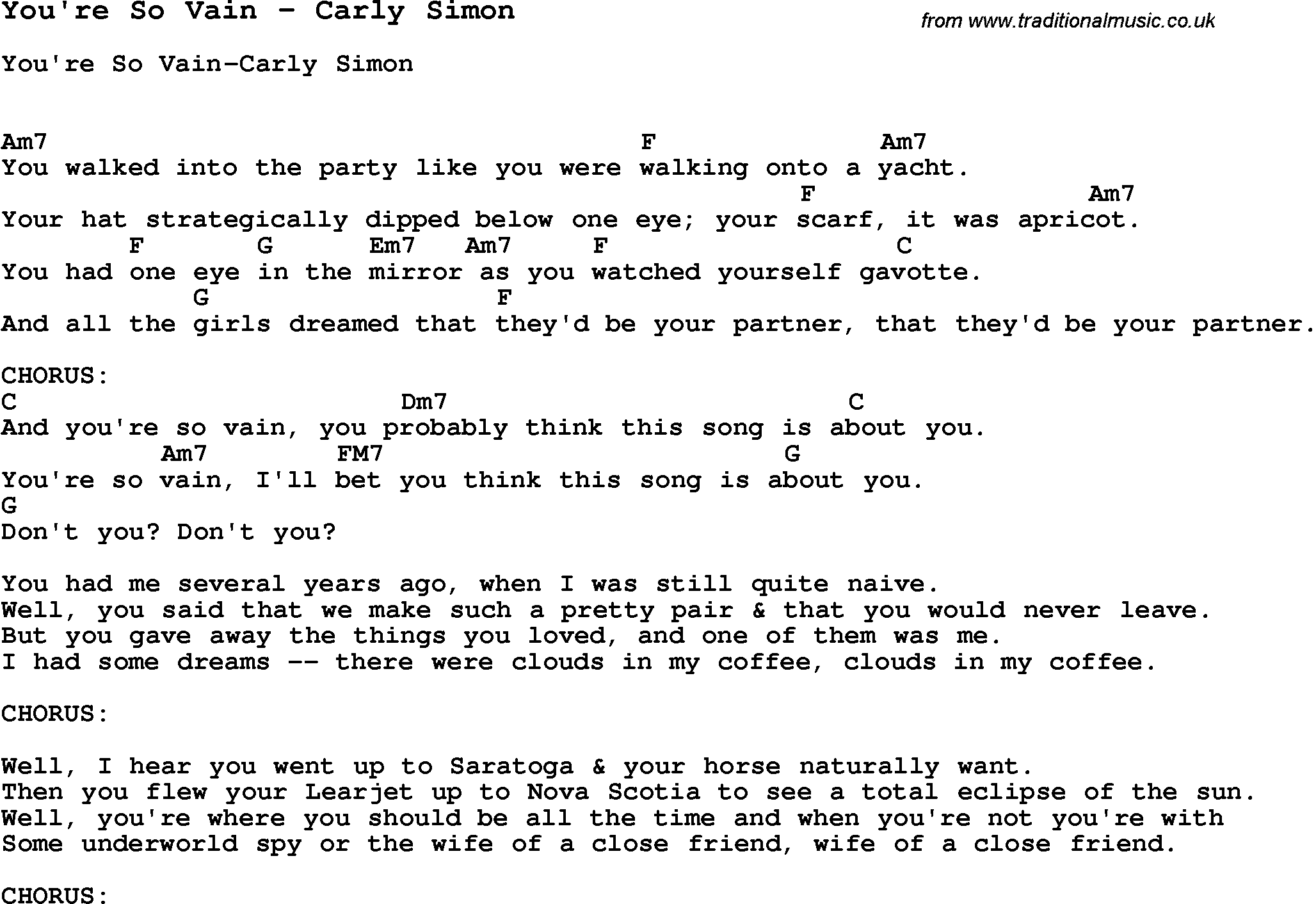
"You had me several years ago when I was still quite naive / Well you said that we made such a pretty pair / And that you would never leave / But you gave away the things you loved and one of them was me."
That’s him. Case closed on that section. But here is where it gets complicated: Simon has been very clear that the rest of the song is about two other men. It’s a composite. It’s a mood. It’s a character study of a specific type of high-society narcissism that Simon encountered while navigating the folk-rock scene and the upper crust of New York and London.
The Mick Jagger Mystery
Then there’s the Mick Jagger theory. If you listen closely to the backing vocals—that distinctive, raspy snarl that enters during the chorus—it is unmistakably Jagger. He isn't credited on the original 1972 No Secrets album sleeve, but he was at Trident Studios in London while she was recording. He just hopped in.
People naturally assumed that if he’s singing on the track, he must be the subject. But Carly has consistently denied this. She’s often said they were close friends, maybe more for a fleeting second, but that the song’s "protagonist" isn't the Rolling Stones frontman. It’s actually more likely that Jagger was just in on the joke. Imagine the ego required to sing backup on a track titled "You're So Vain" knowing it’s about someone else in your social circle. It’s a very Jagger move.
Why the Song Still Works in 2026
It’s the apricot scarf. It’s the gavotte. It’s the way she sings "son of a gun" with a mix of affection and absolute disdain.
Most breakup songs are either devastated or angry. This one is different. It’s observational. It’s the musical equivalent of leaning against a wall at a party, drink in hand, watching a man work the room and thinking, God, you are exhausting. That relatability is why it still gets airplay. We have all known a "You're So Vain" person—someone who treats life like a movie they’re starring in while everyone else is just an extra.
The production by Richard Perry is also a massive reason for its longevity. That opening bass line by Klaus Voormann? It’s iconic. It sets a predatory, slinky tone before Carly even opens her mouth. It doesn't sound like a typical 1972 folk record. It sounds expensive. It sounds like the world the song is describing: private jets, the Saratoga races, and the total eclipse of the sun.
The Secret Auction and the "David" Clue
In 2003, Simon took the mystery to a weirdly high-stakes level. She auctioned off the secret of the song's identity at a charity event for Martha's Vineyard Community Services. Dick Ebersol, the then-president of NBC Sports, won with a bid of $50,000.
The conditions? He couldn't tell anyone.
However, he was allowed to release one hint. He revealed that the person's name contains the letter E. A few years later, Simon added that it also contains the letters A and R.
Naturally, fans went wild. This didn't help narrow it down as much as you'd think.
- W-A-R-R-E-N (Beatty) fits.
- M-I-C-K (Jagger) does not.
- D-A-V-I-D (Geffen? Bowie? Cassidy?) became a massive talking point.
For a long time, rumors swirled around David Geffen, who was the head of Elektra Records at the time. The theory was that Simon was upset he was focusing more energy on promoting Joni Mitchell. But Simon eventually debunked this, pointing out she hadn't even met Geffen when she wrote the song.
The Saratoga Connection
"I hear you went up to Saratoga and your horse naturally won."
This line is a direct reference to the Saratoga Race Course in New York, a playground for the wealthy. Simon was a "jet-setter" before the term felt like a cliché. She lived this life. When she talks about the "yacht" and "Nova Scotia," she isn't imagining these things. She was there.
The song is essentially a diary of a woman realizing that the "glamour" of these high-powered men is actually a hollow shell. There’s a specific kind of power in the lyrics—she isn't the victim. She’s the judge. By refusing to name the men for fifty years, she has kept the power. The moment she names them all, the song becomes a historical footnote. As long as it’s a mystery, it belongs to everyone.
Beyond the Gossip: A Masterclass in Songwriting
If we strip away the "Who is it?" tabloid stuff, we’re left with a perfectly constructed pop song. The rhyme scheme in the verses is loose and conversational, which makes the tight, punchy chorus hit even harder.
Notice how she uses the word "gavotte." Who uses that word in a pop song?
"You moved into the blocking as you watched yourself gavotte."
A gavotte is a French peasant dance that became a formal court dance. By using it, she’s calling the subject "performative." She’s saying he isn't just walking; he’s dancing for an audience. It’s a subtle, intellectual burn that most modern songwriters wouldn't dream of attempting.
What You Can Take Away From the "Vain" Legacy
If you're looking for a definitive "One Name" answer, you’re probably going to be disappointed. Carly Simon has crafted a legacy out of ambiguity.
Here is what we know for a fact:
- Verse Two is Warren Beatty. 2. Mick Jagger sang backup but isn't the primary target.
- The song is a composite of at least three men.
- The name(s) contain A, E, and R.
The genius of You're So Vain is that it forced the men in Simon's life to out themselves. By staying silent, she let their own vanity do the work. If you think a song about an arrogant narcissist is about you, you've already lost the argument.
How to listen like an expert
Next time you put on the track, ignore the gossip. Listen to the way the drums kick in after the first chorus. Listen to the "whisper" at the very beginning—some people swear she whispers "Bill" (referring to Bill Spina or perhaps another suitor) at the 0:02 mark. Focus on the transition from the acoustic piano to the lush orchestration.
The song is a time capsule of 1970s cynicism masked as a radio-friendly hook. Whether it's about a movie star or a record mogul doesn't actually change the feeling it gives you when that chorus hits. It’s the ultimate anthem for anyone who has ever realized the person they were dating was actually just in love with a mirror.
To truly appreciate the track, look up Carly's 1987 "Live from Martha's Vineyard" performance. You can see the sparkle in her eyes when she hits those lines. She knows the truth. We don't. And that’s exactly how she wants it.
If you want to dig deeper into the 70s singer-songwriter era, your next move is to check out the production credits on the rest of the No Secrets album. It’s a "who's who" of session legends that defined the California sound, even though it was recorded in the cold rain of London.
Study the lyrics of "The Right Thing to Do" next—it's the flip side of the "Vain" coin, showing the more vulnerable, hopeful side of Simon's songwriting before the cynicism set in. Compare the two, and you'll see why she remains one of the most complex voices of her generation.



