It is the greatest guessing game in music history. Since 1972, the world has been obsessed with one question: Who is the "you" in You're So Vain? Carly Simon wrote a masterpiece of spite, but she also wrote a marketing miracle that has lasted over fifty years.
People think they know. They swear it’s Mick Jagger because he sang backup on the track. Or they’re certain it’s Warren Beatty because, well, he’s Warren Beatty. But the truth is actually a lot more layered—and a little bit more fragmented—than a single name on a list.
The Mystery of You're So Vain
Carly Simon didn't just write a song; she created a legend. When it hit the airwaves in the early 70s, it wasn't just another folk-rock hit. It was an indictment. The opening bass line by Klaus Voormann—low, moody, and slightly arrogant—sets the stage for a takedown of an elite class of men who thought the world revolved around them.
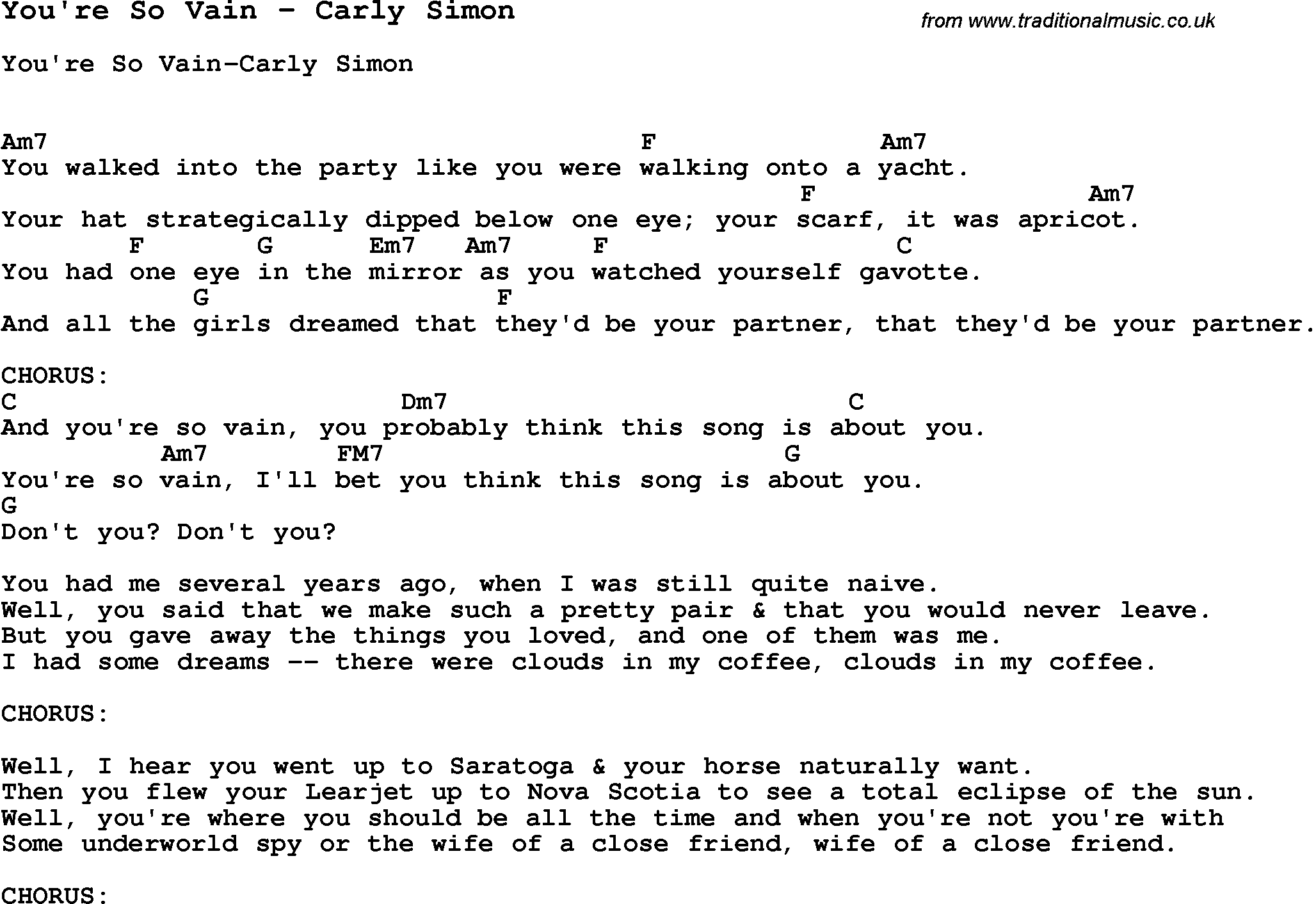
The song’s power comes from its specificity. We see the apricot scarf. We see the private jet. We see the Saratoga races and the total eclipse of the sun. These aren't just lyrics; they are receipts.
Most people don't realize that the song wasn't originally a biting rock anthem. It started as a slower ballad titled "Bless You, Ben." But Carly felt something was missing. The "Ben" character wasn't working. Then, at a party, a certain man walked in with a level of confidence that bordered on the divine, and the song shifted. It became the You're So Vain we know today.
The Warren Beatty Factor
Let’s get the obvious part out of the way. Carly Simon has confirmed that the second verse—the one about the "natural born lover"—is about Warren Beatty.
He knew it, too. After the song came out, Beatty reportedly called Carly to thank her for the song. Talk about proving the point. If you hear a song about a man who is so vain he thinks the song is about him, and your first instinct is to call the singer and say "thanks for the song," you have won the vanity Olympics.
But here’s the kicker: she has explicitly stated that the song is about three different men. Beatty is only one of them. The other two remain, for the most part, locked away in her vault of secrets.
The Men Who Weren't
For decades, the public has tried to pin the tail on the donkey.
Mick Jagger is the most common suspect. It makes sense on paper. He’s in the song. If you listen closely to the chorus, that distinct, soulful drawl in the background is undeniably Jagger. He happened to be at the studio that day and hopped on the mic. But Carly has been adamant: it’s not Mick. She’s described their relationship as more of a "mutual admiration" than the kind of bitter fallout described in the lyrics.
Then there’s James Taylor. They were married, after all. But the timing doesn't fit. You're So Vain was recorded before their marriage really hit the rocks, and James has always been more of the "sensitive songwriter" type than the "yacht-owning playboy" type described in the track.
Other names have been tossed into the ring over the years:
- Kris Kristofferson: They had a brief fling, but he doesn't quite fit the "jet set" vibe.
- Cat Stevens: Another brief flame, but he was far too spiritual for the Saratoga lifestyle.
- David Bowie: Purely speculative, mostly based on his persona at the time.
- David Geffen: This was a popular theory for a while. The "son of a gun" line was rumored to be a dig at the head of her label, Elektra. Carly eventually debunked this, noting she hadn't even met Geffen when she wrote the song.
The $50,000 Secret
In 2003, Carly used her secret for a good cause. She auctioned off the identity of the song’s subject at a charity event for Martha’s Vineyard Community Services.
The winner? Dick Ebersol, the then-president of NBC Sports. He paid $50,000 for the truth. The catch was that he had to sign a non-disclosure agreement. He is allowed to reveal one hint: the person’s name contains the letter "E."
A few years later, Carly added more clues. She revealed the letters "A" and "R" are also in the name.
E-A-R. That doesn't narrow it down much when you're looking at names like Warren Beatty (already confirmed for one verse), Mick Jagger (denied), or even someone like David L-E-A-R-Y. The mystery remains the best-kept secret in Hollywood.
Why the Song Still Bites
What makes You're So Vain a staple of every "Greatest Hits" playlist isn't just the gossip. It’s the production. Richard Perry, the producer, pushed Carly to move away from her folk roots and embrace a bigger, more aggressive sound.
The arrangement is perfection. That piano bridge? It’s iconic. The way the drums kick in right after the first "don't you?" It’s a masterclass in tension and release.
But mostly, it’s the relatability. Everyone has known a "You're So Vain" person. That person who enters a room like they’re walking onto a yacht. The person who uses people like accessories. Carly tapped into a universal frustration with narcissism long before we had a word for it on social media.
The Hidden Meanings in the Lyrics
"You had one eye in the mirror as you watched yourself gavotte."
Most people don't even know what a gavotte is. It’s a French peasant dance that became popular in the court of Louis XIV. By using that word, Carly wasn't just saying the guy was dancing; she was saying he was performing an old-fashioned, aristocratic display of self-importance. It’s a brilliant, high-brow insult.
Then there’s the line: "Then you flew your Learjet up to Nova Scotia to see the total eclipse of the sun."
This actually happened. There was a total solar eclipse visible from Nova Scotia in July 1972. Carly was writing this in real-time. She was documenting the lifestyle of the ultra-rich and bored—the "International Jet Set"—who would travel thousands of miles just for a two-minute celestial event, only to probably spend the whole time looking at themselves.
How to Listen to You're So Vain Today
If you want to appreciate the song through a modern lens, you have to look at it as the blueprint for the "diss track." Before Taylor Swift was writing "Dear John" or "All Too Well," Carly Simon was setting the standard for how to air out a former lover with class and devastating wit.
The song is a lesson in power dynamics. By refusing to name the men, Carly keeps all the power. The moment she tells us exactly who it is, the song becomes a historical footnote. As long as she keeps us guessing, she is the one in control.
Actionable Insights for Music Lovers
If you're looking to dive deeper into the world of 70s confessional songwriting, here is how to truly experience this era:
- Listen to the "No Secrets" album in full. Don't just stop at the hit. The entire album is a masterclass in early 70s production and lyrical honesty.
- Compare the "Live at Martha's Vineyard" version. Carly's live performances often add different inflections to the "don't you" lines, giving you a glimpse into her changing feelings about the subject over time.
- Read Carly Simon's memoir, "Boys in the Trees." She goes into detail about her relationships with the men of that era, providing the context that makes the lyrics hit even harder.
- Watch the 2017 documentary "Carly Simon: No Secrets." It breaks down the recording process at Trident Studios in London and shows how they achieved that specific, crisp 70s sound.
The brilliance of the song is that it survives because of its ambiguity. We don't need to know who the "son of a gun" is to feel the sting of the lyrics. In a way, the song is about all of us—or at least, all the people we've met who thought they were the main character in everyone else's story.



