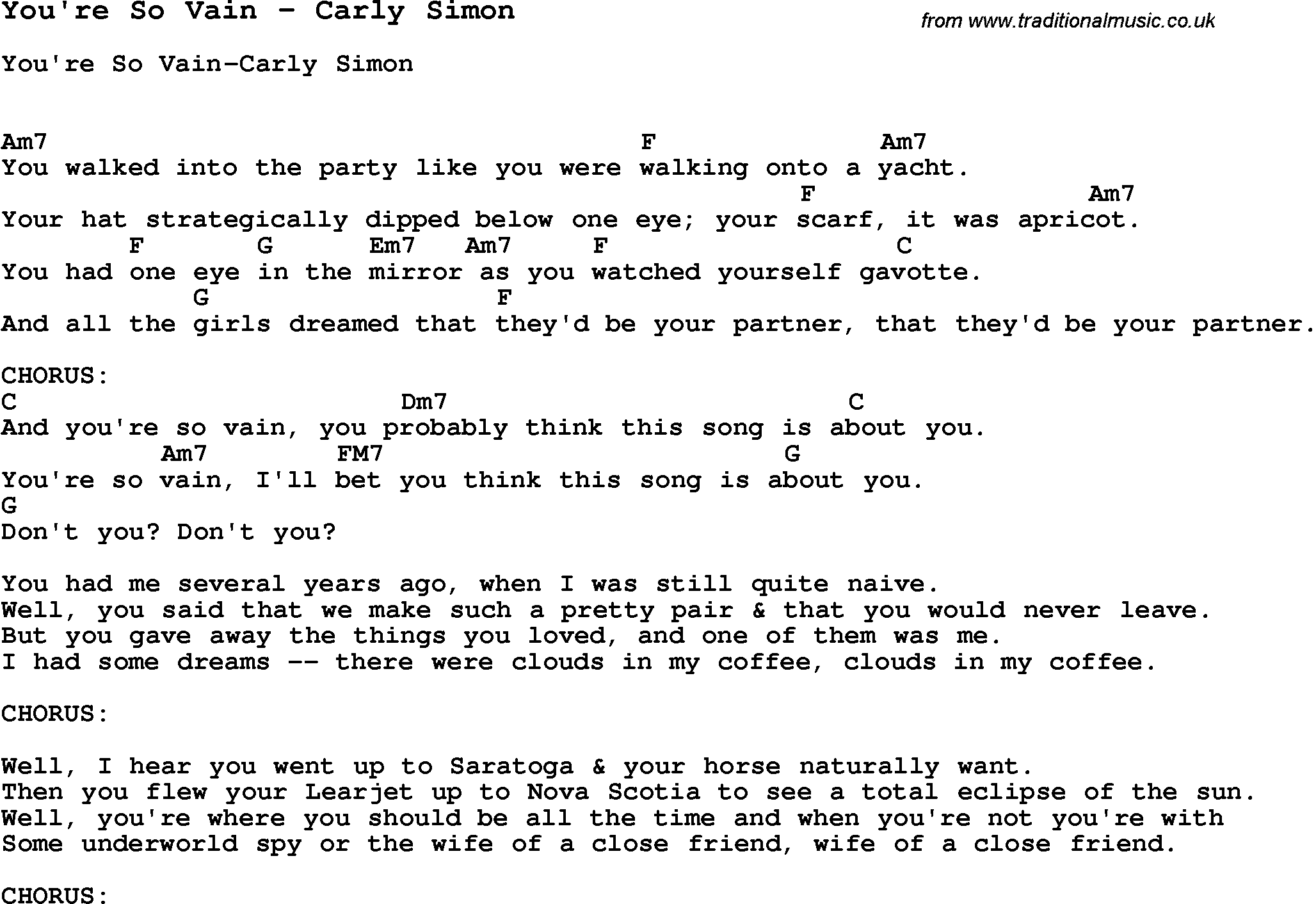
It is the greatest musical whodunit in history. For over fifty years, people have been dissecting the lyrics of the You're So Vain song, trying to figure out which 1970s heartbreaker deserved that iconic, biting takedown. It’s a track that feels remarkably modern even now. You can practically hear the eye-roll in Carly Simon’s voice as the bassline kicks in.
She knew. She knew exactly who she was talking to, but she kept us guessing for decades.
The song hit number one on the Billboard Hot 100 in early 1973, and ever since, it has become a cultural shorthand for narcissism. Honestly, the irony is the best part. By writing a song about a man’s vanity, she ensured that he—and several other famous men—would be talked about until the end of time. It’s the ultimate long game.
The Warren Beatty Factor
Let's just get the big one out of the way immediately. Warren Beatty.
For years, he was the primary suspect. It made sense. He was the quintessential Hollywood playboy of the era. He was handsome, he was everywhere, and he certainly had the ego to match the lyrics. In 2015, after decades of coy smiles and "no comments," Carly Simon finally confirmed to People magazine that the second verse is, in fact, about Warren Beatty.
"I have confirmed that the second verse is Warren," she said. But then she added the kicker. "Warren thinks the whole thing is about him!"
That’s the most "You're So Vain" thing that could possibly happen. Even when he’s only 33% of the song, he assumes he owns the whole 100%. The second verse is the one that mentions the "scarf it was apricot" and the "horse naturally won." It paints a picture of a man who inhabits a world of easy luxury and effortless conquest.
The Mystery of the Other Two Verses
So, if Warren is the second verse, who fills the rest of the You're So Vain song?
This is where it gets murky. Carly has stated that the song is a "composite" of three different men from her life. She’s been incredibly disciplined about not leaking the other names, though she’s dropped breadcrumbs over the years.
Mick Jagger is a name that comes up constantly. He actually sang uncredited backing vocals on the track. You can hear him clearly if you listen to the chorus—that distinct, soulful grit behind Carly’s smooth delivery. It’s sort of a "hiding in plain sight" situation. However, Simon has gone on record saying it’s not specifically about Mick, even if his presence on the track adds a layer of meta-commentary that is just delicious.
Then there’s Kris Kristofferson. Cat Stevens. James Taylor (her husband at the time).
She’s explicitly denied it’s about James Taylor, which is probably good for the marriage they had at the time, though they later divorced. The search for the "clouds in my coffee" man continues. That line, by the way, came from a flight she took with Billy Mernit. He noticed the clouds reflecting in her coffee cup on the airplane tray, and she jotted it down. It’s a beautiful bit of imagery for a relationship that looks like something solid but is actually just a vaporous reflection.
Why This Song Killed the "Nice Girl" Trope
Before this track, female singer-songwriters were often expected to be delicate, yearning, or heartbroken in a very specific, soft way.
Simon changed the energy.
The You're So Vain song isn't a "please love me" ballad. It’s a "you’re kind of a joke" anthem. It’s assertive. It’s observational. When she sings about him watching himself in the mirror as he walks into a party, she isn't crying; she's observing him like a scientist looks at a particularly vain species of beetle.
Produced by Richard Perry, the track has this incredible "thump" to it. Klaus Voormann’s opening bass riff is legendary. It sets a mood that is dark, sophisticated, and slightly menacing. It doesn't sound like a folk song; it sounds like a reckoning.
The $50,000 Secret
In 2003, Carly Simon auctioned off the secret of the song's identity for charity.
The winner was Dick Ebersol, the president of NBC Sports. He paid $50,000 at a Martha’s Vineyard charity auction for the right to know. The catch? He had to sign a confidentiality agreement. He was allowed to reveal one hint to the public: the name contains the letter "E."
A few years later, Simon revealed two more letters: "A" and "R."
- W-A-R-R-E-N. (Beatty)
- M-I-C-K. (No 'E' or 'A')
- J-A-M-E-S. (No 'R')
The letters fit Warren, but since we already know he's verse two, the "E," "A," and "R" must apply to the other subjects as well. Or perhaps she's just messing with us. She's a master of the long-form tease. She once told Regis Philbin that the name "David" was involved, leading many to jump to David Geffen or David Bowie, but she later walked that back or clarified that she was just playing along.
Deciphering the "Clouds in My Coffee"
What does it actually mean?
Beyond the literal reflection in the cup, it has become a metaphor for being confused by someone's surface-level charm. You think you see something deep—the clouds—but you're just looking at a reflection of the sky while you're stuck on the ground. It’s the feeling of realizing the person you’re with is entirely superficial.
The song resonates because everyone has met that person. The one who enters a room and immediately checks the "reflective surfaces" to ensure their hair is perfect. The one who uses people as accessories to their own greatness.
How to Listen to "You're So Vain" Today
To truly appreciate the You're So Vain song, you have to stop thinking of it as a 70s relic and start listening to it as the blueprint for the modern "diss track."
Taylor Swift, Olivia Rodrigo, and SZA all owe a debt to this song. It’s the mother of the specific, detail-oriented breakup track.
Actionable Listening Guide
- Isolate the Bass: Listen to the first 10 seconds through high-quality headphones. That bass isn't just playing notes; it's swaggering. It perfectly mimics the walk of the man described in the lyrics.
- Focus on the Backing Vocals: During the final choruses, try to tune out Carly and listen only to Mick Jagger. His performance is frantic and almost mocking. It adds a layer of "cool" that few other songs can match.
- The "L" Sound: Notice how she enunciates the "L" in "naturally" and "gavotte." There is a deliberate, posh affectation there. She is mocking the high-society world this man inhabits.
- Check the Lyrics for the "Gavotte": A gavotte is an old French folk dance. By saying he "watched himself gavotte," she’s calling him archaic and performative. It’s a brilliant, high-brow insult hidden in a pop song.
The song remains a masterclass in songwriting because it refuses to give up all its secrets. In an era where every celebrity detail is leaked on social media within seconds, Carly Simon’s 50-year-old secret is a refreshing reminder that some things are better left to the imagination.
If you want to dive deeper into the lore, your next step is to watch the 1987 "Live from Martha's Vineyard" performance. You can see the sparkle in her eye when she hits those lines—she’s still enjoying the joke, and honestly, so are we.
Key Takeaway: The power of the song isn't just in the mystery of the names, but in the universal experience of seeing through someone's ego. Whether it’s Warren Beatty or a guy at a local bar, the "vanity" remains the same.
Next Step for Music Fans: Look up the original 1972 lyrics sheet. There are often scribbled-out lines in early drafts of famous songs that give away more than the final recording. While Simon has kept hers mostly under wraps, the evolution of the "apricot scarf" line shows how she sharpened her pen to create the most pointed critique in rock history.



