Everyone thinks they know who Carly Simon was singing about in 1972. You’ve probably heard the rumors. Maybe you’re convinced it’s Mick Jagger because of those unmistakable backing vocals, or perhaps you’re on Team Warren Beatty. But the truth about the You're So Vain song is actually a lot messier, more calculated, and frankly, more brilliant than a simple "gotcha" moment.
It changed how we look at celebrities.
Before this track hit the airwaves, breakup songs were usually either heartbroken laments or generic "you cheated" anthems. Simon did something different. She created a puzzle. She turned a personal grudge into a high-stakes guessing game that has lasted over fifty years, essentially inventing the "blind item" format of modern pop music long before Taylor Swift started hiding clues in liner notes.
The Men Behind the Verse
Let’s get the big one out of the way. Warren Beatty. He’s the only one Simon has explicitly confirmed—at least for the second verse. She told People magazine back in 2015 that the line about the scarf and the mirror was definitely about him. But here’s the kicker: Beatty, in his classic style, reportedly thinks the entire song is about him. Simon’s response? A dry observation that he’s proving the song's point just by thinking so.
It’s meta. It’s hilarious. It’s also incredibly effective marketing.
Then there’s Mick Jagger. He sang on the track—uncredited at first—which naturally fueled the fire. If you listen closely to the chorus, you can hear his distinct rasp blending with Simon’s. Some fans argue that she wouldn’t let him sing on a song that was trashing him, but others think that’s exactly the kind of move a 70s rock star would make. It’s ironic.
What about Kris Kristofferson? Cat Stevens? James Taylor? Simon was moving in circles with the most famous men on the planet. The You're So Vain song wasn't just a hit; it was a roadmap of the era’s "It" crowd. She’s admitted over the years that the song is actually a composite of three different men.
- One is Warren Beatty (Confirmed).
- The other two remain anonymous, though she has dropped hints over decades.
- She once auctioned off the secret to NBC Sports president Dick Ebersol for $50,000 at a charity event, but he’s sworn to secrecy.
Why the Mystery Still Works
We live in an age of oversharing. Today, an artist would just drop a "diss track" and tag the person on Instagram. Simon’s restraint is what gave the song its legs. By not telling us, she made the song immortal. Every time a new generation hears that iconic bass line—played by Klaus Voormann, by the way—they start the investigation all over again.
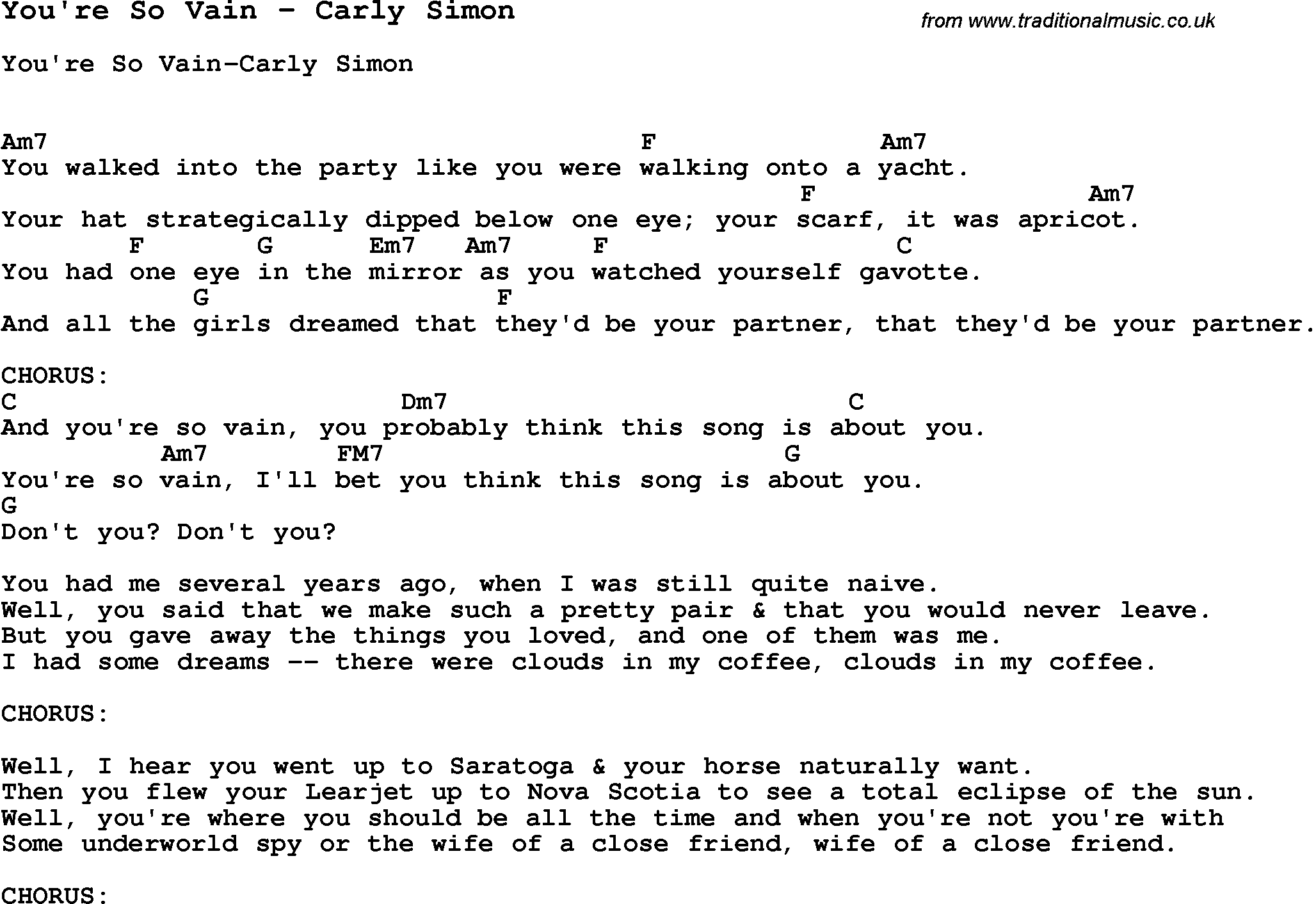
The production itself is a masterclass in tension. It starts with that low, moody bass. It feels like someone walking into a party and immediately judging everyone there. Then Simon comes in with that opening line: "You walked into the party like you were walking onto a yacht."
It’s savage.
The songwriting works because it’s specific yet universal. We’ve all known that person. The one who uses people as accessories. The one who is "where they should be" all the time. By tapping into that universal feeling of being annoyed by a narcissist, Simon ensured the You're So Vain song would outlast the specific men who inspired it.
The Saratoga Clue
In a 2003 re-recording of the song, Simon supposedly whispered a name backwards. Fans went into a frenzy. If you play it back, it sounds like "David." This led people to David Geffen, the music mogul. But Simon later debunked this, saying she didn't even know Geffen in 1972.
Then there’s the "L.A., Saratoga, and Nova Scotia" line.
These aren't just random locations. They were the playgrounds of the wealthy and elite in the early 70s. Saratoga refers to the horse racing season in upstate New York. If you were someone in 1971, you were in Saratoga in August. The song is a travelogue of vanity. It paints a picture of a man who is constantly performing, even when he’s "watching himself gavotte." (And honestly, who uses the word "gavotte" in a pop song? Only someone as sophisticated as Carly Simon.)
The Impact on Modern Music
You can see the DNA of this track in everything from Fleetwood Mac’s Rumours to the entire discography of Olivia Rodrigo. It established the "confessional" style that isn't just about feelings, but about situations.
- It taught artists that silence is a tool.
- It proved that a song could be a commercial success and a lyrical puzzle simultaneously.
- It shifted the power dynamic in celebrity breakups.
Before this, the press controlled the narrative. With the You're So Vain song, Simon took control. She held the cards. She decided who got a hint and who got left in the dark. It was an early form of female empowerment in the male-dominated recording industry of the 1970s. She wasn't the victim of these men; she was their biographer, and she wasn't being kind.
The Secret's Value
Is it possible she’s forgotten? Or that the "composite" story is a way to keep people interested? Maybe. But Simon has always been a sharp writer. Her memoir, Boys in the Trees, dives into her relationships but still manages to keep the full secret of the song intact. That’s talent. To write an entire book about your life and still leave the biggest question unanswered takes serious discipline.
The song’s longevity also comes from its musicality. Produced by Richard Perry, it has a polished, expensive sound that mirrors the lifestyle it’s mocking. The orchestration is lush, the rhythm is steady, and Simon’s vocal performance is cool and detached. She sounds like she’s over it, which is the ultimate insult to a vain person.
What to Do Next
If you want to truly appreciate the layers of the You're So Vain song, you need to stop looking for a single name. Instead, look at the era.
Listen to the isolated vocal tracks. You can find these online. Hearing Jagger’s harmony without the heavy instrumentation makes the chemistry—and the irony—of the recording session much clearer. It’s a bizarre moment in music history where the "subject" (or one of them) is literally helping create the masterpiece that mocks him.
Watch the 1971 live performances. Simon’s body language during this period says more than the lyrics ever could. She was at the height of her powers, dating the biggest stars, and writing the best music of her career.
Compare the lyrics to "Clouds in My Coffee." This phrase, which appears in the song, actually came from a conversation Simon had on a plane. It refers to the reflection of the clouds in a cup of coffee—another image of looking at something else but seeing a reflection. It’s a metaphor for the confusing nature of a relationship with a narcissist. You think you're looking at them, but you're really just seeing a projection.
To get the full experience of Carly Simon’s genius, go back and listen to the No Secrets album in its entirety. It provides the context for her headspace at the time. You’ll see that while this song was the big hit, the entire record is an exploration of honesty and the lack thereof in high-society relationships.
Pay attention to the names "A," "E," and "R." Simon has confirmed these letters are in the names of the three men. Warren Beatty fits. Who are the others? Mick Jagger? (No 'E'). James Taylor? (No 'R' in James). The search continues, and that is exactly how Carly Simon wants it.



